A 75-year-old hospitalized woman with a history of Alzheimer dementia is evaluated due to labile blood pressure and worsening agitation. The patient was admitted 4 days ago for right hip replacement after a traumatic fall and hip fracture. Her immediate postoperative course was complicated by agitation, and she was treated with haloperidol. Despite treatment, the patient continues to be agitated and confused. Today, her systolic blood pressure has measured between 120 and 170 mm Hg. Temperature is 38.7 C (101.6 F) , pulse is 120/min, and respirations are 22/min. Pulse oximetry is 97% on room air. On mental status examination, the patient is not oriented to place or person. She is drooling and diaphoretic. Heart and lungs are normal. The abdomen is soft and nontender. The operative site is clean and dry. Muscle tone is increased in both the upper and the lower extremities. Tremor is present. Deep tendon reflexes are 2+. Babinski sign is absent. Laboratory results are as follows: 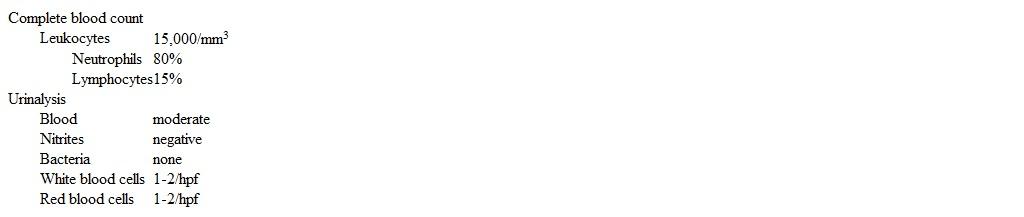 Which of the following is the most likely explanation for this patient's symptoms?
A) Anesthetic-triggered hypermetabolic crisis
B) Excessive catecholamine production by a tumor
C) Decreased central dopaminergic activity
D) Infection-induced hyperarousal
E) Ischemic infarction of the cerebellum
Correct Answer:

Verified
Q95: A 15-year-old, previously healthy boy is brought
Q96: A 21-year-old woman is brought to the
Q97: A 26-year-old primigravida at 38 weeks gestation
Q98: A 5-year-old girl is brought to the
Q99: A 25-year-old woman, gravida 1 para 1,
Q101: A 28-year-old woman, gravida 1 para 1,
Q102: A 15-year-old girl is brought to the
Q103: A 35-year-old man comes to the office
Q104: A 33-year-old woman is brought to the
Q105: A 62-year-old woman is hospitalized for cellulitis
Unlock this Answer For Free Now!
View this answer and more for free by performing one of the following actions

Scan the QR code to install the App and get 2 free unlocks

Unlock quizzes for free by uploading documents