A 28-year-old fourth-year medical student is brought to the emergency department by 3 hospital security officers after causing a disturbance in the medical director's office. On questioning, the student says that he has developed a "simple cure for cancer." He is extremely excited about this discovery but is perplexed that the medical director does not take him seriously. He says that this discovery will be praised in the medical and scientific communities and will result in a Nobel Prize. The patient has "endless energy" and "a million ideas" in his head. He has difficulty focusing on answering questions at times and becomes irritable and hostile when efforts are made to redirect him. Medical history is significant for depression at age 19. Family history is significant for adult polycystic kidney disease in his father. Temperature is 37 C (98.6 F) , blood pressure is 142/82 mm Hg, pulse is 104/min, and respirations are 20/min. Review of systems and physical examination are otherwise unremarkable. Laboratory results are as follows: 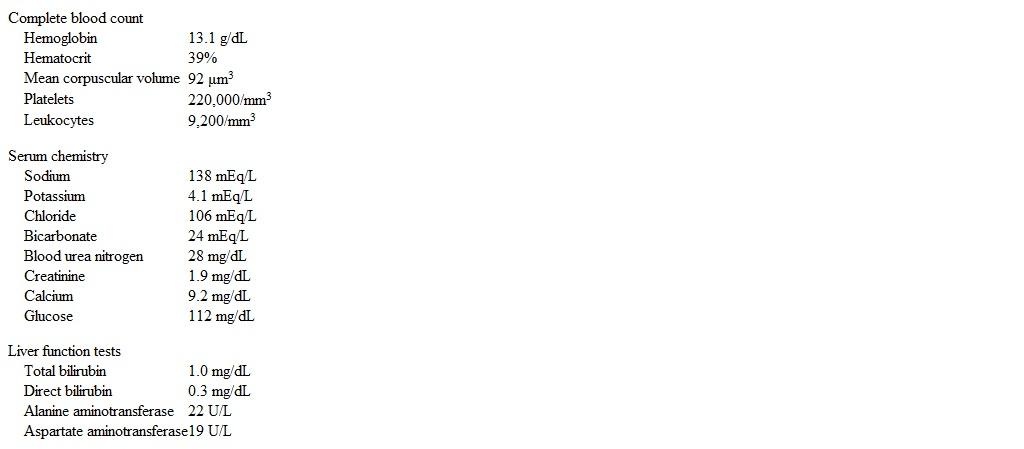 Urine drug screen is negative. Which of the following medications is most appropriate for long-term management of this patient's illness?
A) Bupropion
B) Haloperidol
C) Lithium
D) Topiramate
E) Valproate
Correct Answer:

Verified
Q131: A 13-year-old girl is brought to the
Q132: A 52-year-old woman with a history of
Q133: A 4-year-old boy is brought to the
Q134: A 27-year-old man is brought to the
Q135: A 12-year-old girl is brought to the
Q137: A 3-year-old girl is brought to the
Q138: A 28-year-old woman is evaluated for the
Q139: A 28-year-old woman comes to the office
Q140: A 32-year-old woman with a history of
Q141: A 22-year-old man comes to the office
Unlock this Answer For Free Now!
View this answer and more for free by performing one of the following actions

Scan the QR code to install the App and get 2 free unlocks

Unlock quizzes for free by uploading documents