A 52-year-old woman comes to the office for follow-up after a forearm fracture. She experienced a nondisplaced radial fracture in a ground-level fall a week ago, and was treated with casting in the emergency department. The patient has a history of chronic constipation but has had no polyuria, bone pain, hematuria, or headaches. Medical history is notable for borderline hypertension that has been stable for several years with dietary modification. Her only medications include calcium and vitamin D supplements that she started after experiencing menopause a year ago. The patient has a 15-pack-year smoking history but quit 20 years ago; she does not use alcohol or illicit drugs. Her mother has osteoporosis and her father had type 2 diabetes mellitus and hypertension. Blood pressure is 157/98 mm Hg and pulse is 72/min. BMI is 28 kg/m2. Physical examination shows a cast on the right forearm but is otherwise unremarkable. Laboratory results are as follows: 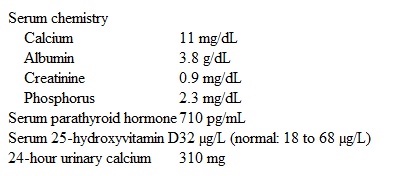 Serum calcium a year ago was 10.9 mg/dL. DXA reveals a T-score of −2.6 at the lumbar spine and −1.8 at the femoral neck. Which of the following is the best management for this patient?
A) Bisphosphonate therapy
B) Hormone replacement therapy
C) Parathyroidectomy
D) Serial laboratory monitoring
E) Thiazide diuretic therapy
Correct Answer:

Verified
Q252: A 32-year-old woman, gravida 3 para 2,
Q253: A 54-year-old woman comes to the emergency
Q254: A 54-year-old woman is brought to the
Q255: A 28-year-old male presents with polyuria and
Q256: A 68-year-old woman comes to the emergency
Q258: A 25-year-old man comes to the
Q259: A 24-year-old female maintained on methimazole for
Q260: A 14-year-old boy comes to the office
Q261: A 76-year-old woman with a history of
Q262: A 25-year-old man comes to the emergency
Unlock this Answer For Free Now!
View this answer and more for free by performing one of the following actions

Scan the QR code to install the App and get 2 free unlocks

Unlock quizzes for free by uploading documents