A 26-year-old man comes to the office due to several months of dysuria and increased urinary frequency. He also has blood in his urine at the end of urination. A month ago, he finished 7 days of oral antibiotics for urinary tract infection, but his symptoms did not improve. The patient has no other medical issues and takes no medications. He emigrated from Ghana 2 years ago and works in a chemical fertilizer factory. The patient smokes a pack of cigarettes daily and occasionally drinks alcohol. He is married and has no children. Temperature is 37.2 C (99 F) , blood pressure is 130/80 mm Hg, and pulse is 76/min. No abdominal mass or suprapubic or costovertebral angle tenderness is present. Genital examination is normal. Laboratory results are as follows: 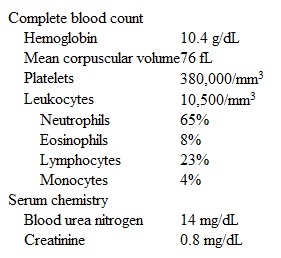 A dipstick urinalysis shows 1+ blood but is otherwise negative. Which of the following is the best next step to establish the diagnosis in this patient?
A) Abdominal ultrasonography
B) CT cystography
C) Expressed prostatic secretion culture
D) Plain abdominal radiography
E) Urine sediment microscopy
Correct Answer:

Verified
Q576: A 16-year-old boy is brought to the
Q577: A 16-year-old boy is brought to the
Q578: A 15-month-old girl is brought to the
Q579: A 36-year-old man comes to the emergency
Q580: A 24-year-old woman comes to the office
Q582: A 14-year-old boy is brought to the
Q583: A 6-day-old boy is brought to the
Q584: A 26-year-old student comes to the emergency
Q585: A 52-year-old woman is brought to the
Q586: A 3-year-old boy is brought to the
Unlock this Answer For Free Now!
View this answer and more for free by performing one of the following actions

Scan the QR code to install the App and get 2 free unlocks

Unlock quizzes for free by uploading documents