A 19-year-old woman is brought to the emergency department by her mother due to suspected drug poisoning. The patient has severe depression treated with fluoxetine and lives with her mother and grandparents. The patient suddenly became ill at home earlier today and developed nausea and vomiting. Her mother suspects the patient may have intentionally ingested a substance to harm herself as her grandparents' medicine cabinet door was found open. On further questioning, the patient states that she swallowed a handful of one of the medications in the cabinet but does not specify further. Her grandparents' medical conditions include anxiety, seasonal allergies, coronary artery disease, and chronic back pain. The patient's mother does not know the specific names and dosages of the medications. Currently, the patient reports nausea and dizziness and has vomited 3 times since arriving at the emergency department. She has smoked a pack of cigarettes daily for the past 5 years and drinks 1 or 2 beers occasionally. She has a history of prior ecstasy use but has no recent use of illicit drugs. Temperature is 38.1 C (100.6 F) , blood pressure is 100/55 mm Hg, pulse is 110/min, and respirations are 28/min. Pulse oximetry shows 99% saturation on ambient air. Examination reveals an awake, agitated young woman with dry mucous membranes. The pupils are 4 mm bilaterally and reactive to light. Heart sounds are normal and the lungs are clear to auscultation. The abdomen is soft, nontender, and nondistended; bowel sounds are normoactive. Motor and sensory deficits are absent, and the patient is fully oriented. A 12-lead ECG shows sinus tachycardia. Chest x-ray reveals clear lung fields and no cardiomegaly. The patient is given intravenous fluids and is placed on continuous ECG monitoring. Laboratory tests are ordered. Laboratory results are as follows: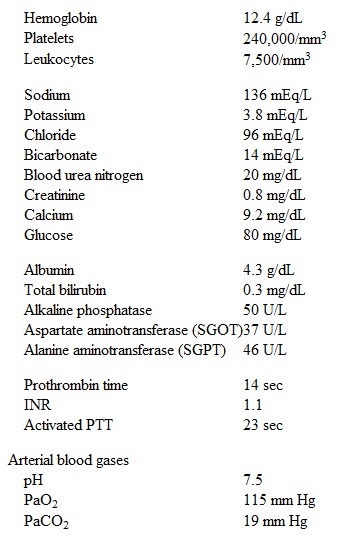 The results of a urine drug screen are pending.
Item 2 of 2
Which of the following is the most appropriate next step in management of this patient?
A) Administer atropine
B) Administer flumazenil
C) Administer physostigmine
D) Intubate with endotracheal tube
E) Start infusion of intravenous sodium bicarbonate
Correct Answer:

Verified
Q762: A 36-year-old woman, gravida 3 para 2,
Q763: A 23-year-old woman, gravida 3 para 2,
Q764: A 30-year-old man is brought to the
Q765: An 8-year-old boy is brought to the
Q766: A 3-year-old boy is brought to the
Q768: A 19-year-old woman is brought to the
Q769: A 4-year-old boy is brought to the
Q770: An 8-year-old boy is brought to the
Q771: A 2-year-old girl is brought to the
Q772: An 18-month-old boy is brought to the
Unlock this Answer For Free Now!
View this answer and more for free by performing one of the following actions

Scan the QR code to install the App and get 2 free unlocks

Unlock quizzes for free by uploading documents