A 27-year-old man comes to the physician with pain in his left knee, ankle, and lower back over the last week. His back feels stiff in the morning and improves with activity. Three months ago, he was treated for chlamydia proctitis with azithromycin and ceftriaxone. He also had painless sores on his glans penis, but tests for syphilis were negative at that time. On examination, he still has multiple shallow ulcers on the glans penis. The patient reports no change in appearance of the ulcers over the 3-month period. There is no urethral discharge or inguinal lymphadenopathy. The left knee and ankle joints are swollen and nontender. No redness or warmth is noted. Laboratory results are as follows: 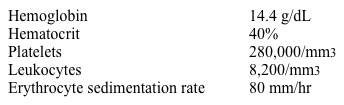 Synovial fluid aspirated from the knee shows a white blood cell count of 4,000/mm3 with 80% neutrophils. Gram stain is negative and no pathogen is isolated on fluid culture.
The suspected pathogen is detected in this patient. Which of the following is the most appropriate therapeutic regimen?
A) Antibiotics
B) Antibiotics, naproxen
C) Antibiotics, sulfasalazine, exercise
D) Naproxen, intraarticular glucocorticoids
E) Systemic glucocorticoids
Correct Answer:

Verified
Q1074: A 12-year-old girl is brought to the
Q1075: A 25-year-old man comes to the emergency
Q1076: A 25-year-old man comes to the emergency
Q1077: A 55-year-old woman comes to the physician
Q1078: An 11-year-old girl is brought to the
Q1080: A 25-year-old man comes to the emergency
Q1081: A 12-year-old boy is brought to the
Q1082: A 4-year-old boy is brought to the
Q1083: A 12-year-old boy is brought to the
Q1084: A 48-year-old Caucasian woman comes to the
Unlock this Answer For Free Now!
View this answer and more for free by performing one of the following actions

Scan the QR code to install the App and get 2 free unlocks

Unlock quizzes for free by uploading documents