Solved

A 36-Year-Old African American Woman Comes to the Emergency Department

Question 1098

Multiple Choice

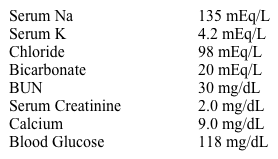
A 36-year-old African American woman comes to the emergency department and complains of a severe, throbbing headache that began several hours ago.  She also has acute onset of blurred vision and nausea.  She took acetaminophen, which did not provide any relief.  She was diagnosed with Raynaud phenomena a few years ago.  She recently started having heartburn, for which she takes over-the-counter ranitidine.  Her temperature is 36.7C (98.0F) , blood pressure is 200/110 mm Hg, and pulse is 94/min.  Pulse oximetry showed 94% in room air.  There is no abdominal bruit.  Ophthalmologic examination demonstrates bilateral papilledema.  The laboratory results are as follows: CBC
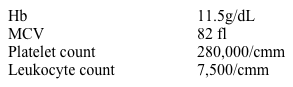
A 36-year-old African American woman comes to the emergency department and complains of a severe, throbbing headache that began several hours ago.  She also has acute onset of blurred vision and nausea.  She took acetaminophen, which did not provide any relief.  She was diagnosed with Raynaud phenomena a few years ago.  She recently started having heartburn, for which she takes over-the-counter ranitidine.  Her temperature is 36.7C (98.0F) , blood pressure is 200/110 mm Hg, and pulse is 94/min.  Pulse oximetry showed 94% in room air.  There is no abdominal bruit.  Ophthalmologic examination demonstrates bilateral papilledema.  The laboratory results are as follows: CBC   Serum    All her routine laboratory values were completely normal six months ago.  Her blood pressure during her previous visits was always <140/80 mm Hg.  What is the most likely diagnosis of this patient? A) Atherosclerotic renal artery stenosis B) Fibromuscular dysplasia C) Hemolytic uremic syndrome D) Pheochromocytoma E) Scleroderma (systemic sclerosis) Serum
A 36-year-old African American woman comes to the emergency department and complains of a severe, throbbing headache that began several hours ago.  She also has acute onset of blurred vision and nausea.  She took acetaminophen, which did not provide any relief.  She was diagnosed with Raynaud phenomena a few years ago.  She recently started having heartburn, for which she takes over-the-counter ranitidine.  Her temperature is 36.7C (98.0F) , blood pressure is 200/110 mm Hg, and pulse is 94/min.  Pulse oximetry showed 94% in room air.  There is no abdominal bruit.  Ophthalmologic examination demonstrates bilateral papilledema.  The laboratory results are as follows: CBC   Serum    All her routine laboratory values were completely normal six months ago.  Her blood pressure during her previous visits was always <140/80 mm Hg.  What is the most likely diagnosis of this patient? A) Atherosclerotic renal artery stenosis B) Fibromuscular dysplasia C) Hemolytic uremic syndrome D) Pheochromocytoma E) Scleroderma (systemic sclerosis)
All her routine laboratory values were completely normal six months ago.  Her blood pressure during her previous visits was always <140/80 mm Hg.  What is the most likely diagnosis of this patient?


A) Atherosclerotic renal artery stenosis
B) Fibromuscular dysplasia
C) Hemolytic uremic syndrome
D) Pheochromocytoma
E) Scleroderma (systemic sclerosis)

Correct Answer:

verifed

Verified

Unlock this answer now
Get Access to more Verified Answers free of charge

Related Questions

Unlock this Answer For Free Now!

View this answer and more for free by performing one of the following actions

qr-code

Scan the QR code to install the App and get 2 free unlocks

upload documents

Unlock quizzes for free by uploading documents