Passage
Suicide is one of the leading causes of death in the United States. Suicide risk is associated with a variety of factors. Personal factors include childhood abuse, certain personality traits (eg, impulsiveness, aggression) , and history of mental illness. Over 90% of people who attempt suicide meet diagnostic criteria for at least one psychological disorder, and suicide risk increases as the number of co-occurring disorders increases. Diagnosis severity also matters: studies suggest that individuals are at greatest risk of attempting suicide while inpatient at or newly discharged from a psychiatric hospital.Social factors also play a role in suicide. Sociologist Émile Durkheim argued that embeddedness in society is a key feature in determining the likelihood of an individual committing suicide. Specifically, the more people that depend on an individual financially, emotionally, or physically, the less likely that individual is to commit suicide. Studies suggest that suicide is also linked to religious affiliation and income level. Religious groups that place more value on community events, church attendance, and collective solidarity tend to have lower rates of suicide among members, whereas more affluent individuals are more likely to commit suicide.Economic trends have also been linked to suicide. One study retrospectively analyzed the relationship between the U.S. economy and suicide rates. It found that the overall suicide rate tends to rise during economic recessions and drop during economic expansions (Figure 1) .
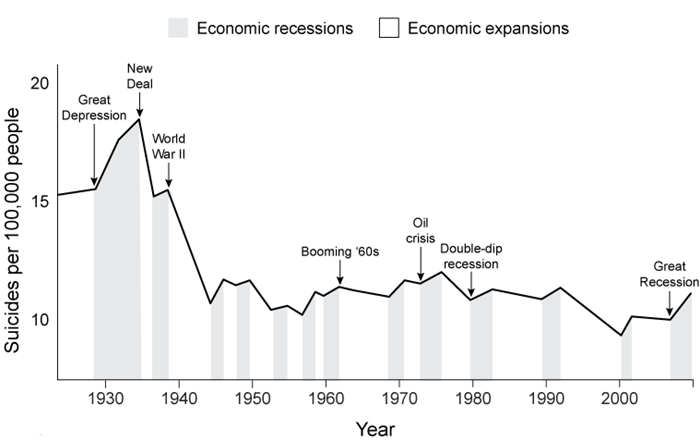 Figure 1 U.S. suicide rates compared to economic trendsFurther analysis of suicide data suggests that for every individual who successfully commits suicide, approximately 25 individuals are unsuccessful in such attempts, costing the United States billions of dollars annually in both lost wages and treatment expense. Although white, middle-aged men are the most likely cohort to successfully commit suicide, women attempt suicide three times more often than men.
-Which of the following is NOT supported by the passage?
A) 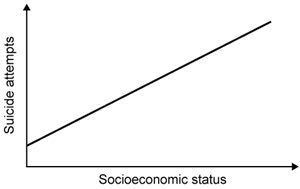
B) 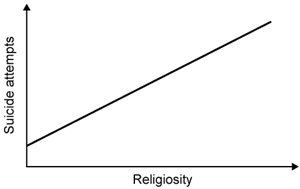
C) 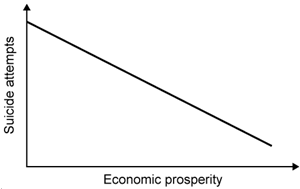
D) 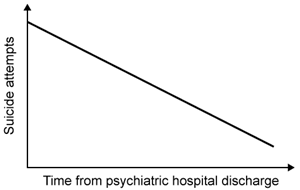
Correct Answer:

Verified
Q1: Passage
Prominent theories of emotion have long held
Q2: Passage
Poverty may be the most foundational risk
Q3: Passage
Both institutional and interpersonal factors contribute to
Q4: Passage
Research suggests that individuals with depression experience
Q5: Passage
Research suggests that individuals with depression experience
Q7: Passage
Until recently, deviance has generally been conceptualized
Q8: Passage
Until recently, deviance has generally been conceptualized
Q9: Passage
Suicide is one of the leading causes
Q10: Passage
Both institutional and interpersonal factors contribute to
Q11: Passage
Poverty may be the most foundational risk
Unlock this Answer For Free Now!
View this answer and more for free by performing one of the following actions

Scan the QR code to install the App and get 2 free unlocks

Unlock quizzes for free by uploading documents