Tail-feather length in birds is sometimes a sexually dimorphic trait; that is, the trait differs substantially for males and for females of the same species. Researchers studied the relationship between tail-feather length (measuring the R1 central tail feather) and weight in a sample of 20 male long-tailed finches raised in an aviary. The data are displayed in the scatterplot below, followed with software output about the least-squares regression model of feather length as a function of weight.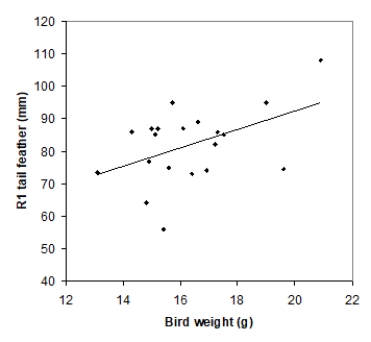
\begin{array}{l}\begin{array} { l l r } \hline &\text {Coefficients }&\text {Standard Error }\\\hline\text {Intercept }&35.7379 & 21.0523 \\\text { Bird-weight}&2.8299 & 1.2811\\\hline\text {R Square }&0.2133\\\text {Standard Error }&\ 10.5270\\end{array}\end{array} What percentage of variation in tail-feather length that can be explained by this linear model?
A) 5%
B) 21%
C) 46%
D) 79%
Correct Answer:

Verified
Q21: Tail-feather length in birds is sometimes
Q22: Tail-feather length in birds is sometimes
Q23: Tail-feather length in birds is sometimes
Q24: Tail-feather length in birds is sometimes
Q25: Tail-feather length in birds is sometimes
Q27: Tail-feather length in birds is sometimes
Q28: Tail-feather length in birds is sometimes
Q29: Tail-feather length in birds is sometimes
Q30: Tail-feather length in birds is sometimes
Q31: Researchers found a linear relationship between
Unlock this Answer For Free Now!
View this answer and more for free by performing one of the following actions

Scan the QR code to install the App and get 2 free unlocks

Unlock quizzes for free by uploading documents