Six Sigma is one approach for setting quality expectations for a given process or output. As pointed out in your text, the term "Six Sigma" comes from statistics: in a normal distribution, the area (probability) outside of +/- six standard deviations from the mean value is exceedingly small. You are provided the following values from a standardized normal distribution .
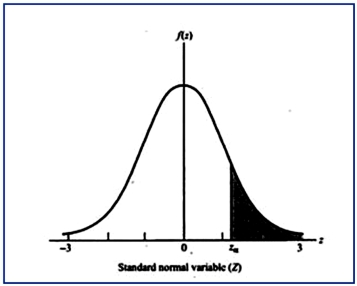
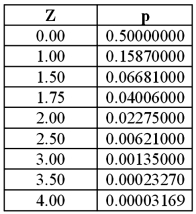 Note: The Z values in the above table refer to the number of sigmas to the right of center . The listed probabilities, p, refer to the area to the right of the chosen Z point, as illustrated by the graph below:
  Required:
1. Given the above, what is the probability for a 1-sigma performance level? How many defects might we expect for a process that is operating at 1-sigma level?
2. Redo #1 above, but this time for a 3-sigma level. What is the percentage increase in quality expected under a 3-sigma performance level compared to a 1-sigma level?
3. Redo #1 above, but this time for a 4-sigma level. Also, what is the anticipated percentage improvement in quality when moving from a 3-sigma to a 4-sigma performance level?
Correct Answer:

Verified
Feedback:
1. Area = 0.15...
View Answer
Unlock this answer now
Get Access to more Verified Answers free of charge
Q122: Steel Inc. specializes in manufacturing ship doors.
Q126: An electronic component has an output voltage
Q132: An electronic component in a computer has
Q136: White Financial Services Corporation is engaged in
Q137: The Bulldog Company incurred the following quality-related
Q137: One of the concerns with moving to
Q140: Turbo-Oven, Inc. is considering a move to
Q141: Exhibit 17.3 provides a diagrammatical representation of
Q142: Provide four reasons why both internal and
Q144: Provide a definition of the term "quality,"
Unlock this Answer For Free Now!
View this answer and more for free by performing one of the following actions

Scan the QR code to install the App and get 2 free unlocks

Unlock quizzes for free by uploading documents