You measure the chemical abundances and space motions of stars near the Sun, and plot your data in the figure shown below. The stars separate into two distinct groups, which you label A and B. These groups are, respectively, in which two stellar components of the Milky Way? 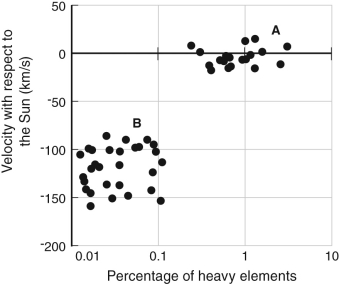
A) disk and halo
B) bulge and disk
C) halo and disk
D) halo and bulge
E) globular clusters and halo
Correct Answer:

Verified
Q55: If you found a halo star that
Q56: Globular clusters, when compared to open clusters,
Q57: In a star that has a chemical
Q58: On average, we expect that _ stars
Q59: Which objects in our Milky Way galaxy
Q61: Cosmic rays are:
A) photons with even higher
Q62: Magnetic fields in the Milky Way are
Q63: Based on the chemical abundances and velocities
Q64: The presence of dwarf galaxies around the
Q65: Describe the differences between the ages and
Unlock this Answer For Free Now!
View this answer and more for free by performing one of the following actions

Scan the QR code to install the App and get 2 free unlocks

Unlock quizzes for free by uploading documents