







 تكلم مع الذكاء الاصطناعي


Zoology 10th Edition by Stephen Miller,John Harley
النسخة 10الرقم المعياري الدولي: 978-0077837273Zoology 10th Edition by Stephen Miller,John Harley
النسخة 10الرقم المعياري الدولي: 978-0077837273 تمرين 9
The exoskeleton or cuticle covers the entire body of an arthropod. The exoskeleton consists of two layers, the epicuticle and the partially hardened procuticle. The growth of an arthropod is accompanied by periodic molting of the exoskeleton, a process called ecdysis.
What properties of the exoskeleton provide for each of the following functions: protection from mechanical injury, protection against desiccation, storing energy for jumping, attachment of muscles, and flexibility?
FIGURE 14.4 Modifications of the Exoskeleton. ( a ) Invaginations of the exoskeleton result in firm ridges and bars when the outer procuticle in the region of the invagination remains thick and hard. These are muscle attachment sites. ( b ) Regions where the outer procuticle is thinned are flexible and form membranes and joints. From: "A LIFE OF INVERTEBRATES" © 1979 W. D. Russell-Hunter.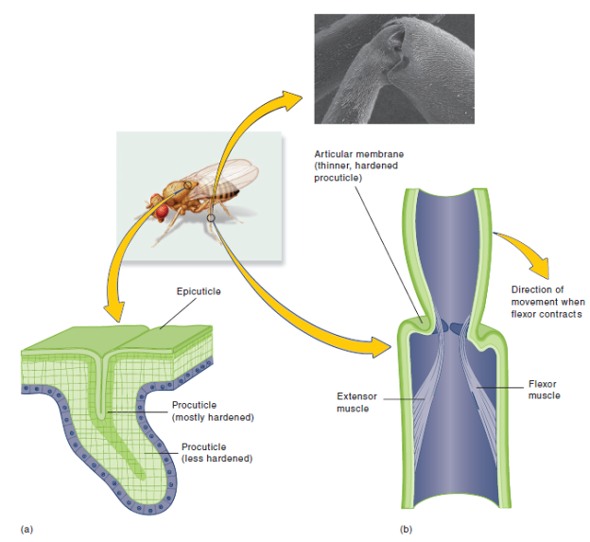
What properties of the exoskeleton provide for each of the following functions: protection from mechanical injury, protection against desiccation, storing energy for jumping, attachment of muscles, and flexibility?
FIGURE 14.4 Modifications of the Exoskeleton. ( a ) Invaginations of the exoskeleton result in firm ridges and bars when the outer procuticle in the region of the invagination remains thick and hard. These are muscle attachment sites. ( b ) Regions where the outer procuticle is thinned are flexible and form membranes and joints. From: "A LIFE OF INVERTEBRATES" © 1979 W. D. Russell-Hunter.
التوضيح موثّق
موثّق
موثّق
Protection from mechanical injury-harden...

Zoology 10th Edition by Stephen Miller,John Harley

لماذا لم يعجبك هذا التمرين؟
أخرى 8 أحرف كحد أدنى و 255 حرفاً كحد أقصى
حرف 255






