







 تكلم مع الذكاء الاصطناعي



Microbiology: A Systems Approach 4th Edition by Marjorie Kelly Cowan
النسخة 4الرقم المعياري الدولي: 978-0073402437Microbiology: A Systems Approach 4th Edition by Marjorie Kelly Cowan
النسخة 4الرقم المعياري الدولي: 978-0073402437 تمرين 13
It's Raining Bacteria
Bacteria are ubiquitous on the planet, but how profound is their impact on our lives In addition to their impact on the earth's temperature, weathering, mineral extraction, and soil formation, recent studies have shown that bacteria have a major influence over another aspect of the earth's ecosystem: the weather. For years, scientists have believed that dust particles or minerals in clouds caused water droplets to coalesce into larger droplets and form rain, snow, or hail. However, recent research shows that bacteria are the predominant particles that induce the formation of precipitation.
After a hailstorm hit the Montana State University campus in Bozeman, Montana, Alexander Michaud and his collaborators gathered hailstones larger than 5 cm in diameter, separated them into four layers, and analyzed them as they melted. They were surprised to find that Pseudomonas syringae, a species of bacteria that is commonly implicated in infections of plants and as the cause of postharvest rots, grew from the water in the hailstones.
Michaud explains that bacteria found in the embryo-the first part of the hailstone to develop-initiate the growth of a hailstone. "In order for precipitation to occur, a nucleating particle must be present to allow for aggregation of water molecules," he states. "There is growing evidence that these nuclei can be bacteria or other biological particles."
Why do you think that climate scientists never realized that microbes actually caused nucleation of water droplets in clouds
How does P. syringae make it rain at warm temperatures
Brent Christner, a scientist who worked with Michaud, has studied snow samples from around the world, and has observed that Michaud's findings are not unique to the hailstorm in Montana. Christner has found that bacteria are the most common warm-temperature rain and snow nucleators. He noted that researchers may have never realized that bacteria were so widespread because when samples were taken from clouds looking for nucleators, they used filters that trapped fine dust but ignored the much smaller microbe-sized particles.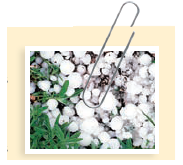 P. syringae isn't the only biological nucleator of ice-other bacteria, fungi, diatoms, and algae can serve as nucleators as well. Water vapors in clouds freeze at temperatures below -35ºC, but nucleators such as P. syringae can cause this to happen at much warmer temperatures. The bacteria possess a protein structure that provides a framework where free-floating water molecules can attach. When the water vapor clings to the bacteria and to other water molecules, it can freeze and fall back to the earth. Until this discovery, atmospheric scientists never realized the impact that biological nucleators had on the formation of rain, snow, and hail. It turns out that bacteria have been making it rain all along.
Can you think of some other applications for low-temperature ice nucleators
Bacteria are ubiquitous on the planet, but how profound is their impact on our lives In addition to their impact on the earth's temperature, weathering, mineral extraction, and soil formation, recent studies have shown that bacteria have a major influence over another aspect of the earth's ecosystem: the weather. For years, scientists have believed that dust particles or minerals in clouds caused water droplets to coalesce into larger droplets and form rain, snow, or hail. However, recent research shows that bacteria are the predominant particles that induce the formation of precipitation.
After a hailstorm hit the Montana State University campus in Bozeman, Montana, Alexander Michaud and his collaborators gathered hailstones larger than 5 cm in diameter, separated them into four layers, and analyzed them as they melted. They were surprised to find that Pseudomonas syringae, a species of bacteria that is commonly implicated in infections of plants and as the cause of postharvest rots, grew from the water in the hailstones.
Michaud explains that bacteria found in the embryo-the first part of the hailstone to develop-initiate the growth of a hailstone. "In order for precipitation to occur, a nucleating particle must be present to allow for aggregation of water molecules," he states. "There is growing evidence that these nuclei can be bacteria or other biological particles."
Why do you think that climate scientists never realized that microbes actually caused nucleation of water droplets in clouds
How does P. syringae make it rain at warm temperatures
Brent Christner, a scientist who worked with Michaud, has studied snow samples from around the world, and has observed that Michaud's findings are not unique to the hailstorm in Montana. Christner has found that bacteria are the most common warm-temperature rain and snow nucleators. He noted that researchers may have never realized that bacteria were so widespread because when samples were taken from clouds looking for nucleators, they used filters that trapped fine dust but ignored the much smaller microbe-sized particles.
P. syringae isn't the only biological nucleator of ice-other bacteria, fungi, diatoms, and algae can serve as nucleators as well. Water vapors in clouds freeze at temperatures below -35ºC, but nucleators such as P. syringae can cause this to happen at much warmer temperatures. The bacteria possess a protein structure that provides a framework where free-floating water molecules can attach. When the water vapor clings to the bacteria and to other water molecules, it can freeze and fall back to the earth. Until this discovery, atmospheric scientists never realized the impact that biological nucleators had on the formation of rain, snow, and hail. It turns out that bacteria have been making it rain all along.Can you think of some other applications for low-temperature ice nucleators
التوضيح موثّق
موثّق
موثّق
The self-organization or self-assembly o...

Microbiology: A Systems Approach 4th Edition by Marjorie Kelly Cowan

لماذا لم يعجبك هذا التمرين؟
أخرى 8 أحرف كحد أدنى و 255 حرفاً كحد أقصى
حرف 255






