







 تكلم مع الذكاء الاصطناعي


Genetics: Analysis and Principles 5th Edition by Robert Brooker
النسخة 5الرقم المعياري الدولي: 978-0073525341Genetics: Analysis and Principles 5th Edition by Robert Brooker
النسخة 5الرقم المعياري الدولي: 978-0073525341 تمرين 5
As described in Figure 14.12, four regions within the trpL mRNA can form stem-loops. Let's suppose that mutations have been previously identified that prevent the ability of a particular region to form a stem-loop with a complementary region. For example, a region 1 mutant cannot form a 1-2 stem-loop, but it can still form a 2-3 or 3-4 stem-loop. Likewise, a region 4 mutant can form a 1-2 or 2-3 stem-loop but not a 3-4 stem-loop. Under the following conditions, would attenuation occur
a. Region 1 is mutant, tryptophan is high, and translation is not occurring
b. Region 2 is mutant, tryptophan is low, and translation is occurring
c. Region 3 is mutant, tryptophan is high, and translation is not occurring
d. Region 4 is mutant, tryptophan is low, and translation is not occurring.FIGURE 14.12 Sequence of the trpL mRNA produced during attenuation. A second method of regulation of the trp operon is attenuation, which occurs when tryptophan levels are sufficient for protein synthesis. A short mRNA is made that includes the trpL coding sequence. As shown here, this mRNA has several regions that are complementary to each other. The possible hydrogen bonding between regions 1 and 2, 2 and 3, and 3 and 4 is also shown, but each region can hydrogen bond to only one other region at a given time. For example, if region 2 is hydrogen bonded to region 1, it cannot simultanteously hydrogen bond with region 3. The last U in the purple attenuator sequence is the last nucleotide that would be transcribed during attenuation. At very low tryptophan concentrations, however, transcription occurs beyond the end of trpL and proceeds through the trpE gene and the rest of the trp operon.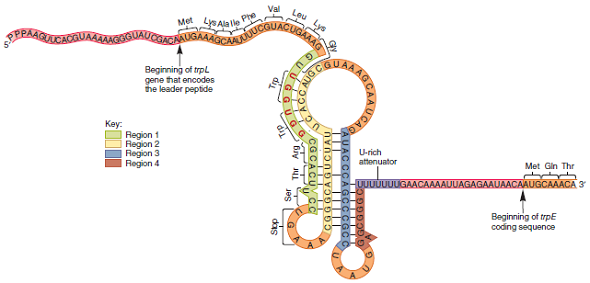
a. Region 1 is mutant, tryptophan is high, and translation is not occurring
b. Region 2 is mutant, tryptophan is low, and translation is occurring
c. Region 3 is mutant, tryptophan is high, and translation is not occurring
d. Region 4 is mutant, tryptophan is low, and translation is not occurring.FIGURE 14.12 Sequence of the trpL mRNA produced during attenuation. A second method of regulation of the trp operon is attenuation, which occurs when tryptophan levels are sufficient for protein synthesis. A short mRNA is made that includes the trpL coding sequence. As shown here, this mRNA has several regions that are complementary to each other. The possible hydrogen bonding between regions 1 and 2, 2 and 3, and 3 and 4 is also shown, but each region can hydrogen bond to only one other region at a given time. For example, if region 2 is hydrogen bonded to region 1, it cannot simultanteously hydrogen bond with region 3. The last U in the purple attenuator sequence is the last nucleotide that would be transcribed during attenuation. At very low tryptophan concentrations, however, transcription occurs beyond the end of trpL and proceeds through the trpE gene and the rest of the trp operon.
التوضيح موثّق
موثّق
موثّق
In this question, we discuss expression ...

Genetics: Analysis and Principles 5th Edition by Robert Brooker

لماذا لم يعجبك هذا التمرين؟
أخرى 8 أحرف كحد أدنى و 255 حرفاً كحد أقصى
حرف 255






