







 تكلم مع الذكاء الاصطناعي



Essentials of the Living World 5th Edition by George Johnson
النسخة 5الرقم المعياري الدولي: 978-0078096945Essentials of the Living World 5th Edition by George Johnson
النسخة 5الرقم المعياري الدولي: 978-0078096945 تمرين 1
How Does Arrowgrass Tolerate Salt?
Plants grow almost everywhere on earth, thriving in many places where exposure, drought, and other severe conditions challenge their survival. In deserts, a common stress is the presence of high levels of salt in the soils. Soil salinity is also a problem for millions of acres of abandoned farmland because the accumulation of salt from irrigation water restricts growth. Why does excess salt in the soil present a problem for a plant? For one thing, high levels of sodium ions that are taken up by the roots are toxic. For another, a plant's roots cannot obtain water when growing in salty soil. Osmosis (the movement of water molecules to areas of higher solute concentrations, see page 85) causes water to move in the opposite direction, drawn out of the roots by the soil's high levels of salt. And yet plants do grow in these soils. How do they manage?
To investigate this, researchers have studied seaside arrowgrass ( Triglochin maritima ), the plant you see to the right. Arrowgrass plants are able to grow in very salty seashore soils, where few other plants survive. How are they able to survive? Researchers found that their roots do not take up salt and so do not accumulate toxic levels of salt.
However, this still leaves the arrowgrass plant the challenge of preventing its root cells from losing water to the surrounding salty soil. How then do the roots achieve osmotic balance? In an attempt to find out, researchers grew arrowgrass plants in nonsalty soil for two weeks, then transferred them to one of several soils that differed in salt level. After 10 days, shoots were harvested and analyzed for amino acids, because accumulating amino acids could be one way that the cells maintain osmotic balance. Results are presented in the graph.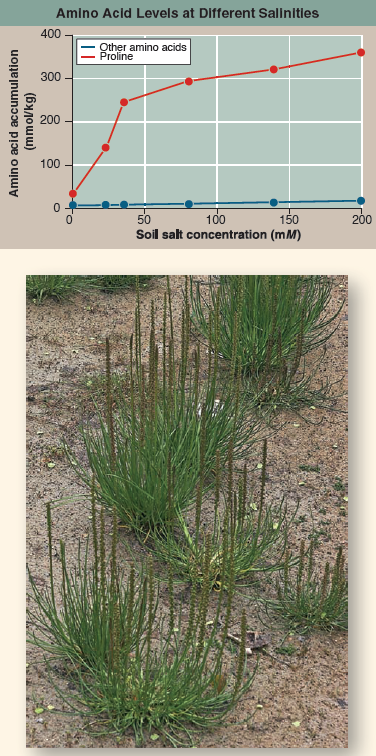
Applying Concepts What do the abbreviations "m M " and "mmol/kg" mean?
Plants grow almost everywhere on earth, thriving in many places where exposure, drought, and other severe conditions challenge their survival. In deserts, a common stress is the presence of high levels of salt in the soils. Soil salinity is also a problem for millions of acres of abandoned farmland because the accumulation of salt from irrigation water restricts growth. Why does excess salt in the soil present a problem for a plant? For one thing, high levels of sodium ions that are taken up by the roots are toxic. For another, a plant's roots cannot obtain water when growing in salty soil. Osmosis (the movement of water molecules to areas of higher solute concentrations, see page 85) causes water to move in the opposite direction, drawn out of the roots by the soil's high levels of salt. And yet plants do grow in these soils. How do they manage?
To investigate this, researchers have studied seaside arrowgrass ( Triglochin maritima ), the plant you see to the right. Arrowgrass plants are able to grow in very salty seashore soils, where few other plants survive. How are they able to survive? Researchers found that their roots do not take up salt and so do not accumulate toxic levels of salt.
However, this still leaves the arrowgrass plant the challenge of preventing its root cells from losing water to the surrounding salty soil. How then do the roots achieve osmotic balance? In an attempt to find out, researchers grew arrowgrass plants in nonsalty soil for two weeks, then transferred them to one of several soils that differed in salt level. After 10 days, shoots were harvested and analyzed for amino acids, because accumulating amino acids could be one way that the cells maintain osmotic balance. Results are presented in the graph.
Applying Concepts What do the abbreviations "m M " and "mmol/kg" mean?
التوضيح موثّق
موثّق
موثّق
The abbreviation of mM is, millimoles pe...

Essentials of the Living World 5th Edition by George Johnson

لماذا لم يعجبك هذا التمرين؟
أخرى 8 أحرف كحد أدنى و 255 حرفاً كحد أقصى
حرف 255






