



expand icon
book Biochemistry 4th Edition by Christopher Mathews,Kensal van Holde, Dean Appling, Spencer Anthony Cahill cover

Biochemistry 4th Edition by Christopher Mathews,Kensal van Holde, Dean Appling, Spencer Anthony Cahill

النسخة 4الرقم المعياري الدولي: 978-0138004644
book Biochemistry 4th Edition by Christopher Mathews,Kensal van Holde, Dean Appling, Spencer Anthony Cahill cover

Biochemistry 4th Edition by Christopher Mathews,Kensal van Holde, Dean Appling, Spencer Anthony Cahill

النسخة 4الرقم المعياري الدولي: 978-0138004644
تمرين 17
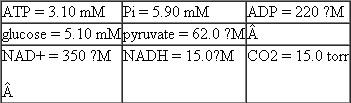
For parts (a) and (b) of this problem use the following standard reduction potentials, free energies, and nonequilibrium concentrations of reactants and products: For parts (a) and (b) of this problem use the following standard reduction potentials, free energies, and nonequilibrium concentrations of reactants and products:     pyruvate + NADH + 2H + ethanol + NAD + + CO<sub>2</sub> AG° = 64.4kJ/mol ATP + H<sub>2</sub> O ADP + P i + H+ G ° = 30.5kJ/mol (a) Consider the last two steps in the alcoholic fermentation of glucose by brewer's yeast:    Calculate the nonequilibrium concentration of ethanol in yeast cells, if G = 38.3 kJ/mol for this reaction at pH = 7.4 and 37 °C when the reactants and products are at the concentrations given above. (b) Consider the degradation of glucose to pyruvate by the glycolytic pathway:    Calculate G for this reaction at pH = 7.4 and 37 °C. For parts (a) and (b) of this problem use the following standard reduction potentials, free energies, and nonequilibrium concentrations of reactants and products:     pyruvate + NADH + 2H + ethanol + NAD + + CO<sub>2</sub> AG° = 64.4kJ/mol ATP + H<sub>2</sub> O ADP + P i + H+ G ° = 30.5kJ/mol (a) Consider the last two steps in the alcoholic fermentation of glucose by brewer's yeast:    Calculate the nonequilibrium concentration of ethanol in yeast cells, if G = 38.3 kJ/mol for this reaction at pH = 7.4 and 37 °C when the reactants and products are at the concentrations given above. (b) Consider the degradation of glucose to pyruvate by the glycolytic pathway:    Calculate G for this reaction at pH = 7.4 and 37 °C. pyruvate + NADH + 2H + ethanol + NAD + + CO2 AG° = 64.4kJ/mol
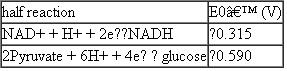
ATP + H2 O ADP + P i + H+ G ° = 30.5kJ/mol
(a) Consider the last two steps in the alcoholic fermentation of glucose by brewer's yeast: For parts (a) and (b) of this problem use the following standard reduction potentials, free energies, and nonequilibrium concentrations of reactants and products:     pyruvate + NADH + 2H + ethanol + NAD + + CO<sub>2</sub> AG° = 64.4kJ/mol ATP + H<sub>2</sub> O ADP + P i + H+ G ° = 30.5kJ/mol (a) Consider the last two steps in the alcoholic fermentation of glucose by brewer's yeast:    Calculate the nonequilibrium concentration of ethanol in yeast cells, if G = 38.3 kJ/mol for this reaction at pH = 7.4 and 37 °C when the reactants and products are at the concentrations given above. (b) Consider the degradation of glucose to pyruvate by the glycolytic pathway:    Calculate G for this reaction at pH = 7.4 and 37 °C.

Calculate the nonequilibrium concentration of ethanol in yeast cells, if G = 38.3 kJ/mol for this reaction at pH = 7.4 and 37 °C when the reactants and products are at the concentrations given above.
(b) Consider the degradation of glucose to pyruvate by the glycolytic pathway: For parts (a) and (b) of this problem use the following standard reduction potentials, free energies, and nonequilibrium concentrations of reactants and products:     pyruvate + NADH + 2H + ethanol + NAD + + CO<sub>2</sub> AG° = 64.4kJ/mol ATP + H<sub>2</sub> O ADP + P i + H+ G ° = 30.5kJ/mol (a) Consider the last two steps in the alcoholic fermentation of glucose by brewer's yeast:    Calculate the nonequilibrium concentration of ethanol in yeast cells, if G = 38.3 kJ/mol for this reaction at pH = 7.4 and 37 °C when the reactants and products are at the concentrations given above. (b) Consider the degradation of glucose to pyruvate by the glycolytic pathway:    Calculate G for this reaction at pH = 7.4 and 37 °C.

Calculate G for this reaction at pH = 7.4 and 37 °C.
التوضيح
موثّق
like image
like image
close menu
Biochemistry 4th Edition by Christopher Mathews,Kensal van Holde, Dean Appling, Spencer Anthony Cahill
cross icon

