







 تكلم مع الذكاء الاصطناعي


The Living World 8th Edition by George Johnson
النسخة 8الرقم المعياري الدولي: 978-0078024214The Living World 8th Edition by George Johnson
النسخة 8الرقم المعياري الدولي: 978-0078024214 تمرين 12
Do Enzymes Physically Attach to Their Substrates?
When scientists first began to examine the chemical activities of organisms, no one knew that biochemical reactions were catalyzed by enzymes. The first enzyme was discovered in 1833 by French chemist Anselme Payen. He was studying how beer is made from barley: First barley is pressed and gently heated so its starches break down into simple two-sugar units; then yeasts convert these units into ethanol. Payen found that the initial breakdown requires a chemical factor that is not alive and that does not seem to be used up during the process-a catalyst. He called this first enzyme diastase (we call it amylase today).
Did this catalyst operate at a distance, increasing the reaction rate all around it, much as raising the temperature of nearby molecules might do? or did it operate in physical contact, actually attaching to the molecules whose reaction it catalyzed (its "substrate")?
The answer was discovered in 1903 by French chemist Victor Henri. He saw that the hypothesis that an enzyme physically binds to its substrate makes a clear and testable prediction: in a solution of substrate and enzyme, there must be a maximum reaction rate, faster than which the reaction cannot proceed. When all the enzyme molecules are working full tilt, the reaction simply cannot go any faster, no matter how much more substrate you add to the solution. To test this prediction, Henri carried out the experiment whose results you see in the graph, measuring the reaction rate ( V ) of diastase at different substrate concentrations ( S ).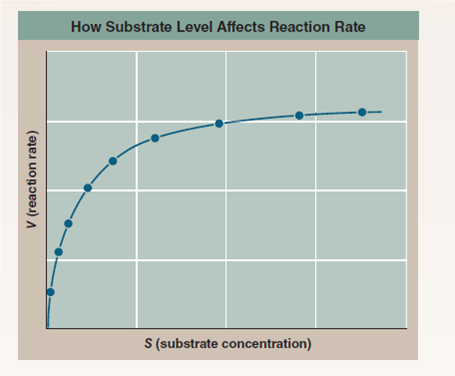
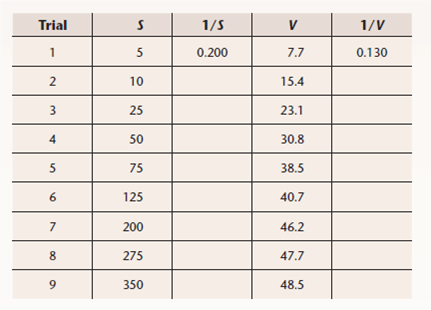
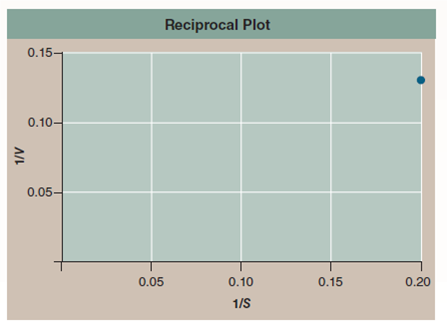
Making Inferences As S increases, does V increase? If so, in what manner-steadily or by smaller and smaller amounts? Is there a maximum reaction rate?
When scientists first began to examine the chemical activities of organisms, no one knew that biochemical reactions were catalyzed by enzymes. The first enzyme was discovered in 1833 by French chemist Anselme Payen. He was studying how beer is made from barley: First barley is pressed and gently heated so its starches break down into simple two-sugar units; then yeasts convert these units into ethanol. Payen found that the initial breakdown requires a chemical factor that is not alive and that does not seem to be used up during the process-a catalyst. He called this first enzyme diastase (we call it amylase today).
Did this catalyst operate at a distance, increasing the reaction rate all around it, much as raising the temperature of nearby molecules might do? or did it operate in physical contact, actually attaching to the molecules whose reaction it catalyzed (its "substrate")?
The answer was discovered in 1903 by French chemist Victor Henri. He saw that the hypothesis that an enzyme physically binds to its substrate makes a clear and testable prediction: in a solution of substrate and enzyme, there must be a maximum reaction rate, faster than which the reaction cannot proceed. When all the enzyme molecules are working full tilt, the reaction simply cannot go any faster, no matter how much more substrate you add to the solution. To test this prediction, Henri carried out the experiment whose results you see in the graph, measuring the reaction rate ( V ) of diastase at different substrate concentrations ( S ).
Making Inferences As S increases, does V increase? If so, in what manner-steadily or by smaller and smaller amounts? Is there a maximum reaction rate?
التوضيح موثّق
موثّق
موثّق
It is clear from the given graph and dat...

The Living World 8th Edition by George Johnson

لماذا لم يعجبك هذا التمرين؟
أخرى 8 أحرف كحد أدنى و 255 حرفاً كحد أقصى
حرف 255






