







 تكلم مع الذكاء الاصطناعي


The Living World 8th Edition by George Johnson
النسخة 8الرقم المعياري الدولي: 978-0078024214The Living World 8th Edition by George Johnson
النسخة 8الرقم المعياري الدولي: 978-0078024214 تمرين 10
Does HIV Infect All White Blood Cells?
Humans are protected from microbial infections by their immune system, a collection of cells that circulate in the blood. Loosely called "white blood cells," this collection actually contains a variety of different cell types. Some of them possess CD4 cell surface identification markers (think of them as id tags). Cells that trigger antibody production when they detect virus-infected cells and macrophage cells that initially attack invading bacteria both carry CD4 Id tags. Other cells possess CD8 Id tags, such as killer cells, which are immune cells that bore holes into virus-infected cells. In an aids patient, neither CD4 nor CD8 cells actively defend against HIV infection. Are either or both of these cell types killed by the HIV virus?
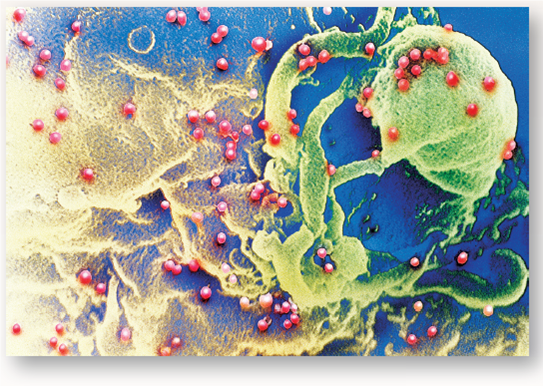
To investigate this issue, researchers mixed together cd4-tagged cells (called cd4+ cells) and CD8-tagged cells (called CD8+ cells), and then added HIV to the mixture. HIV, colored red in the electron micrograph shown here, was then able to infect either kind of cell. The white blood cell culture was monitored at 5-day intervals for 25 days, taking a sample at each interval and scoring it for how many CD4 + cells and how many CD8 + cells it contained. The surviving percentage of each cell type in each sample is presented in the graph on the right above.
Further Analysis neither CD4 + nor CD8 + cells actively defend AIDS patients. If one of them is not eliminated by HIV, why do you suppose it ceases to defend HIV-infected aids patients? Can you think of a way to investigate this possibility?
Humans are protected from microbial infections by their immune system, a collection of cells that circulate in the blood. Loosely called "white blood cells," this collection actually contains a variety of different cell types. Some of them possess CD4 cell surface identification markers (think of them as id tags). Cells that trigger antibody production when they detect virus-infected cells and macrophage cells that initially attack invading bacteria both carry CD4 Id tags. Other cells possess CD8 Id tags, such as killer cells, which are immune cells that bore holes into virus-infected cells. In an aids patient, neither CD4 nor CD8 cells actively defend against HIV infection. Are either or both of these cell types killed by the HIV virus?
To investigate this issue, researchers mixed together cd4-tagged cells (called cd4+ cells) and CD8-tagged cells (called CD8+ cells), and then added HIV to the mixture. HIV, colored red in the electron micrograph shown here, was then able to infect either kind of cell. The white blood cell culture was monitored at 5-day intervals for 25 days, taking a sample at each interval and scoring it for how many CD4 + cells and how many CD8 + cells it contained. The surviving percentage of each cell type in each sample is presented in the graph on the right above.
Further Analysis neither CD4 + nor CD8 + cells actively defend AIDS patients. If one of them is not eliminated by HIV, why do you suppose it ceases to defend HIV-infected aids patients? Can you think of a way to investigate this possibility?
التوضيح موثّق
موثّق
موثّق
In this question, we discuss the infecti...

The Living World 8th Edition by George Johnson

لماذا لم يعجبك هذا التمرين؟
أخرى 8 أحرف كحد أدنى و 255 حرفاً كحد أقصى
حرف 255






