







 تكلم مع الذكاء الاصطناعي


The Living World 8th Edition by George Johnson
النسخة 8الرقم المعياري الدولي: 978-0078024214The Living World 8th Edition by George Johnson
النسخة 8الرقم المعياري الدولي: 978-0078024214 تمرين 13
Has Brain Size Increased as Hominids Evolved?
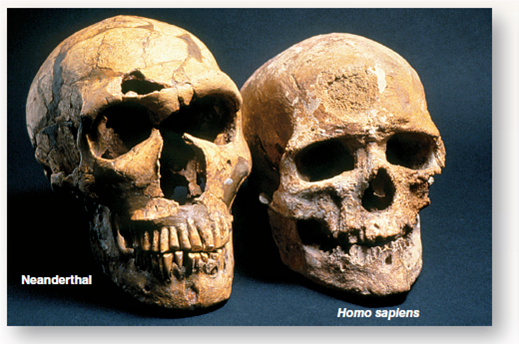
As noted in this chapter, brain size has become progressively larger as hominids evolved. Interestingly, Neanderthal fossils ( left in the photo below) typically have larger brains than fossils of modern humans ( right in photo below), about 1,650 cubic centimeters (cc) for Homo neanderthalensis versus about 1,500 cc for H. sapiens. Does this suggest that Neanderthals were smarter than us?
the graph to the right explores the evolution of hominid brain size by plotting the age of each major type of hominid versus its brain size (that is, the volume of the skull cranium's interior). For each type of hominid, there is some variation in cranial volume among the fossils that have been described, and a typical value is presented (the number in parentheses by each point). The value for H. neanderthalensis , for example, is plotted as a typical 1,650 cc, even though a skull found in the amud cave of israel (see page 469) is 90 cc larger. Some paleontologists consider H. ergaster to be a variant of H. erectus , and H. heidelbergensis and H. neanderthalensis to be variants of H. sapiens , but for the sake of this analysis, the "splitters" view is presented. While the question used to be controversial, most anthropologists now feel that H. neanderthalensis and H. sapiens are separate species, both descended from H. heidelbergensis (however it is named).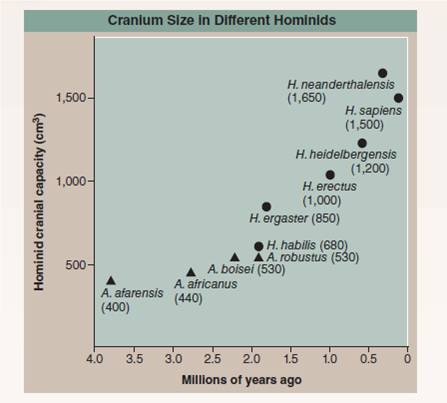
Drawing Conclusions
a. Does brain size appear to have evolved faster in the genus Homo than in the genus Australopithecus ? How much faster?
b. Given the clear and undisputed larger brain size of Neanderthals and the conclusion you have drawn in 4a, does this allow you to further conclude that neanderthals were smarter than today's humans?
As noted in this chapter, brain size has become progressively larger as hominids evolved. Interestingly, Neanderthal fossils ( left in the photo below) typically have larger brains than fossils of modern humans ( right in photo below), about 1,650 cubic centimeters (cc) for Homo neanderthalensis versus about 1,500 cc for H. sapiens. Does this suggest that Neanderthals were smarter than us?
the graph to the right explores the evolution of hominid brain size by plotting the age of each major type of hominid versus its brain size (that is, the volume of the skull cranium's interior). For each type of hominid, there is some variation in cranial volume among the fossils that have been described, and a typical value is presented (the number in parentheses by each point). The value for H. neanderthalensis , for example, is plotted as a typical 1,650 cc, even though a skull found in the amud cave of israel (see page 469) is 90 cc larger. Some paleontologists consider H. ergaster to be a variant of H. erectus , and H. heidelbergensis and H. neanderthalensis to be variants of H. sapiens , but for the sake of this analysis, the "splitters" view is presented. While the question used to be controversial, most anthropologists now feel that H. neanderthalensis and H. sapiens are separate species, both descended from H. heidelbergensis (however it is named).
Drawing Conclusions
a. Does brain size appear to have evolved faster in the genus Homo than in the genus Australopithecus ? How much faster?
b. Given the clear and undisputed larger brain size of Neanderthals and the conclusion you have drawn in 4a, does this allow you to further conclude that neanderthals were smarter than today's humans?
التوضيح موثّق
موثّق
موثّق
In this question, we discuss the connect...

The Living World 8th Edition by George Johnson

لماذا لم يعجبك هذا التمرين؟
أخرى 8 أحرف كحد أدنى و 255 حرفاً كحد أقصى
حرف 255






