







 تكلم مع الذكاء الاصطناعي


The Living World 8th Edition by George Johnson
النسخة 8الرقم المعياري الدولي: 978-0078024214The Living World 8th Edition by George Johnson
النسخة 8الرقم المعياري الدولي: 978-0078024214 تمرين 1
How Do Llamas Live So High Up?
Because of mixing, the air animals breathe is 21% oxygen everywhere, even way up into the sky 100 km above earth's surface. However, the amount of air (the number of molecules in a unit volume) decreases sharply with altitude, as shown in the upper graph. Air pressure at 5,000 meters is half that at sea level. This lack of air presents a serious problem to humans, as mountain climbers know. The amount of oxygen in the air (measured as oxygen partial pressure) is lower, so there is simply too little oxygen to fuel a climber's muscles. To combat this problem, high-altitude climbers typically spend months acclimating to high altitudes, a period in which their bodies greatly increase the amount of hemoglobin in their red blood cells and so increase the amount of oxygen the red blood cells can capture. Many mammals live their entire lives at high altitudes. The llama and the vicuna (pictured here) both live in the high Andes of South America, often above 5,000 meters. Do they stuff extra hemoglobin into their red blood cells too, or are they able to solve the problem of low oxygen in another way?
The graph on the lower right displays three "oxygen loading curves" that reveal the effectiveness with which hemoglobin binds oxygen. The more effective the binding, the less oxygen required before hemoglobin becomes fully loaded. In the graph, the percent hemoglobin saturation (that is, how much of the hemoglobin is bound to oxygen) is presented on the y axis, and the oxygen partial pressure (a measure of the amount of oxygen available to the hemoglobin molecules) is presented on the x axis. Oxygen-loading curves are presented for three mammalian species: humans living at sea level, and llamas and vicunas, each living in the Andes above 5,000 meters.\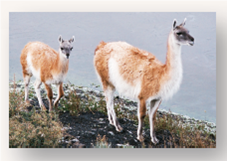
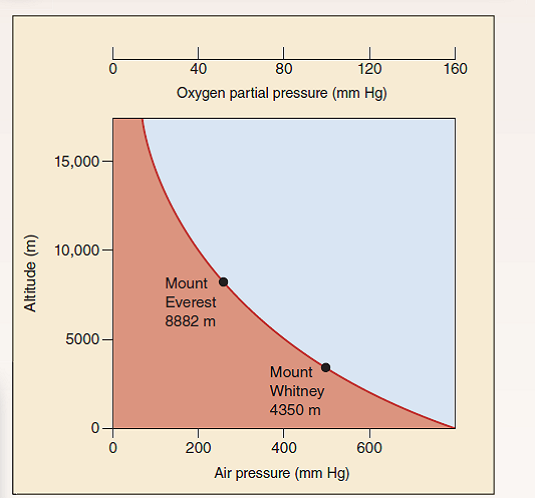
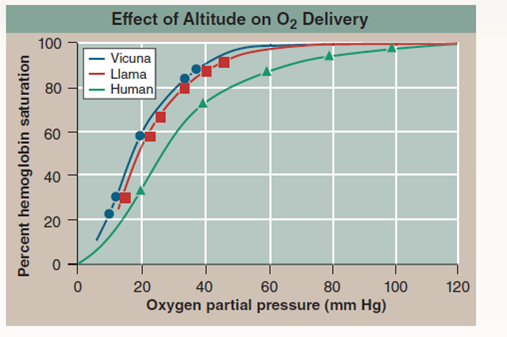
Making Inferences At an elevation of 5,000 meters, the partial pressure of oxygen is 80 mm hg (half of what it is at sea level). At this elevation, how much of human hemoglobin has succeeded in binding oxygen? How much of llama hemoglobin? Of vicuna?
Because of mixing, the air animals breathe is 21% oxygen everywhere, even way up into the sky 100 km above earth's surface. However, the amount of air (the number of molecules in a unit volume) decreases sharply with altitude, as shown in the upper graph. Air pressure at 5,000 meters is half that at sea level. This lack of air presents a serious problem to humans, as mountain climbers know. The amount of oxygen in the air (measured as oxygen partial pressure) is lower, so there is simply too little oxygen to fuel a climber's muscles. To combat this problem, high-altitude climbers typically spend months acclimating to high altitudes, a period in which their bodies greatly increase the amount of hemoglobin in their red blood cells and so increase the amount of oxygen the red blood cells can capture. Many mammals live their entire lives at high altitudes. The llama and the vicuna (pictured here) both live in the high Andes of South America, often above 5,000 meters. Do they stuff extra hemoglobin into their red blood cells too, or are they able to solve the problem of low oxygen in another way?
The graph on the lower right displays three "oxygen loading curves" that reveal the effectiveness with which hemoglobin binds oxygen. The more effective the binding, the less oxygen required before hemoglobin becomes fully loaded. In the graph, the percent hemoglobin saturation (that is, how much of the hemoglobin is bound to oxygen) is presented on the y axis, and the oxygen partial pressure (a measure of the amount of oxygen available to the hemoglobin molecules) is presented on the x axis. Oxygen-loading curves are presented for three mammalian species: humans living at sea level, and llamas and vicunas, each living in the Andes above 5,000 meters.\
Making Inferences At an elevation of 5,000 meters, the partial pressure of oxygen is 80 mm hg (half of what it is at sea level). At this elevation, how much of human hemoglobin has succeeded in binding oxygen? How much of llama hemoglobin? Of vicuna?
التوضيح موثّق
موثّق
موثّق
If the partial pressure of oxygen in hum...

The Living World 8th Edition by George Johnson

لماذا لم يعجبك هذا التمرين؟
أخرى 8 أحرف كحد أدنى و 255 حرفاً كحد أقصى
حرف 255






