







 تكلم مع الذكاء الاصطناعي


The Living World 8th Edition by George Johnson
النسخة 8الرقم المعياري الدولي: 978-0078024214The Living World 8th Edition by George Johnson
النسخة 8الرقم المعياري الدولي: 978-0078024214 تمرين 2
Why Do Diabetics Excrete
Glucose in Their Urine?
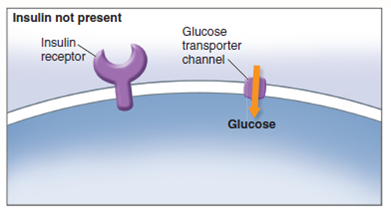
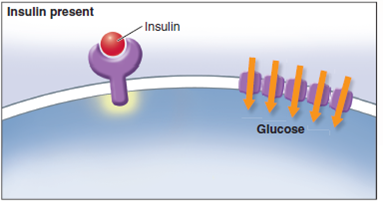
Late-onset diabetes is a serious and increasingly common disorder in which the body's cells lose their ability to respond to insulin, a hormone which is needed to trigger their uptake of glucose. As illustrated below, the binding of insulin to a receptor in the plasma membrane causes the rapid insertion of glucose transporter channels into the plasma membrane, allowing the cell to take up glucose. In diabetics, however, glucose molecules accumulate in the blood while the body's cells starve for the lack of them. In mild cases, blood glucose levels rise to several times the normal value of 4 m M; in severe untreated cases, blood glucose levels may become enormously elevated, up tO25 times the normal value. A characteristic symptom of even mild diabetes is the excretion of large amounts of glucose in the urine. The name of the disorder, diabetes mellitus , means "excessive secretion of sweet urine." In normal individuals, by contrast, only trace amounts of glucose are excreted. The kidney very effi ciently reabsorbs glucose molecules from the fl uid passing through it. Why doesn't it do so in diabetic individuals?
The graph on the upper right displays so-called glucose tolerance curves for a normal person ( blue line ) and a diabetic ( red line ). After a night without food, each individual drank a test dose of 100 grams of glucose dissolved in water. Blood glucose levels were then monitored at 30-minute and one-hour intervals. The dotted line indicates the kidney threshold, the maximum concentration of blood glucose molecules (about 10 m M ) that the kidney is able to retrieve from the fl uid passing through it when all of its glucose-transporting channels are being utilized full-bore.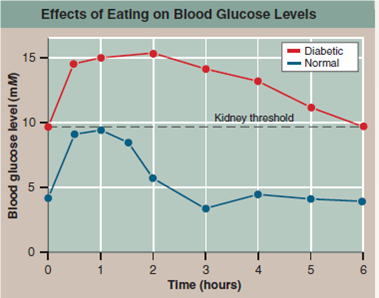
Further Analysis
a. If glucose molecules are being excreted in the urine, then they are not being converted to fatty acids for storage as fat. This would imply that severe diabetics would lose weight, even if on a high-calorie diet. How would you go about testing this prediction?
b. Denied glucose, the cells of a diabetic might be expected to turn in desperation to the cell's protein as a food source. How might you test this hypothesis?
Glucose in Their Urine?
Late-onset diabetes is a serious and increasingly common disorder in which the body's cells lose their ability to respond to insulin, a hormone which is needed to trigger their uptake of glucose. As illustrated below, the binding of insulin to a receptor in the plasma membrane causes the rapid insertion of glucose transporter channels into the plasma membrane, allowing the cell to take up glucose. In diabetics, however, glucose molecules accumulate in the blood while the body's cells starve for the lack of them. In mild cases, blood glucose levels rise to several times the normal value of 4 m M; in severe untreated cases, blood glucose levels may become enormously elevated, up tO25 times the normal value. A characteristic symptom of even mild diabetes is the excretion of large amounts of glucose in the urine. The name of the disorder, diabetes mellitus , means "excessive secretion of sweet urine." In normal individuals, by contrast, only trace amounts of glucose are excreted. The kidney very effi ciently reabsorbs glucose molecules from the fl uid passing through it. Why doesn't it do so in diabetic individuals?
The graph on the upper right displays so-called glucose tolerance curves for a normal person ( blue line ) and a diabetic ( red line ). After a night without food, each individual drank a test dose of 100 grams of glucose dissolved in water. Blood glucose levels were then monitored at 30-minute and one-hour intervals. The dotted line indicates the kidney threshold, the maximum concentration of blood glucose molecules (about 10 m M ) that the kidney is able to retrieve from the fl uid passing through it when all of its glucose-transporting channels are being utilized full-bore.
Further Analysis
a. If glucose molecules are being excreted in the urine, then they are not being converted to fatty acids for storage as fat. This would imply that severe diabetics would lose weight, even if on a high-calorie diet. How would you go about testing this prediction?
b. Denied glucose, the cells of a diabetic might be expected to turn in desperation to the cell's protein as a food source. How might you test this hypothesis?
التوضيح موثّق
موثّق
موثّق
Diabetes is a serious metabolic disorder...

The Living World 8th Edition by George Johnson

لماذا لم يعجبك هذا التمرين؟
أخرى 8 أحرف كحد أدنى و 255 حرفاً كحد أقصى
حرف 255






