







 تكلم مع الذكاء الاصطناعي


International Economics 15th Edition by Robert Carbaugh
النسخة 15الرقم المعياري الدولي: 978-1285854359International Economics 15th Edition by Robert Carbaugh
النسخة 15الرقم المعياري الدولي: 978-1285854359 تمرين 16
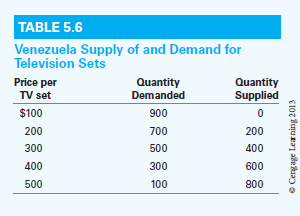
Table 5.6 illustrates the demand and supply schedules for television sets in Venezuela, a "small" nation that is unable to affect world prices. On graph paper, sketch Venezuela's demand and supply schedules of television sets.
a. Suppose Venezuela imports TV sets at a price of $150 each. Under free trade, how many sets does Venezuela produce, consume, and import? Determine Venezuela's consumer surplus and producer surplus.
b. Assume that Venezuela imposes a quota that limits imports to 300 TV sets. Determine the quota-induced price increase and the resulting decrease in consumer surplus. Calculate the quota's redistributive, consumption, protective, and revenue effects. Assuming that Venezuelan import companies organize as buyers and bargain favorably with competitive foreign exporters, what is the overall welfare loss to Venezuela as a result of the quota? Suppose that foreign exporters organize as a monopoly seller. What is the overall welfare loss to Venezuela as a result of the quota?
c. Suppose that, instead of a quota, Venezuela grants its import-competing producers a subsidy of $100 per TV set. In your diagram, draw the subsidy-adjusted supply schedule for Venezuelan producers. Does the subsidy result in a rise in the price of TV sets above the free-trade level? Determine Venezuela's production, consumption, and imports of TV sets under the subsidy. What is the total cost of the subsidy to the Venezuelan government? Of this amount, how much is transferred to Venezuelan producers in the form of producer surplus, and how much is absorbed by higher production costs due to inefficient domestic production? Determine the overall welfare loss to Venezuela under the subsidy.
a. Suppose Venezuela imports TV sets at a price of $150 each. Under free trade, how many sets does Venezuela produce, consume, and import? Determine Venezuela's consumer surplus and producer surplus.
b. Assume that Venezuela imposes a quota that limits imports to 300 TV sets. Determine the quota-induced price increase and the resulting decrease in consumer surplus. Calculate the quota's redistributive, consumption, protective, and revenue effects. Assuming that Venezuelan import companies organize as buyers and bargain favorably with competitive foreign exporters, what is the overall welfare loss to Venezuela as a result of the quota? Suppose that foreign exporters organize as a monopoly seller. What is the overall welfare loss to Venezuela as a result of the quota?
c. Suppose that, instead of a quota, Venezuela grants its import-competing producers a subsidy of $100 per TV set. In your diagram, draw the subsidy-adjusted supply schedule for Venezuelan producers. Does the subsidy result in a rise in the price of TV sets above the free-trade level? Determine Venezuela's production, consumption, and imports of TV sets under the subsidy. What is the total cost of the subsidy to the Venezuelan government? Of this amount, how much is transferred to Venezuelan producers in the form of producer surplus, and how much is absorbed by higher production costs due to inefficient domestic production? Determine the overall welfare loss to Venezuela under the subsidy.
التوضيح موثّق
موثّق
موثّق
The following table provides information...

International Economics 15th Edition by Robert Carbaugh

لماذا لم يعجبك هذا التمرين؟
أخرى 8 أحرف كحد أدنى و 255 حرفاً كحد أقصى
حرف 255






