







 تكلم مع الذكاء الاصطناعي


Kraus' Recreation and Leisure in Modern Society 10th Edition by Daniel McLean, Linda Dayer-Berenson, Brian Luke Seaward, Amy Hurd
النسخة 10الرقم المعياري الدولي: 978-1449689575Kraus' Recreation and Leisure in Modern Society 10th Edition by Daniel McLean, Linda Dayer-Berenson, Brian Luke Seaward, Amy Hurd
النسخة 10الرقم المعياري الدولي: 978-1449689575 تمرين 11
Types and Uses of Urban Parks, 1850-1965
Early urban parks in the United States were places seen as an antidote to the problems of cities, which were perceived as dangerous, dirty, and unhealthy places. Parks formed an important component of the urban environment, and cities embraced them. Those same parks today provide a type of precursor to the emerging sustainable park of the twenty-first century. Cranz and Boland define three periods of park development beginning in 1850 and continuing through 1965. The three periods include the following:
Pleasure ground (18501900)
Reform park (19001930)
Recreation facility (19301965)
Each of the park types is described in terms of social goal, activities, size, relation to city, elements, promoters, and beneficiaries.
The importance of understanding the different park movements from 1850 to the mid-1960s is to gain a greaterappreciation of how citizens, politicians, and social and environmental movements affected park design and use.The first wave saw the large urban parks created all across the country, including such places as Central Park in NewYork City, Golden Gate Park in San Francisco, and Grant Park in Chicago. These large urban parks became majorcomponents of large urban areas, most becoming the core of larger and more diverse park and recreation systems.
The three park systems described in Table 3.1 show how the movements shifted, as did the population. In most cases, the park movement followed, rather than led, public needs and desires. As social reform advanced, the pleasure ground gave way to a more active and focused reform park, many of which still boast the same services and benefits today, although they have been changed several times. The recreation facility, a continuing popular model, was an expression of efforts to move from the city core to the suburbs.
TABLE 1 Typology of Urban Parks, 1850-1965
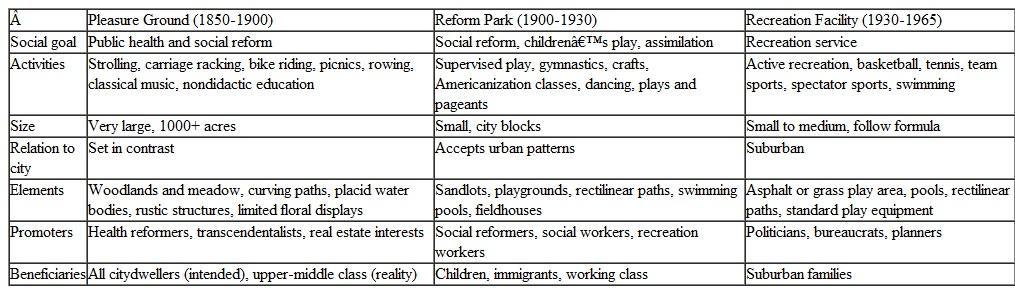 Adapted from Galen Cranz and Michael Boland. "Defining the Sustainable Park: A Fifth Model for Urban Parks." Landscape Journal , (Vol. 23, No. 2, 2004): 102-140.
What were the actual benefits to the beneficiaries of the different types of parks
Early urban parks in the United States were places seen as an antidote to the problems of cities, which were perceived as dangerous, dirty, and unhealthy places. Parks formed an important component of the urban environment, and cities embraced them. Those same parks today provide a type of precursor to the emerging sustainable park of the twenty-first century. Cranz and Boland define three periods of park development beginning in 1850 and continuing through 1965. The three periods include the following:
Pleasure ground (18501900)
Reform park (19001930)
Recreation facility (19301965)
Each of the park types is described in terms of social goal, activities, size, relation to city, elements, promoters, and beneficiaries.
The importance of understanding the different park movements from 1850 to the mid-1960s is to gain a greaterappreciation of how citizens, politicians, and social and environmental movements affected park design and use.The first wave saw the large urban parks created all across the country, including such places as Central Park in NewYork City, Golden Gate Park in San Francisco, and Grant Park in Chicago. These large urban parks became majorcomponents of large urban areas, most becoming the core of larger and more diverse park and recreation systems.
The three park systems described in Table 3.1 show how the movements shifted, as did the population. In most cases, the park movement followed, rather than led, public needs and desires. As social reform advanced, the pleasure ground gave way to a more active and focused reform park, many of which still boast the same services and benefits today, although they have been changed several times. The recreation facility, a continuing popular model, was an expression of efforts to move from the city core to the suburbs.
TABLE 1 Typology of Urban Parks, 1850-1965
Adapted from Galen Cranz and Michael Boland. "Defining the Sustainable Park: A Fifth Model for Urban Parks." Landscape Journal , (Vol. 23, No. 2, 2004): 102-140.What were the actual benefits to the beneficiaries of the different types of parks
التوضيح موثّق
موثّق
موثّق
Case synopsis:
The given case reveals t...

Kraus' Recreation and Leisure in Modern Society 10th Edition by Daniel McLean, Linda Dayer-Berenson, Brian Luke Seaward, Amy Hurd

لماذا لم يعجبك هذا التمرين؟
أخرى 8 أحرف كحد أدنى و 255 حرفاً كحد أقصى
حرف 255






