







 تكلم مع الذكاء الاصطناعي


Kraus' Recreation and Leisure in Modern Society 10th Edition by Daniel McLean, Linda Dayer-Berenson, Brian Luke Seaward, Amy Hurd
النسخة 10الرقم المعياري الدولي: 978-1449689575Kraus' Recreation and Leisure in Modern Society 10th Edition by Daniel McLean, Linda Dayer-Berenson, Brian Luke Seaward, Amy Hurd
النسخة 10الرقم المعياري الدولي: 978-1449689575 تمرين 1
Serious Leisure Contributes to Successful Aging
Serious leisure is a concept first proposed by sociologist Robert Stebbens in 1982, who contended that "serious leisure is the systematic pursuit of an amateur, hobbyist, or volunteer core activity that people find so substantial, interesting and fulfilling that … they launch themselves on a (leisure) career centered on acquiring and expressing a combination of its special skills, knowledge, and experience." a In the context of Maslow's hierarchy of needs, serious leisure fulfills multiple need and growth roles for individuals, ranging from belonging to creativity. Stebbens sees serious leisure as a substitution for work for those who may have left the workforce, whether voluntarily or involuntarily, yet he says serious leisure is not a livelihood and one should not get caught up in seeing serious leisure as a substitute for work. Serious leisure carries with it "numerous pleasant expectations and memories, doing so to a degree only rarely found in work." b
As part of his description of serious leisure, Stebbens identified six qualities, or descriptors, that are present. In some ways, they are similar to life challenges and do not always represent positive emotions, but they do represent challenges individuals must face in the pursuit of serious leisure. There are linkages to Maslow's hierarchy of human needs at the creativity level as well as Csikszentmihalyi's flow theory. The six qualities are as follows:
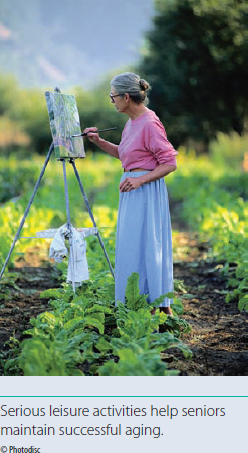
Serious leisure activities help seniors maintain successful aging.
The occasional need to persevere to overcome difficulties
The presence of a career that involves achievement, occurring through stages of development and involvement
A significant personal effort focusing on unique acquired knowledge, skill, or training
Eight durable benefits including social interaction and belongingness, self-expression, self-enrichment, enhancement of self-image, feelings of accomplishment, lasting physical products, self actualization, and renewal
A strong identity formed among participants in their chosen pursuits
A unique ethos formed related to the activity resulting in a special social world a
Today's aging population, as reported elsewhere in this text, no longer conforms to the concept of a slow downward spiral or the notion that involvement, physical activity, and learning are not part of acceptable retirement activities. Rather, as the baby boomer population ages, this group is challenging all of the notions of what is appropriate for an aging population. Involvement, engagement, physical activity, and extended work or work-related activities are becoming the norm. As part of this change in the approach to and views of aging, serious leisure is receiving more attention from researchers. Linked with predictors of successful aging, serious leisure is showing promise as a way to enrich successful aging. Rowe and Kahn identify three factors crucial to successful aging: "the absence of disease and disability; maintaining mental and physical functioning; and continuing engagement with life." d Brown and colleagues studied older adults involved in a dance program and identified six themes related to the qualities of serious leisure. c They found perseverance among the participants as they learned how to dance. The perseverance was manifest among the participants in attitude and behaviors as they attempted to master basic and advanced dancing steps. Second, the notion of a leisure career included achievement or involvement among the participants. For those so engaged, "the concept of a leisure career reflects the successful aging components of learning, involvement, and keeping active." d The third quality and theme involved considerable personal effort to acquire specific knowledge of the leisure activity. The characteristic of a unique ethos reflects directly upon the development of a new and specialized social world resulting in a strong social network, both of which are recognized components of successful aging. The benefits of involvement in serious leisure as they relate to this study involved self-actualization, self-enrichment, self-expression, feelings of accomplishment, enhancement of self-image, regeneration of self, self-gratification, lasting physical products, and social interaction and belongingness. The benefits of involvement may have the most long-lasting impact on the participants and successful aging. Identity formulation , another quality, comes from the other five characteristics and the researchers found the participants formed a strong identity with their pursuits. More important, it suggests the power of serious leisure as a contributor to successful aging.
Explain how you participate in serious leisure.
Serious leisure is a concept first proposed by sociologist Robert Stebbens in 1982, who contended that "serious leisure is the systematic pursuit of an amateur, hobbyist, or volunteer core activity that people find so substantial, interesting and fulfilling that … they launch themselves on a (leisure) career centered on acquiring and expressing a combination of its special skills, knowledge, and experience." a In the context of Maslow's hierarchy of needs, serious leisure fulfills multiple need and growth roles for individuals, ranging from belonging to creativity. Stebbens sees serious leisure as a substitution for work for those who may have left the workforce, whether voluntarily or involuntarily, yet he says serious leisure is not a livelihood and one should not get caught up in seeing serious leisure as a substitute for work. Serious leisure carries with it "numerous pleasant expectations and memories, doing so to a degree only rarely found in work." b
As part of his description of serious leisure, Stebbens identified six qualities, or descriptors, that are present. In some ways, they are similar to life challenges and do not always represent positive emotions, but they do represent challenges individuals must face in the pursuit of serious leisure. There are linkages to Maslow's hierarchy of human needs at the creativity level as well as Csikszentmihalyi's flow theory. The six qualities are as follows:
Serious leisure activities help seniors maintain successful aging.
The occasional need to persevere to overcome difficulties
The presence of a career that involves achievement, occurring through stages of development and involvement
A significant personal effort focusing on unique acquired knowledge, skill, or training
Eight durable benefits including social interaction and belongingness, self-expression, self-enrichment, enhancement of self-image, feelings of accomplishment, lasting physical products, self actualization, and renewal
A strong identity formed among participants in their chosen pursuits
A unique ethos formed related to the activity resulting in a special social world a
Today's aging population, as reported elsewhere in this text, no longer conforms to the concept of a slow downward spiral or the notion that involvement, physical activity, and learning are not part of acceptable retirement activities. Rather, as the baby boomer population ages, this group is challenging all of the notions of what is appropriate for an aging population. Involvement, engagement, physical activity, and extended work or work-related activities are becoming the norm. As part of this change in the approach to and views of aging, serious leisure is receiving more attention from researchers. Linked with predictors of successful aging, serious leisure is showing promise as a way to enrich successful aging. Rowe and Kahn identify three factors crucial to successful aging: "the absence of disease and disability; maintaining mental and physical functioning; and continuing engagement with life." d Brown and colleagues studied older adults involved in a dance program and identified six themes related to the qualities of serious leisure. c They found perseverance among the participants as they learned how to dance. The perseverance was manifest among the participants in attitude and behaviors as they attempted to master basic and advanced dancing steps. Second, the notion of a leisure career included achievement or involvement among the participants. For those so engaged, "the concept of a leisure career reflects the successful aging components of learning, involvement, and keeping active." d The third quality and theme involved considerable personal effort to acquire specific knowledge of the leisure activity. The characteristic of a unique ethos reflects directly upon the development of a new and specialized social world resulting in a strong social network, both of which are recognized components of successful aging. The benefits of involvement in serious leisure as they relate to this study involved self-actualization, self-enrichment, self-expression, feelings of accomplishment, enhancement of self-image, regeneration of self, self-gratification, lasting physical products, and social interaction and belongingness. The benefits of involvement may have the most long-lasting impact on the participants and successful aging. Identity formulation , another quality, comes from the other five characteristics and the researchers found the participants formed a strong identity with their pursuits. More important, it suggests the power of serious leisure as a contributor to successful aging.
Explain how you participate in serious leisure.
التوضيح موثّق
موثّق
موثّق
Leisure:
Leisure refers to the idle tim...

Kraus' Recreation and Leisure in Modern Society 10th Edition by Daniel McLean, Linda Dayer-Berenson, Brian Luke Seaward, Amy Hurd

لماذا لم يعجبك هذا التمرين؟
أخرى 8 أحرف كحد أدنى و 255 حرفاً كحد أقصى
حرف 255






