







 تكلم مع الذكاء الاصطناعي


Leadership 5th Edition by Larry Siegel, Robert Lussier, Robert Lussier, Christopher Achua, Christopher Achua
النسخة 5الرقم المعياري الدولي: 9781133711896Leadership 5th Edition by Larry Siegel, Robert Lussier, Robert Lussier, Christopher Achua, Christopher Achua
النسخة 5الرقم المعياري الدولي: 9781133711896 تمرين 23
Have you ever heard of Foxconn Technology Group and its founder and CEO Terry Gou? It is the largest exporter out of China. Foxconn is a Taiwanese contract manufacturer employing 920,000 Chinese workers across more than 20 mainland factories. 49 Its business is fueled by the United States' and the world's hunger for high-tech gadgets and toys at rock-bottom prices, shareholders demanding solid profit margins, and workers eager to move up the economic ladder. 50
Foxconn has been the most trusted name in contract manufacturing services.51 Some of the major companies Foxconn makes contracted products for include IBM, Cisco, Microsoft, Nokia, Sony, Dell, Hewlett-Packard, and Apple. 52 If you have a PlayStation, computer, or smart phone there is a good chance that all or part of it was made by Foxconn. It is the only manufacturer that makes the iPad and one of two producer of the iPhone. 53
Foxconn has a plant in Houston, Texas, that employs around 1,000 workers, specializing in high-end servers for corporate clients. Gou plans to move additional automated production to the United States and ship its goods to China. 54 Foxconn is the second largest exporter in the Czech Republic,55 and it also plans to expand to Slovakia and Turkey and may lead a plan to expand Brazil's electronics industry. 56 Gou started Hon Hai Precision Industry Company, the anchor company of Foxconn Technology Group, in 1974 at age 23 with a $7,500 loan from his mother. 57 He has been characterized as always thinking about a way to shave another nickel off the cost of a product, as a charming salesman, as a daring strategist, as a ruthless taskmaster, and as a reincarnated Henry Ford.58 Gou was ranked sixth on the Fortune Asia's 25 Most Powerful list. 59 Forbes estimated Gou's personal fortune at $5.9 billion, but he says, "I think for me, I am not interested in knowing how much I have. I don't care. I am working not for the money at this moment, I am working for society, I am working for my employees." 60
Although Terry Gou's story is interesting, in this case we focus on lower-level manager Li Chang. (Please note: Foxconn is an existing company. However, Chang and Jackie Lee are not the names of actual managers at Foxconn; they are used to illustrate contingency leadership.)
Li Chang worked her way up to become the manager in a department making parts for the iPad. Chang's job was to supervise the production of one part that is used as a component in other products. Running the machines to make the standard parts is not complicated, and her employees generally find the job to be boring with low pay. Chang closely supervised the employees to make sure they kept production on schedule. She believed that if she did not
watch the employees closely and keep them informed of their output, they would slack off and miss production goals. Chang's employees viewed her as an okay boss to work for, as she did take a personal interest in them, and employees were productive. Chang did discipline employees who did not meet standard productivity, and she ended up firing some workers.
Jackie Lee, the manager of a larger department that made instruments to customer specifications, retired, and Chang was given a promotion to manage this department because she did a good job running her old department. Chang never did any design work, nor supervised it. The designers are all engineers who are paid well and who were doing a good job according to their prior supervisor Lee. As Chang observed workers in her usual manner, she realized that all of the designers did their work differently. So she closely observed their work and looked for good ideas that all her employees could follow. It wasn't long before Chang was telling employees how to do a better job of designing the custom specifications. Things were not going too well, however, as employees told Chang that she did not know what she was talking about. Chang tried to rely on her authority, which worked while she was watching employees. However, once she left one employee to observe another, the workers went back to doing things their own way. Chang's employees were complaining about her being a poor manager behind her back.
The complaints about Chang being a poor manager got to Terry Gou. Gou also realized that performance in the design department had gone down since Chang took over as manager. Gou decided to call Chang into his office to discuss how things are going.
GO TO THE INTERNET: To learn more about Terry Gou and Foxconn, visit its Web site (http://www.foxconn.com).
Support your answers to the following questions with specific information from the case and text or with other information you get from the Web or other sources.
1. Which leadership style would Fiedler say Li Chang uses?
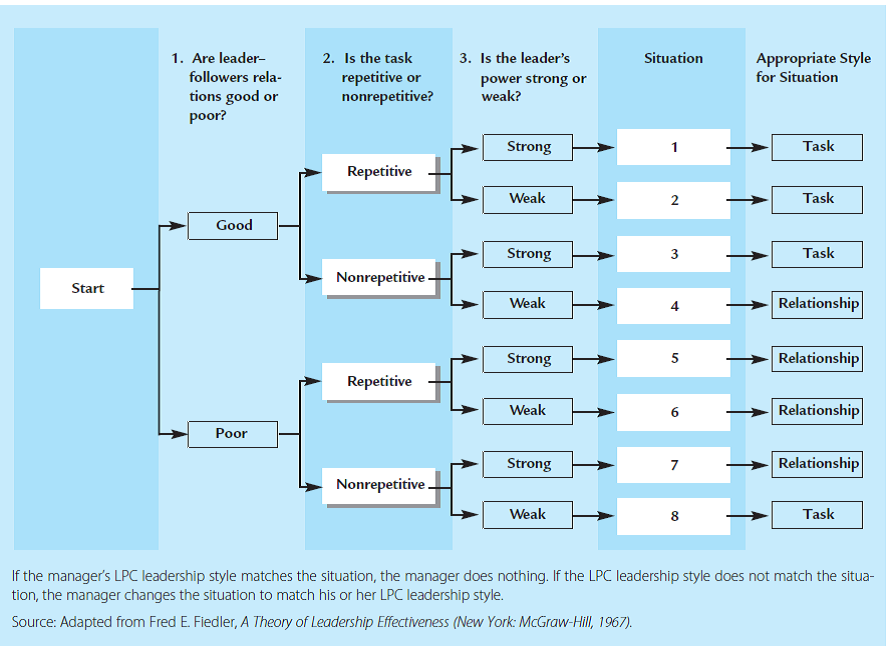
2. Using Exhibit 4.3 on page 118, Fiedler's contingency leadership model, what situation and leadership style are appropriate for the production department and for the custom design department?
3. Why isn't Chang doing an effective job in the design department?
4. What would Fiedler and Kerr and Jermier recommend that Chang do to improve performance?
5. Which of the two basic continuum leadership styles would Tannenbaum and Schmidt recommend for Chang and other managers of the design department?
6. Which path-goal leadership style would House recommend for Chang and other managers of the design department?
C U M U L A T I V E C A S E Q U E S T I O N S
7. Describe Chang's personality based on the Big Five model of personality (Chapter 2). How does Chang's personality influence her leadership style?
8. How is Chang's leadership style and behavior affecting employee needs and motivation (Chapter 3)?
9. Which source and type of power does Chang use? Is she using the appropriate power? If not, which power should Chang use (Chapter 4)?
C A S E E X E R C I S E A N D R O L E - P L A Y
Preparation: Put yourself in the role of Terry Gou. (1) Which normative leadership style would you use with Chang during the meeting? (2) How would you handle the meeting with Chang? (3) What will you say to her?
In-Class Meeting: Break into groups of four to six members, and discuss the three preparation questions.
Role-Play: One person (representing themselves or a group) meets with Chang to role-play the meeting for the class to observe. The person does not identify which normative leadership style they are using. You can discuss the role-play, as discussed next. More than one role-play may also take place.
Observer Role: As the rest of the class members watch the role-play, they should: (1) Identify the leadership style used by the person playing the role of Gou. (2) State if it is the appropriate leadership style for this situation. (3) Look for things that Gou does well, and does not do so well. For your suggested improvements, be sure to have alternative behaviors that are coaching.
Discussion: After the first role-play, the class (1) votes for the leadership style used by the person role-playing Gou, (2) determines the appropriate leadership style, and (3) discusses good behavior and better behavior that could be used. If additional role-plays are used, skip step 2.
(Reference Exhibit 4.3)
Foxconn has been the most trusted name in contract manufacturing services.51 Some of the major companies Foxconn makes contracted products for include IBM, Cisco, Microsoft, Nokia, Sony, Dell, Hewlett-Packard, and Apple. 52 If you have a PlayStation, computer, or smart phone there is a good chance that all or part of it was made by Foxconn. It is the only manufacturer that makes the iPad and one of two producer of the iPhone. 53
Foxconn has a plant in Houston, Texas, that employs around 1,000 workers, specializing in high-end servers for corporate clients. Gou plans to move additional automated production to the United States and ship its goods to China. 54 Foxconn is the second largest exporter in the Czech Republic,55 and it also plans to expand to Slovakia and Turkey and may lead a plan to expand Brazil's electronics industry. 56 Gou started Hon Hai Precision Industry Company, the anchor company of Foxconn Technology Group, in 1974 at age 23 with a $7,500 loan from his mother. 57 He has been characterized as always thinking about a way to shave another nickel off the cost of a product, as a charming salesman, as a daring strategist, as a ruthless taskmaster, and as a reincarnated Henry Ford.58 Gou was ranked sixth on the Fortune Asia's 25 Most Powerful list. 59 Forbes estimated Gou's personal fortune at $5.9 billion, but he says, "I think for me, I am not interested in knowing how much I have. I don't care. I am working not for the money at this moment, I am working for society, I am working for my employees." 60
Although Terry Gou's story is interesting, in this case we focus on lower-level manager Li Chang. (Please note: Foxconn is an existing company. However, Chang and Jackie Lee are not the names of actual managers at Foxconn; they are used to illustrate contingency leadership.)
Li Chang worked her way up to become the manager in a department making parts for the iPad. Chang's job was to supervise the production of one part that is used as a component in other products. Running the machines to make the standard parts is not complicated, and her employees generally find the job to be boring with low pay. Chang closely supervised the employees to make sure they kept production on schedule. She believed that if she did not
watch the employees closely and keep them informed of their output, they would slack off and miss production goals. Chang's employees viewed her as an okay boss to work for, as she did take a personal interest in them, and employees were productive. Chang did discipline employees who did not meet standard productivity, and she ended up firing some workers.
Jackie Lee, the manager of a larger department that made instruments to customer specifications, retired, and Chang was given a promotion to manage this department because she did a good job running her old department. Chang never did any design work, nor supervised it. The designers are all engineers who are paid well and who were doing a good job according to their prior supervisor Lee. As Chang observed workers in her usual manner, she realized that all of the designers did their work differently. So she closely observed their work and looked for good ideas that all her employees could follow. It wasn't long before Chang was telling employees how to do a better job of designing the custom specifications. Things were not going too well, however, as employees told Chang that she did not know what she was talking about. Chang tried to rely on her authority, which worked while she was watching employees. However, once she left one employee to observe another, the workers went back to doing things their own way. Chang's employees were complaining about her being a poor manager behind her back.
The complaints about Chang being a poor manager got to Terry Gou. Gou also realized that performance in the design department had gone down since Chang took over as manager. Gou decided to call Chang into his office to discuss how things are going.
GO TO THE INTERNET: To learn more about Terry Gou and Foxconn, visit its Web site (http://www.foxconn.com).
Support your answers to the following questions with specific information from the case and text or with other information you get from the Web or other sources.
1. Which leadership style would Fiedler say Li Chang uses?
2. Using Exhibit 4.3 on page 118, Fiedler's contingency leadership model, what situation and leadership style are appropriate for the production department and for the custom design department?
3. Why isn't Chang doing an effective job in the design department?
4. What would Fiedler and Kerr and Jermier recommend that Chang do to improve performance?
5. Which of the two basic continuum leadership styles would Tannenbaum and Schmidt recommend for Chang and other managers of the design department?
6. Which path-goal leadership style would House recommend for Chang and other managers of the design department?
C U M U L A T I V E C A S E Q U E S T I O N S
7. Describe Chang's personality based on the Big Five model of personality (Chapter 2). How does Chang's personality influence her leadership style?
8. How is Chang's leadership style and behavior affecting employee needs and motivation (Chapter 3)?
9. Which source and type of power does Chang use? Is she using the appropriate power? If not, which power should Chang use (Chapter 4)?
C A S E E X E R C I S E A N D R O L E - P L A Y
Preparation: Put yourself in the role of Terry Gou. (1) Which normative leadership style would you use with Chang during the meeting? (2) How would you handle the meeting with Chang? (3) What will you say to her?
In-Class Meeting: Break into groups of four to six members, and discuss the three preparation questions.
Role-Play: One person (representing themselves or a group) meets with Chang to role-play the meeting for the class to observe. The person does not identify which normative leadership style they are using. You can discuss the role-play, as discussed next. More than one role-play may also take place.
Observer Role: As the rest of the class members watch the role-play, they should: (1) Identify the leadership style used by the person playing the role of Gou. (2) State if it is the appropriate leadership style for this situation. (3) Look for things that Gou does well, and does not do so well. For your suggested improvements, be sure to have alternative behaviors that are coaching.
Discussion: After the first role-play, the class (1) votes for the leadership style used by the person role-playing Gou, (2) determines the appropriate leadership style, and (3) discusses good behavior and better behavior that could be used. If additional role-plays are used, skip step 2.
(Reference Exhibit 4.3)
التوضيح موثّق
موثّق
موثّق
The case discusses about the employer su...

Leadership 5th Edition by Larry Siegel, Robert Lussier, Robert Lussier, Christopher Achua, Christopher Achua

لماذا لم يعجبك هذا التمرين؟
أخرى 8 أحرف كحد أدنى و 255 حرفاً كحد أقصى
حرف 255






