







 تكلم مع الذكاء الاصطناعي


Leadership 5th Edition by Larry Siegel, Robert Lussier, Robert Lussier, Christopher Achua, Christopher Achua
النسخة 5الرقم المعياري الدولي: 9781133711896Leadership 5th Edition by Larry Siegel, Robert Lussier, Robert Lussier, Christopher Achua, Christopher Achua
النسخة 5الرقم المعياري الدولي: 9781133711896 تمرين 17
In July 2009, Ursula Burns became the Chairwoman and CEO of Xerox, taking over from her former boss Ann Mulcahy. Xerox Corporation, a $22 billion global enterprise for business process and document management, is ranked No. 121 on the 2011 list of Fortune 500 companies.
Her elevation marked two milestones: the first time an African-American woman was named CEO of a major American corporation, and the first time a woman succeeded another woman in the top job at a company of this size. 84 Ms. Burns's story is the quintessential tale of the American Dream. She has defied the odds. She was raised in a housing project on Manhattan's Lower East Side by a hard-working single mother who cleaned, ironed, did child care-anything to see that Ursula and her siblings got a good education. She attended an all-girls Catholic High School in New York. he then went on to obtain a BS in Mechanical Engineering from Polytechnic Institute of NYU in 1980 and a master's in Mechanical Engineering from Columbia University a year later.
She joined Xerox as a summer intern in 1980. Ms. Burns, who is now 52, has never been shy about speaking her mind. On more than one occasion, her outspokenness caught the attention of higher-ups in the Xerox corporate office. It's how she ended up working with two of Xerox's former CEOs early on in her career. Referring to Ms. Burns, Mr. Hicks (former CEO) said, "She was enormously curious," she wanted to know why we were doing some things at the time, and she was always prepared in a way that I thought was very refreshing." Her hard work, determination, and dedication paid off. After a number of mid-level assignments, she eventually entered the executive ranks of Xerox. She was named a senior vice president in 2000 and became president of two different business groups over the next two years. Ann Mulcahy, the CEO at the time, told Ursula that she needed her help on the turnaround team. The pair worked closely together for almost a decade in a relationship that both women describe as a true partnership. Ms. Burns was named president of Xerox in 2007, a signal to investors and employees that she was the heir apparent.
African-Americans with Burns's background were not common at Xerox, but she never saw her race or low socioeconomic status as a liability. "My perspective comes in part from being a New York black lady, in part from being an engineer," she said. "I know that I'm smart and have opinions that are worth being heard." When asked who her big influences were before joining Xerox, Ms. Burns had this to say: "150 percent my mother. My mother was pragmatic, focused and exceedingly practical and she was the ultimate selfdetermining person." Burns describes her mother as a value-driven single mother who believed in the mantra, "where you are, is not who you are" and who viewed a good education as a way "up and out." 85
It is obvious that Ms. Burns is not comfortable being in the spotlight or getting all the recognition and praise that the media and others have heaped on her since being named to the top job at Xerox. "The accolades that I get for doing absolutely nothing are amazing-I've been named to every list, literally, since I became the CEO," Ms. Burns says. "In the first 30 days, I was named to a list of the most impressive XYZ. The accolades are good for five minutes, but then it takes kind of a shine off the real story. The real story is not Ursula Burns. I just happen to be the person standing up at this point representing Xerox."
She is taking over at a time when investors are eager to see Xerox build both revenue and earnings. She wants its 130,000 employees to get over the past, take more initiative, and become more fearless. She is encouraging them to take risks but not be reckless. She defines Xerox's culture as one of teamwork and the entrepreneurial spirit. Another contributing factor to Team Xerox's success is a shared vision. As Ms. Burns explains it, "The importance of having the people in the company completely aligned around a common set of goals, and using that alignment to drive a sense of urgency, focus and commitment, is crucial." Imploring all her followers to step up and take more initiative in solving problems, she said, "I cannot be viewed as the solution to all problems in this company." 86,87
About accomplishments that have taken place since she became CEO, such as major product announcements, launches of new businesses, acquisitions, and major operational efficiencies, she said they are all the "collective accomplishments of Team Xerox." This in fact is an example of her modesty and desire to share credit for an action that many analysts and investors criticized her for taking. According to the Wall Street Journal, the cornerstone of Ms. Burns's strategy, which she dubbed Xerox 2010, was the acquisition of Dallas-based service company Affiliated Computer Services (ACS) for $6.4 billion. At the time critics said it was the wrong move because it was too costly in the midst of a recession and too large-ACS had 74,000 employees compared to Xerox's 54,000 at the time. A year later, Ms. Burns is being lauded for the move. The service sector of Xerox is now bringing in nearly half of the company's total revenue. 88
In a recent speech to investors and analysts at the New York Stock Exchange, Ms Burns talked about "the new Xerox." "A lot has changed. We have been working on transforming the company. We're confident we have the right strategy, the competitive advantage and a disciplined focus on executing," she said. She is intent on transforming Xerox into a service-based business. This is a defensive strategy aimed at protecting the Xerox from the growing threat posed by digital technology to its traditional hardware line. 89 There is no doubt that her influence inside and outside Xerox is growing. She was recently named by President Barack Obama to help lead the White House national program on STEM (science, technology, engineering, and math) in November 2009 and was appointed vice chair of the President's Export Council in March 2010.
GO TO THE INTERNET: To learn more about Ursula Burns and Xerox, visit its Web site (http://www.xerox.com)
Support your answers to the following questions with specific information from the case and text or with other information you get from the Web or other sources.
1. In your opinion is Ursula Burns more of a charismatic leader, transformational leader, or both?
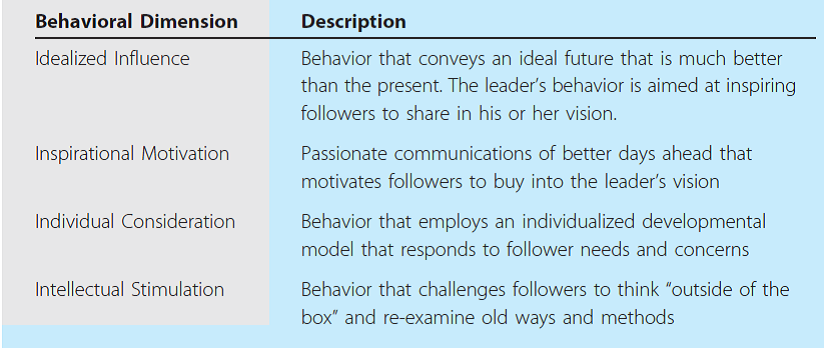
2. Exhibit 9.5 identifies transformational and charismatic leader behaviors. In your opinion, which of the behavioral components does Ms. Burns exemplify?
(Reference Exhibit 9.5)

3. A key attribute of servant leadership is that it transcends self-interest to serve the needs of others. Does Ursula Burns fit this bill?
4. Exhibit 9.4 identifies the qualities of charismatic and transformational leaders. Based on your knowledge of Ms. Burns, which of the 12 qualities can you directly attribute to her?
(Reference Exhibit 9.4)
5. Every leader has a sense of his or her personal meaning, described in the text as the degree to which people's lives make emotional sense and to which the demands confronted by them are perceived as being worthy of energy and commitment Based on the facts of the case, what is/are the sources from which Burns derives her personal meaning? (Note: personal meaning is discussed in the chapter as one of the factors used to differentiate between charismatic and transformational leadership).
C U M U L A T I V E C A S E Q U E S T I O N S
6. According to the leadership continuum model of Tannenbaum and Schmidt, where would you put Ursula Burns based on the facts of the case (see Chapter 5)?
7. Communication is a major competency for leaders (Chapter 6). Would you agree that this is a quality that Burns likely possesses, to have been as effective as she has been so far?
8. Leader-member exchange theory describes the type of relationship that often develops between leaders and followers (Chapter 7). How would you describe the dyadic relationship between Anne Mulcahy and Ursula Burns?
9. One of the characteristics of effective teams is the presence of a capable and competent team leader (Chapter 8). Chapter 8 describes different activities of the team leader in creating an effective team (see Exhibit 8.1 on page 283), including turning obstacles into opportunities. Would you describe Ursula Burns as an effective team leader?
(Reference Exhibit 8.1)

Her elevation marked two milestones: the first time an African-American woman was named CEO of a major American corporation, and the first time a woman succeeded another woman in the top job at a company of this size. 84 Ms. Burns's story is the quintessential tale of the American Dream. She has defied the odds. She was raised in a housing project on Manhattan's Lower East Side by a hard-working single mother who cleaned, ironed, did child care-anything to see that Ursula and her siblings got a good education. She attended an all-girls Catholic High School in New York. he then went on to obtain a BS in Mechanical Engineering from Polytechnic Institute of NYU in 1980 and a master's in Mechanical Engineering from Columbia University a year later.
She joined Xerox as a summer intern in 1980. Ms. Burns, who is now 52, has never been shy about speaking her mind. On more than one occasion, her outspokenness caught the attention of higher-ups in the Xerox corporate office. It's how she ended up working with two of Xerox's former CEOs early on in her career. Referring to Ms. Burns, Mr. Hicks (former CEO) said, "She was enormously curious," she wanted to know why we were doing some things at the time, and she was always prepared in a way that I thought was very refreshing." Her hard work, determination, and dedication paid off. After a number of mid-level assignments, she eventually entered the executive ranks of Xerox. She was named a senior vice president in 2000 and became president of two different business groups over the next two years. Ann Mulcahy, the CEO at the time, told Ursula that she needed her help on the turnaround team. The pair worked closely together for almost a decade in a relationship that both women describe as a true partnership. Ms. Burns was named president of Xerox in 2007, a signal to investors and employees that she was the heir apparent.
African-Americans with Burns's background were not common at Xerox, but she never saw her race or low socioeconomic status as a liability. "My perspective comes in part from being a New York black lady, in part from being an engineer," she said. "I know that I'm smart and have opinions that are worth being heard." When asked who her big influences were before joining Xerox, Ms. Burns had this to say: "150 percent my mother. My mother was pragmatic, focused and exceedingly practical and she was the ultimate selfdetermining person." Burns describes her mother as a value-driven single mother who believed in the mantra, "where you are, is not who you are" and who viewed a good education as a way "up and out." 85
It is obvious that Ms. Burns is not comfortable being in the spotlight or getting all the recognition and praise that the media and others have heaped on her since being named to the top job at Xerox. "The accolades that I get for doing absolutely nothing are amazing-I've been named to every list, literally, since I became the CEO," Ms. Burns says. "In the first 30 days, I was named to a list of the most impressive XYZ. The accolades are good for five minutes, but then it takes kind of a shine off the real story. The real story is not Ursula Burns. I just happen to be the person standing up at this point representing Xerox."
She is taking over at a time when investors are eager to see Xerox build both revenue and earnings. She wants its 130,000 employees to get over the past, take more initiative, and become more fearless. She is encouraging them to take risks but not be reckless. She defines Xerox's culture as one of teamwork and the entrepreneurial spirit. Another contributing factor to Team Xerox's success is a shared vision. As Ms. Burns explains it, "The importance of having the people in the company completely aligned around a common set of goals, and using that alignment to drive a sense of urgency, focus and commitment, is crucial." Imploring all her followers to step up and take more initiative in solving problems, she said, "I cannot be viewed as the solution to all problems in this company." 86,87
About accomplishments that have taken place since she became CEO, such as major product announcements, launches of new businesses, acquisitions, and major operational efficiencies, she said they are all the "collective accomplishments of Team Xerox." This in fact is an example of her modesty and desire to share credit for an action that many analysts and investors criticized her for taking. According to the Wall Street Journal, the cornerstone of Ms. Burns's strategy, which she dubbed Xerox 2010, was the acquisition of Dallas-based service company Affiliated Computer Services (ACS) for $6.4 billion. At the time critics said it was the wrong move because it was too costly in the midst of a recession and too large-ACS had 74,000 employees compared to Xerox's 54,000 at the time. A year later, Ms. Burns is being lauded for the move. The service sector of Xerox is now bringing in nearly half of the company's total revenue. 88
In a recent speech to investors and analysts at the New York Stock Exchange, Ms Burns talked about "the new Xerox." "A lot has changed. We have been working on transforming the company. We're confident we have the right strategy, the competitive advantage and a disciplined focus on executing," she said. She is intent on transforming Xerox into a service-based business. This is a defensive strategy aimed at protecting the Xerox from the growing threat posed by digital technology to its traditional hardware line. 89 There is no doubt that her influence inside and outside Xerox is growing. She was recently named by President Barack Obama to help lead the White House national program on STEM (science, technology, engineering, and math) in November 2009 and was appointed vice chair of the President's Export Council in March 2010.
GO TO THE INTERNET: To learn more about Ursula Burns and Xerox, visit its Web site (http://www.xerox.com)
Support your answers to the following questions with specific information from the case and text or with other information you get from the Web or other sources.
1. In your opinion is Ursula Burns more of a charismatic leader, transformational leader, or both?
2. Exhibit 9.5 identifies transformational and charismatic leader behaviors. In your opinion, which of the behavioral components does Ms. Burns exemplify?
(Reference Exhibit 9.5)
3. A key attribute of servant leadership is that it transcends self-interest to serve the needs of others. Does Ursula Burns fit this bill?
4. Exhibit 9.4 identifies the qualities of charismatic and transformational leaders. Based on your knowledge of Ms. Burns, which of the 12 qualities can you directly attribute to her?
(Reference Exhibit 9.4)
5. Every leader has a sense of his or her personal meaning, described in the text as the degree to which people's lives make emotional sense and to which the demands confronted by them are perceived as being worthy of energy and commitment Based on the facts of the case, what is/are the sources from which Burns derives her personal meaning? (Note: personal meaning is discussed in the chapter as one of the factors used to differentiate between charismatic and transformational leadership).
C U M U L A T I V E C A S E Q U E S T I O N S
6. According to the leadership continuum model of Tannenbaum and Schmidt, where would you put Ursula Burns based on the facts of the case (see Chapter 5)?
7. Communication is a major competency for leaders (Chapter 6). Would you agree that this is a quality that Burns likely possesses, to have been as effective as she has been so far?
8. Leader-member exchange theory describes the type of relationship that often develops between leaders and followers (Chapter 7). How would you describe the dyadic relationship between Anne Mulcahy and Ursula Burns?
9. One of the characteristics of effective teams is the presence of a capable and competent team leader (Chapter 8). Chapter 8 describes different activities of the team leader in creating an effective team (see Exhibit 8.1 on page 283), including turning obstacles into opportunities. Would you describe Ursula Burns as an effective team leader?
(Reference Exhibit 8.1)
التوضيح موثّق
موثّق
موثّق
UB the CEO and the chair woman of Xerox ...

Leadership 5th Edition by Larry Siegel, Robert Lussier, Robert Lussier, Christopher Achua, Christopher Achua

لماذا لم يعجبك هذا التمرين؟
أخرى 8 أحرف كحد أدنى و 255 حرفاً كحد أقصى
حرف 255






