







 تكلم مع الذكاء الاصطناعي


Marketing 16th Edition by William Pride,Ferrell
النسخة 16الرقم المعياري الدولي: 978-1111526191Marketing 16th Edition by William Pride,Ferrell
النسخة 16الرقم المعياري الدولي: 978-1111526191 تمرين 39
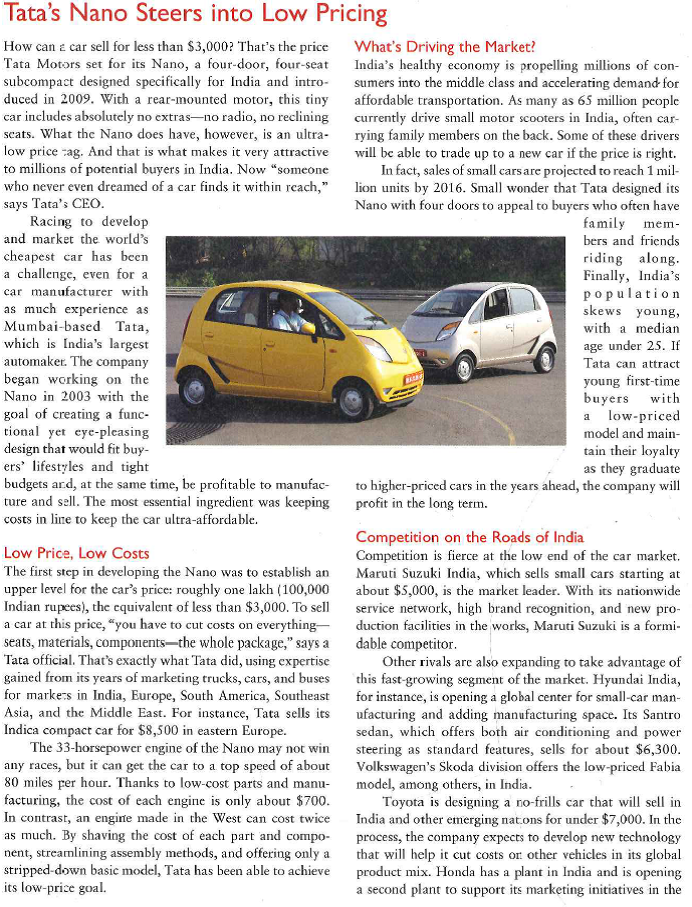
area. Meanwhile, U.S. carmakers are looking at how they might enter the market in the near future.
Renault-Nissan, working with Indian motorcycle manufacturer Bajaj, is developing a car to be priced around $3,000. The company knows a lot about low-cost, low-priced cars because, since 2004, it has produced its popular $7,000 Logan four-door sedan in Romania and Russia. Nearly half a million Logans are already on the roads of Europe, and even though Renault-Nissan's two plants are operating at full capacity all day, every day, the firm is still struggling to meet ever-growing demand.
To shave costs, Renault-Nissan limited the number of parts that go into the Logan and avoided expensive electronics. To speed development and eliminate the high costs of building prototypes, the company proceeded from digital design directly to production. This alone saved $40 million and is one reason for the CEO's confidence that Renault-Nissan can succeed in the worldwide ultra-low-price segment. "With the Logan, we have the product and we have the lead," he says.
Environmental and Safety Concerns
As enthusiastic as Tata and other car manufacturers may be about marketing millions of tiny cars with tiny price tags, the car has generated both environmental and safety concerns. Some critics fear that broadening the base of car ownership will only add to the pollution problems in India's largest cities. Where national and local regulations do not require antipollution devices, manufacturers are unlikely to install them because of the added costs.
Safety is an issue because more cars on the road mean more traffic congestion and more opportunity for accidents. Cars made by Tata and its competitors comply with all of India's safety standards, but those standards do not require equipment, such as air bags and antilock brakes. Safety advocates worry that people traveling in the smallest, lightest cars will be. more vulnerable to serious injury if involved in a traffic accident. For now, the auto-makers are moving ahead as they monitor the issues and stay alert for possible changes in government regulations.
Getting in Gear
Buyers have responded to the Nano's low price tag. Tata received more than 200,000 orders during the 12 months after the car's introduction. Because of limited production capabilities, it had to use a lottery system to select the first 100,000 buyers. Recently, Tata opened a second factory that can produce 250,000 Nanos per year, in an effort to keep up with the expected surge in demand as the Indian economy grows and consumers continue to trade up from motorcycles to cars.
Tata has a long history of good marketing management and above-average profitability. Being based in India gives Tata the advantage of being close to its customers and understanding their needs. And Tata's engineers and designers have found creative ways of containing costs to keep the new car ultra-affordable. With increased competition in the superbudget segment, however, Tata will have to get in gear to keep the Nano ahead of the pack."
1. Which factors seen to have the greatest influence on Tam's decision about pricing its Nano? Explain. 2. What appear to be Tata's primary pricing objectives for the Nano?
3. Assess the level of price competition in India's car industry. What are the implications for Tata's mar-keting?
4. Why must Tata pay close attention to legal and regulatory changes when planning and pricing future models of the Nano?
التوضيح موثّق
موثّق
موثّق
(1)
Factors influencing Company T decisi...

Marketing 16th Edition by William Pride,Ferrell

لماذا لم يعجبك هذا التمرين؟
أخرى 8 أحرف كحد أدنى و 255 حرفاً كحد أقصى
حرف 255






