







 تكلم مع الذكاء الاصطناعي


Marketing 16th Edition by William Pride,Ferrell
النسخة 16الرقم المعياري الدولي: 978-1111526191Marketing 16th Edition by William Pride,Ferrell
النسخة 16الرقم المعياري الدولي: 978-1111526191 تمرين 4
"People against dirty" is the slogan of the San Francisco-based home and body care brand Method. The founders say that they seek not only to clean our homes and bodies, but to remove harmful chemicals from our lives as well. All Method products arc chemical-free and made with natural, safe ingredients. However, Method has not become one of the fastest-growing brands in the United States (sold in more than 2.5,000 retail outlets) by focusing only on a green philosophy. The company has attracted customers with hip, eye-catching packaging and edgy marketing communications in online and traditional media.
Method was founded in 2000 by former roommates and high school friends Adam Lowry and Eric Ryan. Lowry was a chemical engineer who worked as a climatologist for the Carnegie Institute before becoming , Method's "chief greens keeper? Ryan was a marketing expert with experience designing campaigns for The Gap and others.before becoming Method's ".'chief brand architect." Joining forces to help wean people off of the harmful chemicals used to clean homes and bod-.. les, Lowry and Ryan set out to develop products that were effective and natural, as well as packaged in great-looking containers.
Method's concept is not new. Companies such as Seventh Generation have been around for years, but they had difficulty breaking into the main-stream. When choosing distribution channels, Lowry and Ryan decided to steer away from co-ops and health food stores and instead sought mass recognition and distribution at Target, Amazon.com, and other large retailers. To make this channel strategy work, the founders knew that they could not charge the high prices established by other companies marketing eco-friendly cleaning products. They needed to compete head-on with the major cleaning brands.
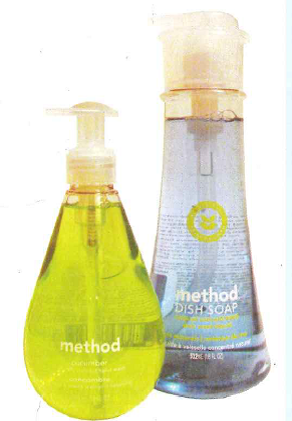
Although they're dedicated to creating products that adhere to strict green standards, Lowry and Ryan agreed from the beginning that taking the green slant would not be the best way to sell their. products. With deep-pocketed rivals such as Procter Gamble and Clorox, the fight to get noticed on the shelf is fierce. This is why packaging has always been a major marketing emphasis for Method.
To help their products stand out, they enlisted designer Karim Rashid (who has also designed for the likes of Prada and Dirt Devil) to create visually appealing packaging. The result is affordable cleaning products in highly attractive, recyclable bottles made from recycled materials. Customers drawn to the product for its looks or the all-natural scents will be purchasing more nonpolluting green products for their home without even knowing it. In the end, Lowry and Ryan want their approach to create a change in perspective among consumers previously uninterested in going green or unable to afford to do so.
In addition, Method has been ahead of the curve in developing new kinds of cleaning products. The company became an industry leader when it created a triple-concentrated laundry detergent long before major companies began doing so. Method has also taken stock of competitive products already on the market and continually works on making its own brand's versions more eco-friendly. Cases in point are dryer sheets and the Omop.
Conventional dryer sheets are coated in beef fat in order to create soft clothing, but this was unacceptable to Lowry. Looking for a vegetarian solution, the company developed dryer sheets coated with canola oil instead. The Omop, Method's answer to the Swifter floor cleaner, is a stylish mop using cloths created from a corn-based plastic product. Unlike Swiffer's cloths, which are synthetic, the Omop's cloths are completely biodegradable.
Now, Method's annual revenues are nearing $100 mil-lion, and the company is using multimedia advertising to turn its brand into a household name. One recent print and online campaign contrasted Method's products and packaging with those of the major brands, urging consumers to "Say no to jugs" (the large containers of detergent marketed by competitors) and "Get off the jugs and get cl6an." The ads communicated the benefits of measuring precise amounts of Method's concentrated detergent from the easy-to-use pump bottle. They also highlighted the eco-friendly, low carbon foot-print of Method's detergent.
Product quality, innovation, value, design, convenience, availability, and competitive advantage have all helped Method grow from a small, unknown company to a profitable mainstream business. Its founders have learned that smart marketing may be the best way to help the environment in the long run. The combination of targeting a fast-growing market segment and cultivating a unique, distinct personality for their green products has allowed Lowry and Ryan to keep Method growing year after year."
I. How has Method implemented the marketing concept?
2. Why is Method successful in a highly competitive industry?
3. Does the success of Method provide insights about the future of green marketing?
Method was founded in 2000 by former roommates and high school friends Adam Lowry and Eric Ryan. Lowry was a chemical engineer who worked as a climatologist for the Carnegie Institute before becoming , Method's "chief greens keeper? Ryan was a marketing expert with experience designing campaigns for The Gap and others.before becoming Method's ".'chief brand architect." Joining forces to help wean people off of the harmful chemicals used to clean homes and bod-.. les, Lowry and Ryan set out to develop products that were effective and natural, as well as packaged in great-looking containers.
Method's concept is not new. Companies such as Seventh Generation have been around for years, but they had difficulty breaking into the main-stream. When choosing distribution channels, Lowry and Ryan decided to steer away from co-ops and health food stores and instead sought mass recognition and distribution at Target, Amazon.com, and other large retailers. To make this channel strategy work, the founders knew that they could not charge the high prices established by other companies marketing eco-friendly cleaning products. They needed to compete head-on with the major cleaning brands.
Although they're dedicated to creating products that adhere to strict green standards, Lowry and Ryan agreed from the beginning that taking the green slant would not be the best way to sell their. products. With deep-pocketed rivals such as Procter Gamble and Clorox, the fight to get noticed on the shelf is fierce. This is why packaging has always been a major marketing emphasis for Method.
To help their products stand out, they enlisted designer Karim Rashid (who has also designed for the likes of Prada and Dirt Devil) to create visually appealing packaging. The result is affordable cleaning products in highly attractive, recyclable bottles made from recycled materials. Customers drawn to the product for its looks or the all-natural scents will be purchasing more nonpolluting green products for their home without even knowing it. In the end, Lowry and Ryan want their approach to create a change in perspective among consumers previously uninterested in going green or unable to afford to do so.
In addition, Method has been ahead of the curve in developing new kinds of cleaning products. The company became an industry leader when it created a triple-concentrated laundry detergent long before major companies began doing so. Method has also taken stock of competitive products already on the market and continually works on making its own brand's versions more eco-friendly. Cases in point are dryer sheets and the Omop.
Conventional dryer sheets are coated in beef fat in order to create soft clothing, but this was unacceptable to Lowry. Looking for a vegetarian solution, the company developed dryer sheets coated with canola oil instead. The Omop, Method's answer to the Swifter floor cleaner, is a stylish mop using cloths created from a corn-based plastic product. Unlike Swiffer's cloths, which are synthetic, the Omop's cloths are completely biodegradable.
Now, Method's annual revenues are nearing $100 mil-lion, and the company is using multimedia advertising to turn its brand into a household name. One recent print and online campaign contrasted Method's products and packaging with those of the major brands, urging consumers to "Say no to jugs" (the large containers of detergent marketed by competitors) and "Get off the jugs and get cl6an." The ads communicated the benefits of measuring precise amounts of Method's concentrated detergent from the easy-to-use pump bottle. They also highlighted the eco-friendly, low carbon foot-print of Method's detergent.
Product quality, innovation, value, design, convenience, availability, and competitive advantage have all helped Method grow from a small, unknown company to a profitable mainstream business. Its founders have learned that smart marketing may be the best way to help the environment in the long run. The combination of targeting a fast-growing market segment and cultivating a unique, distinct personality for their green products has allowed Lowry and Ryan to keep Method growing year after year."
I. How has Method implemented the marketing concept?
2. Why is Method successful in a highly competitive industry?
3. Does the success of Method provide insights about the future of green marketing?
التوضيح موثّق
موثّق
موثّق
Company M implements its marketing conce...

Marketing 16th Edition by William Pride,Ferrell

لماذا لم يعجبك هذا التمرين؟
أخرى 8 أحرف كحد أدنى و 255 حرفاً كحد أقصى
حرف 255






