







 تكلم مع الذكاء الاصطناعي


Economics Today 18th Edition by Roger LeRoy Miller
النسخة 18الرقم المعياري الدولي: 978-0133882285Economics Today 18th Edition by Roger LeRoy Miller
النسخة 18الرقم المعياري الدولي: 978-0133882285 تمرين 2
Purchasing Power Parity in Bus Tickets Eludes Brazilians
Samy Dana, a professor at a business school in Sao Paulo, Brazil, has been evaluating whether concerns about city bus prices expressed by protestors have justification. After examining data provided by the United bank of Switzerland (UBS), Professor Dana has found evidence of a sharp difference in the purchasing power required for fares to ride Brazillian city buses.
UBS has performed purchasing - power - parity conversions of prices of various goods and services, including city bus rides.To measure the purchasing powerrequirements for different items UBS has converted prices paid in national currencies to number of minutes required to earn equivalent amounts of incomes denominated in those currencies.In Mumbai, India, for instance, an average resident must work 3 minutes to earn sufficient wages to pay for a city bus ticket.The purchasing power parity prices are 3 minutes of work in Los Angeles and in Beijing,China, and 5 minutes of work in New York and Paris. in Brazil's two largest cities Sao Paulo and Rio de Janeiro the purchasing - power - parity price is at least twice as high as in these and most other cities around the world , at 10 minutes of work required to generate sufficiebt income to pay bus fares. Thus, when measured in terms of purchasing power incime parities , Brazilian bus rides between two points rank among the most expensive on the planet.
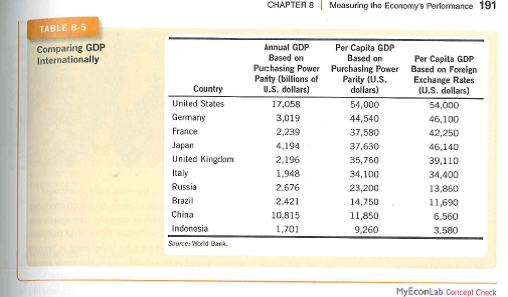
Could the purchasing power parities for per capita real GDP levels in Table 8-5 above be expressed in terms of work time instead of U.S dollars? Explain?
Samy Dana, a professor at a business school in Sao Paulo, Brazil, has been evaluating whether concerns about city bus prices expressed by protestors have justification. After examining data provided by the United bank of Switzerland (UBS), Professor Dana has found evidence of a sharp difference in the purchasing power required for fares to ride Brazillian city buses.
UBS has performed purchasing - power - parity conversions of prices of various goods and services, including city bus rides.To measure the purchasing powerrequirements for different items UBS has converted prices paid in national currencies to number of minutes required to earn equivalent amounts of incomes denominated in those currencies.In Mumbai, India, for instance, an average resident must work 3 minutes to earn sufficient wages to pay for a city bus ticket.The purchasing power parity prices are 3 minutes of work in Los Angeles and in Beijing,China, and 5 minutes of work in New York and Paris. in Brazil's two largest cities Sao Paulo and Rio de Janeiro the purchasing - power - parity price is at least twice as high as in these and most other cities around the world , at 10 minutes of work required to generate sufficiebt income to pay bus fares. Thus, when measured in terms of purchasing power incime parities , Brazilian bus rides between two points rank among the most expensive on the planet.
Could the purchasing power parities for per capita real GDP levels in Table 8-5 above be expressed in terms of work time instead of U.S dollars? Explain?
التوضيح موثّق
موثّق
موثّق
Purchasing power parity is the adjustmen...

Economics Today 18th Edition by Roger LeRoy Miller

لماذا لم يعجبك هذا التمرين؟
أخرى 8 أحرف كحد أدنى و 255 حرفاً كحد أقصى
حرف 255






