



expand icon
book Essential Genetics 6th Edition by Daniel Hartl cover

Essential Genetics 6th Edition by Daniel Hartl

النسخة 6الرقم المعياري الدولي: 978-1449686482
book Essential Genetics 6th Edition by Daniel Hartl cover

Essential Genetics 6th Edition by Daniel Hartl

النسخة 6الرقم المعياري الدولي: 978-1449686482
تمرين 18
A human geneticist discovers the molecular variation in DNA sequence illustrated in the accompanying diagrams of electrophoresis gels. In the human population as a whole, she finds any of four phenotypes, shown in panel A. She believes that this may be a simple genetic polymorphism with three alleles, like the ABO blood groups. There are two alleles that yield DNA fragments of different sizes, fast (F) or slow (S) migration, and a "null" allele (O) in which the DNA fragment is deleted. The genotypes in panel A would therefore be, from left to right, FF or FO, SS or SO, FS, and OO. In the population as a whole, the putative OO genotype is extremely common, and the FS genotype is quite rare. To investigate this hypothesis further, the geneticist studies offspring of matings between parents who have the putative FS genotype (panel B). The types of progeny, and their numbers, are shown in panel C.
(a) What result would be expected from the three-allele hypothesis?
(b) Are the observed data consistent with this result? Why or why not?
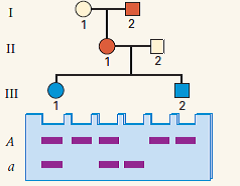
A human geneticist discovers the molecular variation in DNA sequence illustrated in the accompanying diagrams of electrophoresis gels. In the human population as a whole, she finds any of four phenotypes, shown in panel A. She believes that this may be a simple genetic polymorphism with three alleles, like the ABO blood groups. There are two alleles that yield DNA fragments of different sizes, fast (F) or slow (S) migration, and a null allele (O) in which the DNA fragment is deleted. The genotypes in panel A would therefore be, from left to right, FF or FO, SS or SO, FS, and OO. In the population as a whole, the putative OO genotype is extremely common, and the FS genotype is quite rare. To investigate this hypothesis further, the geneticist studies offspring of matings between parents who have the putative FS genotype (panel B). The types of progeny, and their numbers, are shown in panel C.  (a) What result would be expected from the three-allele hypothesis?  (b) Are the observed data consistent with this result? Why or why not?      (c) Suggest a genetic hypothesis that can explain the data in panel C. (d) Are the data consistent with your hypothesis?
(c) Suggest a genetic hypothesis that can explain the data in panel C.
(d) Are the data consistent with your hypothesis?
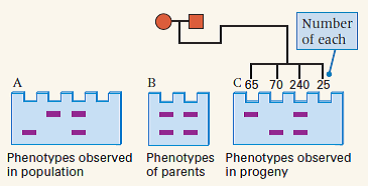
A human geneticist discovers the molecular variation in DNA sequence illustrated in the accompanying diagrams of electrophoresis gels. In the human population as a whole, she finds any of four phenotypes, shown in panel A. She believes that this may be a simple genetic polymorphism with three alleles, like the ABO blood groups. There are two alleles that yield DNA fragments of different sizes, fast (F) or slow (S) migration, and a null allele (O) in which the DNA fragment is deleted. The genotypes in panel A would therefore be, from left to right, FF or FO, SS or SO, FS, and OO. In the population as a whole, the putative OO genotype is extremely common, and the FS genotype is quite rare. To investigate this hypothesis further, the geneticist studies offspring of matings between parents who have the putative FS genotype (panel B). The types of progeny, and their numbers, are shown in panel C.  (a) What result would be expected from the three-allele hypothesis?  (b) Are the observed data consistent with this result? Why or why not?      (c) Suggest a genetic hypothesis that can explain the data in panel C. (d) Are the data consistent with your hypothesis?
التوضيح
موثّق
like image
like image

For this problem, it is proposed that a ...

close menu
Essential Genetics 6th Edition by Daniel Hartl
cross icon

