







 تكلم مع الذكاء الاصطناعي


Business Driven Technology 6th Edition by Paige Baltzan
النسخة 6الرقم المعياري الدولي: 9780073376905Business Driven Technology 6th Edition by Paige Baltzan
النسخة 6الرقم المعياري الدولي: 9780073376905 تمرين 30
The World Is Flat-Thomas Friedman
In his book The World Is Flat, Thomas Friedman describes the unplanned cascade of technological and social shifts that effectively leveled the economic world and "accidentally made Beijing, Bangalore, and Bethesda next-door neighbors." Chances are good that Bhavya in Bangalore will read your next X-ray, or as Friedman learned firsthand, "Grandma Betty in her bathrobe" will make your JetBlue plane reservation from her Salt Lake City home.
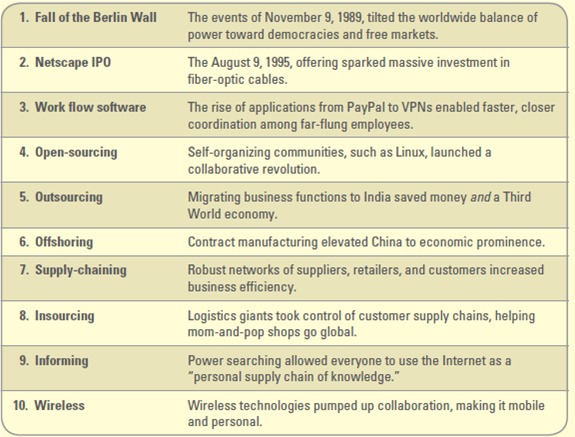
Friedman believes this is Globalization 3.0. "In Globalization 1.0, which began around 1492, the world went from size large to size medium. In Globalization 2.0, the era that introduced us to multinational companies, it went from size medium to size small. And then around 2000 came Globalization 3.0, in which the world went from being small to tiny. There is a difference between being able to make long-distance phone calls cheaper on the Internet and walking around Riyadh with a PDA where you can have all of Google in your pocket. It is a difference in degree that's so enormous it becomes a difference in kind," Friedman states. Figure 1.10 displays Friedman's list of "flatteners."
FIGURE 1.10 Thomas Friedman's 10 Forces That Flattened the World
Friedman says these flatteners converged around the year 2000 and "created a flat world: a global, Web-enabled platform for multiple forms of sharing knowledge and work, irrespective of time, distance, geography, and increasingly, language." At the very moment this platform emerged, three huge economies materialized-those of India, China, and the former Soviet Union-"and 3 billion people who were out of the game, walked onto the playing field." A final convergence may determine the fate of the United States in this chapter of globalization. A "political perfect storm," as Friedman describes it-the dot-com bust, the attacks of 9/11, and the Enron scandal-"distract us completely as a country." Just when we need to face the fact of globalization and the need to compete in a new world, "we're looking totally elsewhere."
Friedman believes that the next great breakthrough in bioscience could come from a 5-year-old who downloads the human genome in Egypt. Bill Gates's view is similar: "Twenty years ago, would you rather have been a B-student in Poughkeepsie or a genius in Shanghai Twenty years ago you'd rather be a B-student in Poughkeepsie. Today, it is not even close. You'd much prefer to be the genius in Shanghai because you can now export your talents anywhere in the world."
Do you agree or disagree with Friedman's assessment that the world is flat Be sure to justify your answer.
In his book The World Is Flat, Thomas Friedman describes the unplanned cascade of technological and social shifts that effectively leveled the economic world and "accidentally made Beijing, Bangalore, and Bethesda next-door neighbors." Chances are good that Bhavya in Bangalore will read your next X-ray, or as Friedman learned firsthand, "Grandma Betty in her bathrobe" will make your JetBlue plane reservation from her Salt Lake City home.
Friedman believes this is Globalization 3.0. "In Globalization 1.0, which began around 1492, the world went from size large to size medium. In Globalization 2.0, the era that introduced us to multinational companies, it went from size medium to size small. And then around 2000 came Globalization 3.0, in which the world went from being small to tiny. There is a difference between being able to make long-distance phone calls cheaper on the Internet and walking around Riyadh with a PDA where you can have all of Google in your pocket. It is a difference in degree that's so enormous it becomes a difference in kind," Friedman states. Figure 1.10 displays Friedman's list of "flatteners."
FIGURE 1.10 Thomas Friedman's 10 Forces That Flattened the World
Friedman says these flatteners converged around the year 2000 and "created a flat world: a global, Web-enabled platform for multiple forms of sharing knowledge and work, irrespective of time, distance, geography, and increasingly, language." At the very moment this platform emerged, three huge economies materialized-those of India, China, and the former Soviet Union-"and 3 billion people who were out of the game, walked onto the playing field." A final convergence may determine the fate of the United States in this chapter of globalization. A "political perfect storm," as Friedman describes it-the dot-com bust, the attacks of 9/11, and the Enron scandal-"distract us completely as a country." Just when we need to face the fact of globalization and the need to compete in a new world, "we're looking totally elsewhere."
Friedman believes that the next great breakthrough in bioscience could come from a 5-year-old who downloads the human genome in Egypt. Bill Gates's view is similar: "Twenty years ago, would you rather have been a B-student in Poughkeepsie or a genius in Shanghai Twenty years ago you'd rather be a B-student in Poughkeepsie. Today, it is not even close. You'd much prefer to be the genius in Shanghai because you can now export your talents anywhere in the world."
Do you agree or disagree with Friedman's assessment that the world is flat Be sure to justify your answer.
التوضيح موثّق
موثّق
موثّق
Introduction
It introduces to the Fried...

Business Driven Technology 6th Edition by Paige Baltzan

لماذا لم يعجبك هذا التمرين؟
أخرى 8 أحرف كحد أدنى و 255 حرفاً كحد أقصى
حرف 255






