







 تكلم مع الذكاء الاصطناعي


Contemporary Engineering Economics 6th Edition by Chan Park
النسخة 6الرقم المعياري الدولي: 978-0134105598Contemporary Engineering Economics 6th Edition by Chan Park
النسخة 6الرقم المعياري الدولي: 978-0134105598 تمرين 13
Fast growth in the population of the city of Orlando and in surrounding counties-Orange County in particular-has resulted in insurmountable traffic congestion. The county has few places to turn for extra money for road improvements-except new taxes. County officials have said that the money they receive from current taxes is insufficient to widen overcrowded roads, improve roads that don't meet modern standards, and pave dirt roads. State residents now pay 12 cents in taxes on every gallon of gas. Four cents of that goes to the federal government, 4 cents to the state, 3 cents to the county in which the tax is collected, and 1 cent to the cities. The county commissioner has suggested that the county get the money by tacking an extra penny-a-gallon tax onto gasoline, bringing the total federal and state gas tax to 13 cents a gallon. This new tax would add about $2.6 million a year to the road-construction budget. The extra money would have a significant impact. With the additional revenue, the county could sell a $24 million bond issue. It would then have the option of spreading that amount among many smaller projects or concentrating on a major project.
Assuming that voters would approve a higher gas tax, county engineers were asked to prepare a priority list outlining which roads would be improved with the extra money. The road engineers also computed the possible public benefits associated with each road-construction project; they accounted for a possible reduction in travel time, a reduction in the accident rate, land appreciation, and savings in the operating costs of vehicles. Table is a list of the projects and their characteristics.
TABLE 1
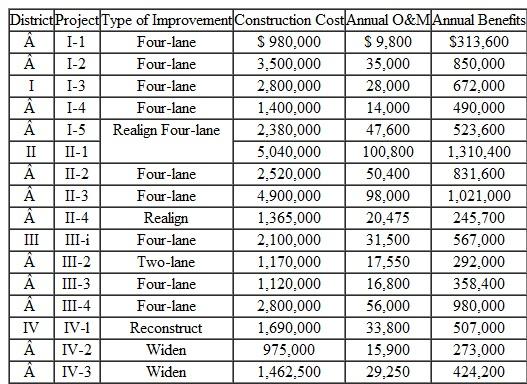 Assume a 20-year planning horizon and an interest rate of 10%. Which projects would be considered for funding in parts (a) and (b)
(a) Due to political pressure, each district will have the same amount of funding, say, $6 million.
(b) The funding will be based on tourist traffic volumes. Districts I and II combined will get $15 million, and Districts III and IV combined will get $9 million. It is desirable to have at least one four-lane project from each district.
Assuming that voters would approve a higher gas tax, county engineers were asked to prepare a priority list outlining which roads would be improved with the extra money. The road engineers also computed the possible public benefits associated with each road-construction project; they accounted for a possible reduction in travel time, a reduction in the accident rate, land appreciation, and savings in the operating costs of vehicles. Table is a list of the projects and their characteristics.
TABLE 1
Assume a 20-year planning horizon and an interest rate of 10%. Which projects would be considered for funding in parts (a) and (b) (a) Due to political pressure, each district will have the same amount of funding, say, $6 million.
(b) The funding will be based on tourist traffic volumes. Districts I and II combined will get $15 million, and Districts III and IV combined will get $9 million. It is desirable to have at least one four-lane project from each district.
التوضيح موثّق
موثّق
موثّق
The sixteenth chapter that is in the tex...

Contemporary Engineering Economics 6th Edition by Chan Park

لماذا لم يعجبك هذا التمرين؟
أخرى 8 أحرف كحد أدنى و 255 حرفاً كحد أقصى
حرف 255






