







 تكلم مع الذكاء الاصطناعي


Contemporary Engineering Economics 6th Edition by Chan Park
النسخة 6الرقم المعياري الدولي: 978-0134105598Contemporary Engineering Economics 6th Edition by Chan Park
النسخة 6الرقم المعياري الدولي: 978-0134105598 تمرين 21
Because of a rapid growth in population, a small town in Pennsylvania is considering several options to establish a wastewater treatment facility that can handle upto a flow of 2 million gallons per day (MGD). The town has five treatment options available.
• Option 1: No action. This option will lead to continued deterioration of the environment. If growth continues and pollution results, fines imposed (as high as $10,000 per day) would soon exceed construction costs.
• Option 2: Land-treatment facility. This option will provide a system for land treatment of the wastewater to be generated over the next 20 years and will require the utilization of the most land for treatment of the wastewater. In addition to the need to find a suitable site, pumping of the waste-water for a considerable distance out of town will be required. The land cost in the area is $3,000 per acre. The system will use spray irrigation to distribute wastewater over the site. No more than 1 inch of wastewater can be applied in one week per acre.
• Option 3: Activated sludge-treatment facility. This option will provide an activated sludge-treatment facility at a site near the planning area. No pumping will be required, and only seven acres of land will be needed for construction of the plant, at a cost of $7,000 per acre.
• Option 4: Trickling filter-treatment facility. Provide a trickling filter-treatment facility at the same site selected for the activated sludge plant of option 3. The land required will be the same as that for option 3. Both facilities will provide similar levels of treatment but will be using different units.
• Option 5: Lagoon-treatment system. Utilize a three-cell lagoon system for treatment. The lagoon system requires substantially more land than options 3 and 4 require but less than option 2. Due to the larger land requirement, this treatment system will have to be located some distance outside of the planning area and will require pumping of the wastewater to reach the site.
TABLE ST 16.2
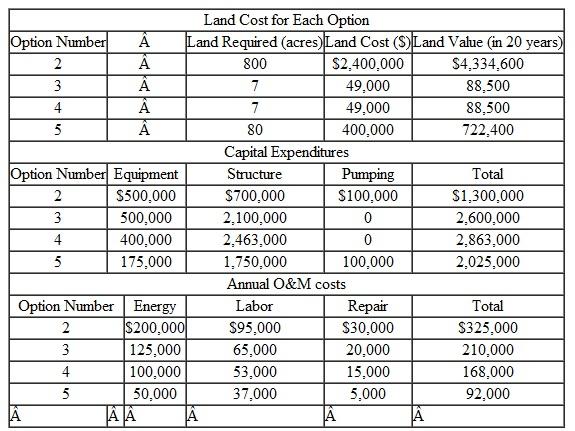
 Table summarizes, respectively, (1) the land cost and land value for each option, (2) the capital expenditures for each option, and (3) the O M costs associated with each option.
TABLE ST 16.3
 The price of land is assumed to be appreciating at an annual rate of 3%, and the equipment installed will require a replacement cycle of 15 years. Its replacement cost will increase at an annual rate of 5% (over the initial cost), and its salvage value at the end of each replacement cycle will be 50% of the original replacement cost. The structure requires replacement after 40 years and will have a salvage value of 60% of the original cost. The cost of energy and repair will increase at an annual rate of 5% and 2%, respectively. The labor cost will increase at an annual rate of 4%.
With the following sets of assumptions, answer parts (a)and(b).
• Assume an analysis period of 120 years.
• Replacement costs for the equipment, as well as for the pumping facilities, will increase at an annual rate of 5%.
• Replacement cost for the structure will remain constant over the planning period. However, the salvage value of the structure will be 60% of the original cost. (Because it has a 40-year replacement cycle, any increase in the future replacement cost will have very little impact on the solution.)
• All O M cost figures are given in today's dollars. For example, the annual energy cost of $200,000 for option 2 means that the actual energy cost during the first operating year will be $200,000(1.05) = $210,000.
• Option 1 is not considered a viable alternative, as its annual operating cost exceeds $3,650,000.
(a) If the interest rate (including inflation) is 10%, which option is the most cost effective
(b) Suppose a household discharges about 400 gallons of wastewater per day through the facility selected in part (a). What should be the monthly bill assessed for this household
• Option 1: No action. This option will lead to continued deterioration of the environment. If growth continues and pollution results, fines imposed (as high as $10,000 per day) would soon exceed construction costs.
• Option 2: Land-treatment facility. This option will provide a system for land treatment of the wastewater to be generated over the next 20 years and will require the utilization of the most land for treatment of the wastewater. In addition to the need to find a suitable site, pumping of the waste-water for a considerable distance out of town will be required. The land cost in the area is $3,000 per acre. The system will use spray irrigation to distribute wastewater over the site. No more than 1 inch of wastewater can be applied in one week per acre.
• Option 3: Activated sludge-treatment facility. This option will provide an activated sludge-treatment facility at a site near the planning area. No pumping will be required, and only seven acres of land will be needed for construction of the plant, at a cost of $7,000 per acre.
• Option 4: Trickling filter-treatment facility. Provide a trickling filter-treatment facility at the same site selected for the activated sludge plant of option 3. The land required will be the same as that for option 3. Both facilities will provide similar levels of treatment but will be using different units.
• Option 5: Lagoon-treatment system. Utilize a three-cell lagoon system for treatment. The lagoon system requires substantially more land than options 3 and 4 require but less than option 2. Due to the larger land requirement, this treatment system will have to be located some distance outside of the planning area and will require pumping of the wastewater to reach the site.
TABLE ST 16.2
Table summarizes, respectively, (1) the land cost and land value for each option, (2) the capital expenditures for each option, and (3) the O M costs associated with each option.TABLE ST 16.3
The price of land is assumed to be appreciating at an annual rate of 3%, and the equipment installed will require a replacement cycle of 15 years. Its replacement cost will increase at an annual rate of 5% (over the initial cost), and its salvage value at the end of each replacement cycle will be 50% of the original replacement cost. The structure requires replacement after 40 years and will have a salvage value of 60% of the original cost. The cost of energy and repair will increase at an annual rate of 5% and 2%, respectively. The labor cost will increase at an annual rate of 4%.With the following sets of assumptions, answer parts (a)and(b).
• Assume an analysis period of 120 years.
• Replacement costs for the equipment, as well as for the pumping facilities, will increase at an annual rate of 5%.
• Replacement cost for the structure will remain constant over the planning period. However, the salvage value of the structure will be 60% of the original cost. (Because it has a 40-year replacement cycle, any increase in the future replacement cost will have very little impact on the solution.)
• All O M cost figures are given in today's dollars. For example, the annual energy cost of $200,000 for option 2 means that the actual energy cost during the first operating year will be $200,000(1.05) = $210,000.
• Option 1 is not considered a viable alternative, as its annual operating cost exceeds $3,650,000.
(a) If the interest rate (including inflation) is 10%, which option is the most cost effective
(b) Suppose a household discharges about 400 gallons of wastewater per day through the facility selected in part (a). What should be the monthly bill assessed for this household
التوضيح موثّق
موثّق
موثّق
The sixteenth chapter that is in the tex...

Contemporary Engineering Economics 6th Edition by Chan Park

لماذا لم يعجبك هذا التمرين؟
أخرى 8 أحرف كحد أدنى و 255 حرفاً كحد أقصى
حرف 255






