







 تكلم مع الذكاء الاصطناعي


Microeconomics 6th Edition by Robert Hall, Shirley Kuiper, Marc Lieberman
النسخة 6الرقم المعياري الدولي: 978-1133708735Microeconomics 6th Edition by Robert Hall, Shirley Kuiper, Marc Lieberman
النسخة 6الرقم المعياري الدولي: 978-1133708735 تمرين 6
Some have argued that the music industry is by nature inefficient because once a piece of music is produced,the firm that owns it has a monopoly and charges the monopoly price. Yet,the marginal cost of making the music available to one more member of the public (via the Internet)is zero. Draw a diagram,similar to Figure 1,to represent this situation. Identify on your diagram:
a. The efficient level of production
b. The level of production a government-regulated music industry would earn if it were permitted to charge just enough for a "fair rate of return"
c. The level of production provided by the (currently unregulated)industry
Figure 1 Regulating a Natural Monopoly
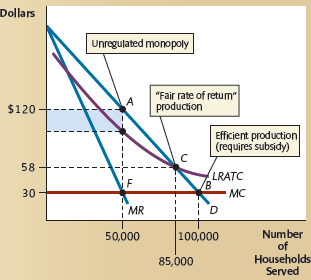
Left unregulated,the cable monopoly would serve 50,000 households,where MC = MR. This is inefficient,because units 50,001 to 100,000 have value to some consumers greater than their marginal cost.
By mandating a price of $30,government regulators could achieve the efficient outcome-100,000 households-at point B. But with price less than LRATC ,the monopoly would suffer a loss,so it would have to be subsidized or go out of business.
The alternative,which is typically chosen,is to set price at $58-the lowest achievable average cost in this market,which includes a "fair rate of return." At this price,the monopoly serves 85,000 households-not quite efficient,but closer than without regulation.
a. The efficient level of production
b. The level of production a government-regulated music industry would earn if it were permitted to charge just enough for a "fair rate of return"
c. The level of production provided by the (currently unregulated)industry
Figure 1 Regulating a Natural Monopoly
Left unregulated,the cable monopoly would serve 50,000 households,where MC = MR. This is inefficient,because units 50,001 to 100,000 have value to some consumers greater than their marginal cost.
By mandating a price of $30,government regulators could achieve the efficient outcome-100,000 households-at point B. But with price less than LRATC ,the monopoly would suffer a loss,so it would have to be subsidized or go out of business.
The alternative,which is typically chosen,is to set price at $58-the lowest achievable average cost in this market,which includes a "fair rate of return." At this price,the monopoly serves 85,000 households-not quite efficient,but closer than without regulation.
التوضيح موثّق
موثّق
موثّق
Music industry is necessarily described ...

Microeconomics 6th Edition by Robert Hall, Shirley Kuiper, Marc Lieberman

لماذا لم يعجبك هذا التمرين؟
أخرى 8 أحرف كحد أدنى و 255 حرفاً كحد أقصى
حرف 255






