







 تكلم مع الذكاء الاصطناعي


Principles of Environmental Science 7th Edition by William Cunningham,Mary Cunningham
النسخة 7الرقم المعياري الدولي: 978-0071314947Principles of Environmental Science 7th Edition by William Cunningham,Mary Cunningham
النسخة 7الرقم المعياري الدولي: 978-0071314947 تمرين 9
Which wavelengths do our eyes respond to, and why? (Refer to fig) About how long are short ultraviolet wavelengths compared to microwave lengths?
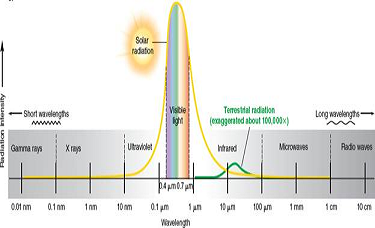
FIGURE The electromagnetic spectrum. Our eyes are sensitive to visible-light wavelengths, which make up nearly half the energy that reaches the earth's surface (represented by the area under the "solar radiation" curve). Photosynthesizing plants use the most abundant solar wavelengths (light and infrared). The earth reemits lower-energy, longer wavelengths (shown by the "terrestrial radiation" curve), mainly the infrared part of the spectrum.
FIGURE The electromagnetic spectrum. Our eyes are sensitive to visible-light wavelengths, which make up nearly half the energy that reaches the earth's surface (represented by the area under the "solar radiation" curve). Photosynthesizing plants use the most abundant solar wavelengths (light and infrared). The earth reemits lower-energy, longer wavelengths (shown by the "terrestrial radiation" curve), mainly the infrared part of the spectrum.
التوضيح موثّق
موثّق
موثّق
Our eyes can see the visible light from ...

Principles of Environmental Science 7th Edition by William Cunningham,Mary Cunningham

لماذا لم يعجبك هذا التمرين؟
أخرى 8 أحرف كحد أدنى و 255 حرفاً كحد أقصى
حرف 255






