







 تكلم مع الذكاء الاصطناعي



The Living World 6th Edition by George Johnson, Jonathan Losos,William Ober,Claire Garrison
النسخة 6الرقم المعياري الدولي: 978-0077280086The Living World 6th Edition by George Johnson, Jonathan Losos,William Ober,Claire Garrison
النسخة 6الرقم المعياري الدولي: 978-0077280086 تمرين 14
Using Radioactive Decay to Date the Iceman
In the fall of 1991, sticking out of the melting snow on the crest of a high pass near the mountainous border between Italy and Austria, two Austrian hikers found a corpse. Right away it was clear the body was very old, frozen in an icy trench where he had sought shelter long ago and only now released as the ice melted. In the years since this startling find, scientists have learned a great deal about the dead man, who they named Ötzi. They know his age, his health, the shoes and clothing he wore, what he ate, and that he died from an arrow that ripped through his back. Its tip is still embedded in the back of his left shoulder. From the distribution of chemicals in his teeth and bones, we know he lived his life within 60 kilometers of where he died. How long ago did this Iceman die Scientists answered this key question by measuring the degree of decay of the short-lived carbon isotope 14 C in Ötzi's body. This procedure is discussed earlier in this chapter (see figure 3.8). The graph to the right displays the radioactive decay curve of the carbon isotope carbon-14 ( 14 C); it takes 5,730 years for half of the 14C present in a sample to decay to nitrogen-14 ( 14 N). When Ötzi's carbon isotopes were analyzed, researchers determined that the ratio of 14 C to 12 C (a ratio is the size of one variable relative to another), also written as the fraction 14 C/ 12 C, in Ötzi's body is 0.435 of the fraction found in tissues of a person who has recently died.
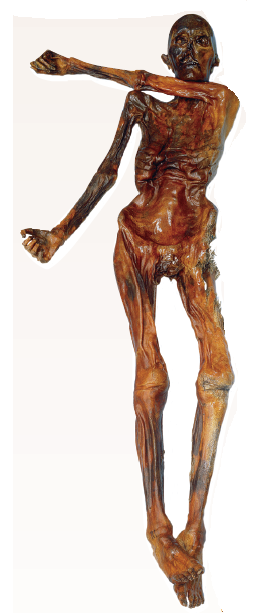
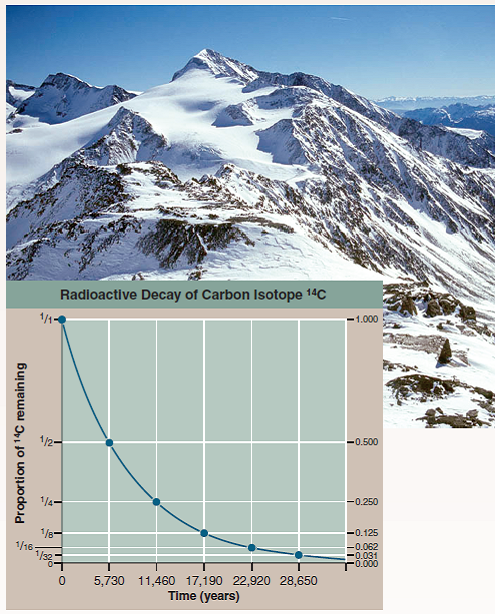
Figure 3.8
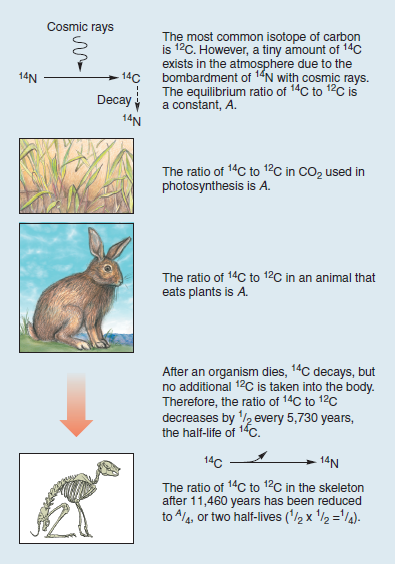
Figure 3.8 Radioactive isotope dating. This diagram illustrates radioactive dating using carbon-14, a short-lived isotope.
Applying Concepts
a. Variable. In the graph, what is the dependent variable
b. Proportion. What proportion (a proportion is the size of a variable relative to the whole) of the 14 C present in Ötzi's body when he died is still there today
In the fall of 1991, sticking out of the melting snow on the crest of a high pass near the mountainous border between Italy and Austria, two Austrian hikers found a corpse. Right away it was clear the body was very old, frozen in an icy trench where he had sought shelter long ago and only now released as the ice melted. In the years since this startling find, scientists have learned a great deal about the dead man, who they named Ötzi. They know his age, his health, the shoes and clothing he wore, what he ate, and that he died from an arrow that ripped through his back. Its tip is still embedded in the back of his left shoulder. From the distribution of chemicals in his teeth and bones, we know he lived his life within 60 kilometers of where he died. How long ago did this Iceman die Scientists answered this key question by measuring the degree of decay of the short-lived carbon isotope 14 C in Ötzi's body. This procedure is discussed earlier in this chapter (see figure 3.8). The graph to the right displays the radioactive decay curve of the carbon isotope carbon-14 ( 14 C); it takes 5,730 years for half of the 14C present in a sample to decay to nitrogen-14 ( 14 N). When Ötzi's carbon isotopes were analyzed, researchers determined that the ratio of 14 C to 12 C (a ratio is the size of one variable relative to another), also written as the fraction 14 C/ 12 C, in Ötzi's body is 0.435 of the fraction found in tissues of a person who has recently died.
Figure 3.8
Figure 3.8 Radioactive isotope dating. This diagram illustrates radioactive dating using carbon-14, a short-lived isotope.
Applying Concepts
a. Variable. In the graph, what is the dependent variable
b. Proportion. What proportion (a proportion is the size of a variable relative to the whole) of the 14 C present in Ötzi's body when he died is still there today
التوضيح موثّق
موثّق
موثّق
Variables are known as tools to do resea...

The Living World 6th Edition by George Johnson, Jonathan Losos,William Ober,Claire Garrison

لماذا لم يعجبك هذا التمرين؟
أخرى 8 أحرف كحد أدنى و 255 حرفاً كحد أقصى
حرف 255






