







 تكلم مع الذكاء الاصطناعي


The Living World 6th Edition by George Johnson, Jonathan Losos,William Ober,Claire Garrison
النسخة 6الرقم المعياري الدولي: 978-0077280086The Living World 6th Edition by George Johnson, Jonathan Losos,William Ober,Claire Garrison
النسخة 6الرقم المعياري الدولي: 978-0077280086 تمرين 19
Does Iron Limit the Growth of Ocean Phytoplankton
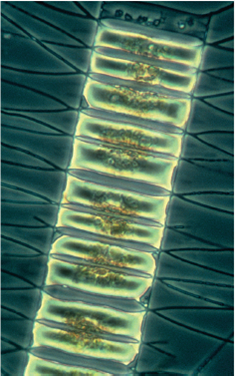
Phytoplankton are microscopic organisms that live in the oceans, carrying out much of the earth's photosynthesis. The photo below is of Chaetoceros, a phytoplankton. Decades ago, scientists noticed "dead zones" in the ocean where little photosynthesis occurred. Looking more closely, they found that phytoplankton collected from these waters are not able to efficiently fix CO2into carbohydrates. In an attempt to understand why not, the scientists hypothesized that lack of iron (needed by the ETS) was the problem, and predicted that fertilizing these ocean waters with iron could trigger an explosively rapid growth of phytoplankton.
To test this idea, they carried out a field experiment, seeding large areas of phytoplankton-poor ocean waters with iron crystals to see if this triggered phytoplankton growth. Other similarly phytoplanktonpoor areas of ocean were not seeded with iron and served as controls.
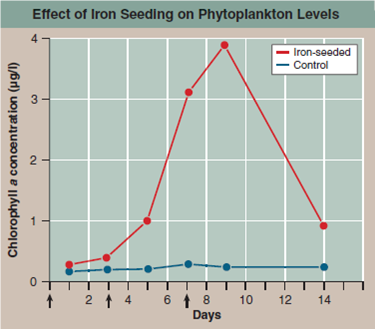
In one such experiment, the results of which are presented in the graph to the right, a 72-km 2 grid of phytoplankton-deficient ocean water was seeded with iron crystals and a tracer substance in three successive treatments, indicated with arrows on the x axis of the graph (on days 0, 3, and 7). The multiple seedings were carried out to reduce the effect of the iron crystals dissipating over time. A smaller control grid, 24 km 2 , was seeded with just the tracer substance.
To assess the numbers of phytoplankton organisms carrying out photosynthesis in the ocean water, investigators did not actually count organisms. Instead, they estimated the amount of chlorophyll a in water samples as an easier-to-measure index. An index is a parameter that accurately reflects the quantity of another less-easily-measured parameter. In this instance, the level of chlorophyll a , easily measured by monitoring the wavelengths of light absorbed by a liquid sample, is a suitable index of phytoplankton, as this pigment is found nowhere else in the ocean other than within phytoplankton.
Chlorophyll a measurements were made periodically on both test and control grids for 14 days. The results are plotted on the graph. Red points indicate chlorophyll a concentrations in iron-seeded waters; blue points indicate chlorophyll a levels in the control grid waters that were not seeded.
Interpreting Data
a. What happened to the levels of chlorophyll a in the test areas of the ocean (red dots)
b. What happened to the levels of chlorophyll a in the control areas (blue dots)
c. Comparing the red line to the blue line, about how many times more numerous are phytoplankton in iron-seeded waters on the three days of seeding
Phytoplankton are microscopic organisms that live in the oceans, carrying out much of the earth's photosynthesis. The photo below is of Chaetoceros, a phytoplankton. Decades ago, scientists noticed "dead zones" in the ocean where little photosynthesis occurred. Looking more closely, they found that phytoplankton collected from these waters are not able to efficiently fix CO2into carbohydrates. In an attempt to understand why not, the scientists hypothesized that lack of iron (needed by the ETS) was the problem, and predicted that fertilizing these ocean waters with iron could trigger an explosively rapid growth of phytoplankton.
To test this idea, they carried out a field experiment, seeding large areas of phytoplankton-poor ocean waters with iron crystals to see if this triggered phytoplankton growth. Other similarly phytoplanktonpoor areas of ocean were not seeded with iron and served as controls.
In one such experiment, the results of which are presented in the graph to the right, a 72-km 2 grid of phytoplankton-deficient ocean water was seeded with iron crystals and a tracer substance in three successive treatments, indicated with arrows on the x axis of the graph (on days 0, 3, and 7). The multiple seedings were carried out to reduce the effect of the iron crystals dissipating over time. A smaller control grid, 24 km 2 , was seeded with just the tracer substance.
To assess the numbers of phytoplankton organisms carrying out photosynthesis in the ocean water, investigators did not actually count organisms. Instead, they estimated the amount of chlorophyll a in water samples as an easier-to-measure index. An index is a parameter that accurately reflects the quantity of another less-easily-measured parameter. In this instance, the level of chlorophyll a , easily measured by monitoring the wavelengths of light absorbed by a liquid sample, is a suitable index of phytoplankton, as this pigment is found nowhere else in the ocean other than within phytoplankton.
Chlorophyll a measurements were made periodically on both test and control grids for 14 days. The results are plotted on the graph. Red points indicate chlorophyll a concentrations in iron-seeded waters; blue points indicate chlorophyll a levels in the control grid waters that were not seeded.
Interpreting Data
a. What happened to the levels of chlorophyll a in the test areas of the ocean (red dots)
b. What happened to the levels of chlorophyll a in the control areas (blue dots)
c. Comparing the red line to the blue line, about how many times more numerous are phytoplankton in iron-seeded waters on the three days of seeding
التوضيح موثّق
موثّق
موثّق
Chlorophyll is the green photosynthetic ...

The Living World 6th Edition by George Johnson, Jonathan Losos,William Ober,Claire Garrison

لماذا لم يعجبك هذا التمرين؟
أخرى 8 أحرف كحد أدنى و 255 حرفاً كحد أقصى
حرف 255






