







 تكلم مع الذكاء الاصطناعي



The Living World 6th Edition by George Johnson, Jonathan Losos,William Ober,Claire Garrison
النسخة 6الرقم المعياري الدولي: 978-0077280086The Living World 6th Edition by George Johnson, Jonathan Losos,William Ober,Claire Garrison
النسخة 6الرقم المعياري الدولي: 978-0077280086 تمرين 14
Are Mutations Random or Directed By the Environment
Once biologists appreciated that Mendelian traits were in fact alternative versions of DNA sequences, which resulted from mutations, a very important question arose and needed to be answered-Are mutations random events that might happen anywhere on the DNA in a chromosome, or are they directed to some degree by the environment Do the mutagens in cigarettes, for example, damage DNA at random locations, or do they preferentially seek out and alter specific sites such as those regulating the cell cycle
This key question was addressed and answered in an elegant, deceptively simple experiment carried out in 1943 by two of the pioneers of molecular genetics, Salvadore Luria and Max Delbruck. They chose to examine a particular mutation that occurs in laboratory strains of the bacterium E. coli. These bacterial cells are susceptible to T1 viruses, tiny chemical parasites that infect, multiply within, and kill the bacteria. If 10 5 bacterial cells are exposed to 10 10 T1 viruses, and the mixture spread on a culture dish, not one cell grows-every single E. coli cell is infected and killed. However, if you repeat the experiment using 10 9 bacterial cells, lots of cells survive! When tested, these surviving cells prove to be mutants, resistant to T1 infection. The question is, did the T1 virus cause the mutations, or were they present all along, too rare to be present in a sample of only 10 5 cells but common enough to be present in 10 9 cells
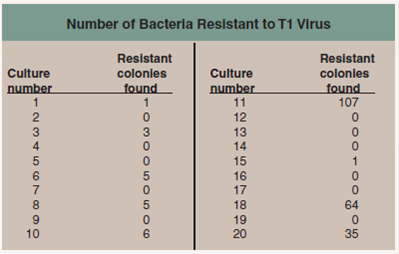
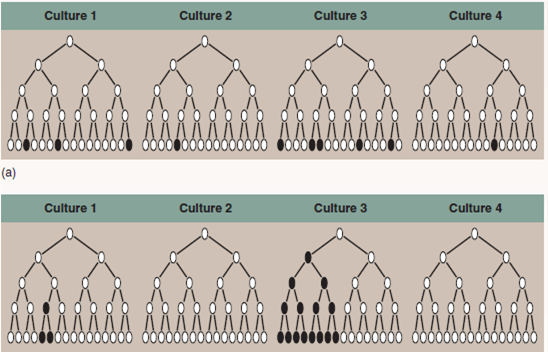
To answer this question, Luria and Delbruck devised a simple experiment they called a "fluctuation test," illustrated here. Five cell generations are shown for each of four independent bacterial cultures, all tested for resistance in the fifth generation. If the T1 virus causes the mutations (top row), then each culture will have more or less the same number of resistant cells, with only a little fluctuation (that is, variation among the four). If, on the other hand, mutations are spontaneous and so equally likely to occur in any generation, then bacterial cultures in which the T1-resistance mutation occurs in earlier generations will possess far more resistant cells by the fifth generation than cultures in which the mutation occurs in later generations, resulting in wide fluctuation among the four cultures. The table presents the data they obtained for 20 individual cultures.
Interpreting Data What is the mean number of T1 resistant colonies found in the 20 individual cultures
Once biologists appreciated that Mendelian traits were in fact alternative versions of DNA sequences, which resulted from mutations, a very important question arose and needed to be answered-Are mutations random events that might happen anywhere on the DNA in a chromosome, or are they directed to some degree by the environment Do the mutagens in cigarettes, for example, damage DNA at random locations, or do they preferentially seek out and alter specific sites such as those regulating the cell cycle
This key question was addressed and answered in an elegant, deceptively simple experiment carried out in 1943 by two of the pioneers of molecular genetics, Salvadore Luria and Max Delbruck. They chose to examine a particular mutation that occurs in laboratory strains of the bacterium E. coli. These bacterial cells are susceptible to T1 viruses, tiny chemical parasites that infect, multiply within, and kill the bacteria. If 10 5 bacterial cells are exposed to 10 10 T1 viruses, and the mixture spread on a culture dish, not one cell grows-every single E. coli cell is infected and killed. However, if you repeat the experiment using 10 9 bacterial cells, lots of cells survive! When tested, these surviving cells prove to be mutants, resistant to T1 infection. The question is, did the T1 virus cause the mutations, or were they present all along, too rare to be present in a sample of only 10 5 cells but common enough to be present in 10 9 cells
To answer this question, Luria and Delbruck devised a simple experiment they called a "fluctuation test," illustrated here. Five cell generations are shown for each of four independent bacterial cultures, all tested for resistance in the fifth generation. If the T1 virus causes the mutations (top row), then each culture will have more or less the same number of resistant cells, with only a little fluctuation (that is, variation among the four). If, on the other hand, mutations are spontaneous and so equally likely to occur in any generation, then bacterial cultures in which the T1-resistance mutation occurs in earlier generations will possess far more resistant cells by the fifth generation than cultures in which the mutation occurs in later generations, resulting in wide fluctuation among the four cultures. The table presents the data they obtained for 20 individual cultures.
Interpreting Data What is the mean number of T1 resistant colonies found in the 20 individual cultures
التوضيح موثّق
موثّق
موثّق
The mean of a certain number of observat...

The Living World 6th Edition by George Johnson, Jonathan Losos,William Ober,Claire Garrison

لماذا لم يعجبك هذا التمرين؟
أخرى 8 أحرف كحد أدنى و 255 حرفاً كحد أقصى
حرف 255






