







 تكلم مع الذكاء الاصطناعي



The Living World 6th Edition by George Johnson, Jonathan Losos,William Ober,Claire Garrison
النسخة 6الرقم المعياري الدولي: 978-0077280086The Living World 6th Edition by George Johnson, Jonathan Losos,William Ober,Claire Garrison
النسخة 6الرقم المعياري الدولي: 978-0077280086 تمرين 20
Does Water Move Up a Tree Through Phloem or Xylem
Before reading this chapter, you may have wondered how water gets to the top of a tree, 10 stories above its roots. A column of water that tall weighs an awful lot. If you were to make a tube of drinking straws that tall and fill it with water, you would not be able to lift it. The answer to this puzzle was first proposed by biologist Otto Renner in Germany in 1911. He suggested that dry air moving across the tree's leaves captured water molecules by evaporation, and that this water was replaced with other water molecules coming in from the roots. Renner's idea, which was essentially correct, forms the core of the cohensionadhesion- tension theory described in this chapter. Essential to the theory is that there is an unbroken water column from leaves to roots, a "pipe" from top to bottom through which the water can move freely.
There are two candidates for the role of water pipe, each a long series of narrow vessels that runs the length of the stem of a tree. As you have learned earlier, these two vessel systems are called xylem and phloem. In principle, either xylem or phloem could provide the plumbing through which water moves up a tree trunk or other stem. Which is it
An elegant experiment demonstrates which of these vessel systems carries water up a tree stem. The bottom end of a stem was placed in water containing the radioactive potassium isotope 42 K. A piece of wax paper was carefully inserted between the xylem and the phloem in a 23-cm section of the stem to prevent any lateral transport of water between xylem and phloem.
After enough time had elapsed to allow water movement up the stem, a 23-cm section of the stem was removed, cut into six segments, and the amounts of 42 K measured both in the xylem and in the phloem of each segment, as well as in the stem immediately above and below the 23-cm section. The amount of radioactivity recorded provides a direct measure of the amount of water that has moved up from the bottom of the stem through either the xylem or phloem. The results are presented in the graph above on the right.
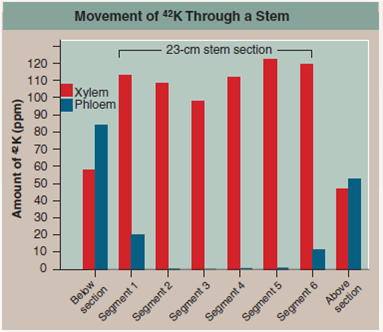
Drawing Conclusions Does water move up a stem through phloem or xylem Explain.
Before reading this chapter, you may have wondered how water gets to the top of a tree, 10 stories above its roots. A column of water that tall weighs an awful lot. If you were to make a tube of drinking straws that tall and fill it with water, you would not be able to lift it. The answer to this puzzle was first proposed by biologist Otto Renner in Germany in 1911. He suggested that dry air moving across the tree's leaves captured water molecules by evaporation, and that this water was replaced with other water molecules coming in from the roots. Renner's idea, which was essentially correct, forms the core of the cohensionadhesion- tension theory described in this chapter. Essential to the theory is that there is an unbroken water column from leaves to roots, a "pipe" from top to bottom through which the water can move freely.
There are two candidates for the role of water pipe, each a long series of narrow vessels that runs the length of the stem of a tree. As you have learned earlier, these two vessel systems are called xylem and phloem. In principle, either xylem or phloem could provide the plumbing through which water moves up a tree trunk or other stem. Which is it
An elegant experiment demonstrates which of these vessel systems carries water up a tree stem. The bottom end of a stem was placed in water containing the radioactive potassium isotope 42 K. A piece of wax paper was carefully inserted between the xylem and the phloem in a 23-cm section of the stem to prevent any lateral transport of water between xylem and phloem.
After enough time had elapsed to allow water movement up the stem, a 23-cm section of the stem was removed, cut into six segments, and the amounts of 42 K measured both in the xylem and in the phloem of each segment, as well as in the stem immediately above and below the 23-cm section. The amount of radioactivity recorded provides a direct measure of the amount of water that has moved up from the bottom of the stem through either the xylem or phloem. The results are presented in the graph above on the right.
Drawing Conclusions Does water move up a stem through phloem or xylem Explain.
التوضيح موثّق
موثّق
موثّق
The shape of xylem is like star. Trachei...

The Living World 6th Edition by George Johnson, Jonathan Losos,William Ober,Claire Garrison

لماذا لم يعجبك هذا التمرين؟
أخرى 8 أحرف كحد أدنى و 255 حرفاً كحد أقصى
حرف 255






