







 تكلم مع الذكاء الاصطناعي


The Living World 6th Edition by George Johnson, Jonathan Losos,William Ober,Claire Garrison
النسخة 6الرقم المعياري الدولي: 978-0077280086The Living World 6th Edition by George Johnson, Jonathan Losos,William Ober,Claire Garrison
النسخة 6الرقم المعياري الدولي: 978-0077280086 تمرين 15
Punctuated Equilibrium: Evaluating a Case History
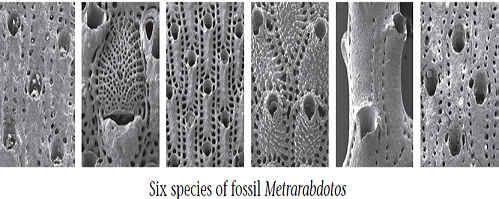
Biologists have long argued over the rate at which evolution occurs. As you read in chapter 17 (section 17.1, under "The Rate of Evolution"), some organisms appear to have evolved gradually (gradualism), while in others evolution seems to have occurred in spurts (punctuated equilibrium). There is evidence of both patterns in the fossil record. Perhaps the most famous claim of punctuated equilibrium has been made by researchers studying the fossil record of marine bryozoans. Bryozoans are microscopic aquatic animals that form branching colonies. You encountered them earlier in this chapter as lophophorates. The fossil record is particularly well documented for Caribbean bryozoan species of the genus Metrarabdotos, whose fossil record extends back more than 15 million years without interruption (a fossil is the mineralized stonelike remains of a long-dead organism; a fossil record is the total collection of fossils of that particular kind of organism known to science).
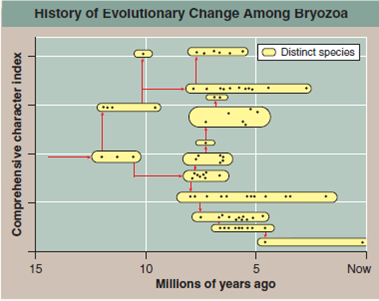
The graph to the upper right displays an analysis of the Metrarabdotos fossil record. Researchers fi rst formulated a comprehensive character index based upon a broad array of bryozoan traits. (A character index is a number assigned to a specimen based on its morphology. Different characteristics are measured and assigned quantitative values, and the character index is determined by adding together the individual character values that apply to the specimen. The closer the character indices are for two specimens, the more closely related they are.) Then each fossil is measured for all of the traits. They then calculated the index number for that fossil and plotted it on the graph as a black dot. Each cluster of dots within an oval represents a distinct species.
Applying Concepts
a. Variable. In the diagram, is there a dependent variable If so, what is it
b. Analyzing Diagrams. How many different species are included in the study illustrated by this diagram How many of these are extinct
Biologists have long argued over the rate at which evolution occurs. As you read in chapter 17 (section 17.1, under "The Rate of Evolution"), some organisms appear to have evolved gradually (gradualism), while in others evolution seems to have occurred in spurts (punctuated equilibrium). There is evidence of both patterns in the fossil record. Perhaps the most famous claim of punctuated equilibrium has been made by researchers studying the fossil record of marine bryozoans. Bryozoans are microscopic aquatic animals that form branching colonies. You encountered them earlier in this chapter as lophophorates. The fossil record is particularly well documented for Caribbean bryozoan species of the genus Metrarabdotos, whose fossil record extends back more than 15 million years without interruption (a fossil is the mineralized stonelike remains of a long-dead organism; a fossil record is the total collection of fossils of that particular kind of organism known to science).
The graph to the upper right displays an analysis of the Metrarabdotos fossil record. Researchers fi rst formulated a comprehensive character index based upon a broad array of bryozoan traits. (A character index is a number assigned to a specimen based on its morphology. Different characteristics are measured and assigned quantitative values, and the character index is determined by adding together the individual character values that apply to the specimen. The closer the character indices are for two specimens, the more closely related they are.) Then each fossil is measured for all of the traits. They then calculated the index number for that fossil and plotted it on the graph as a black dot. Each cluster of dots within an oval represents a distinct species.
Applying Concepts
a. Variable. In the diagram, is there a dependent variable If so, what is it
b. Analyzing Diagrams. How many different species are included in the study illustrated by this diagram How many of these are extinct
التوضيح موثّق
موثّق
موثّق
Evolutionary changes have been going on ...

The Living World 6th Edition by George Johnson, Jonathan Losos,William Ober,Claire Garrison

لماذا لم يعجبك هذا التمرين؟
أخرى 8 أحرف كحد أدنى و 255 حرفاً كحد أقصى
حرف 255






