expand icon
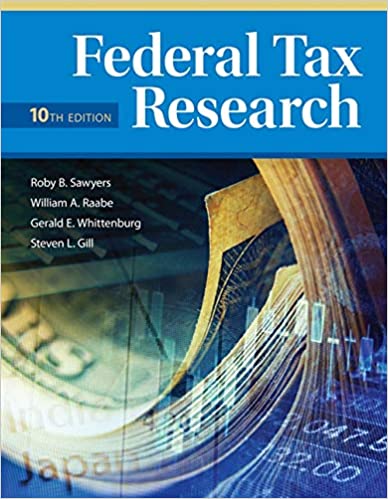
book Federal Tax Research 10th Edition by Steven Gill, Gerald Whittenburg, Roby Sawyers, Debra Sanders, William Raabe cover

Federal Tax Research 10th Edition by Steven Gill, Gerald Whittenburg, Roby Sawyers, Debra Sanders, William Raabe

النسخة 10الرقم المعياري الدولي: 9781285439396
book Federal Tax Research 10th Edition by Steven Gill, Gerald Whittenburg, Roby Sawyers, Debra Sanders, William Raabe cover

Federal Tax Research 10th Edition by Steven Gill, Gerald Whittenburg, Roby Sawyers, Debra Sanders, William Raabe

النسخة 10الرقم المعياري الدولي: 9781285439396
تمرين 3
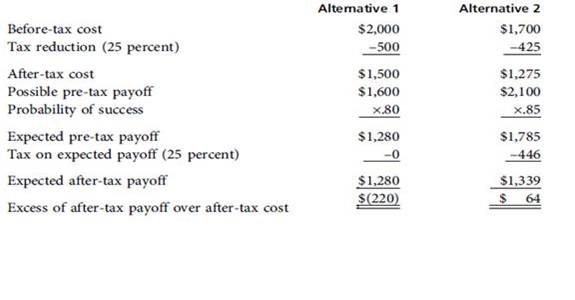
Examples 12-2 and 12-3 in this chapter concern a decision between the same two mutually exclusive alternatives under identical conditions, except for the corporation's marginal tax rate. In Example 12-2, in which the marginal tax rate was 40 percent, the conclusion was to accept Alternative 1. In Example 12-3, in which the marginal tax rate was 25 percent, the conclusion was to accept Alternative 2. Determine the marginal tax rate at which the two alternatives would be economic equivalents; i.e., they would "break even" and generate the same excess after-tax payoff over after-tax cost. Your answer should be based on all conditions and assumptions stated in Examples 12-2 and 12-3.
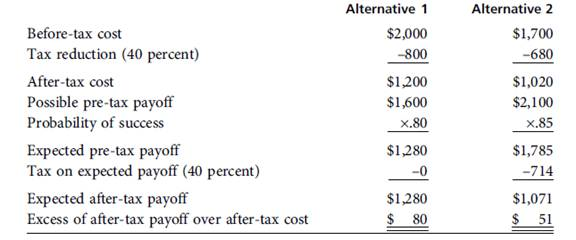
Examples 12-2 and 12-3 in this chapter concern a decision between the same two mutually exclusive alternatives under identical conditions, except for the corporation's marginal tax rate. In Example 12-2, in which the marginal tax rate was 40 percent, the conclusion was to accept Alternative 1. In Example 12-3, in which the marginal tax rate was 25 percent, the conclusion was to accept Alternative 2. Determine the marginal tax rate at which the two alternatives would be economic equivalents; i.e., they would break even and generate the same excess after-tax payoff over after-tax cost. Your answer should be based on all conditions and assumptions stated in Examples 12-2 and 12-3.
التوضيح
موثّق
like image
like image

Economics of Tax Planning
The tax plann...

close menu
Federal Tax Research 10th Edition by Steven Gill, Gerald Whittenburg, Roby Sawyers, Debra Sanders, William Raabe
cross icon