







 تكلم مع الذكاء الاصطناعي


Campbell Biology 11th Edition by Lisa Urry,Michael Cain,Steven Wasserman,Peter Minorsky,Jane Reece
النسخة 11الرقم المعياري الدولي: 978-0134093413Campbell Biology 11th Edition by Lisa Urry,Michael Cain,Steven Wasserman,Peter Minorsky,Jane Reece
النسخة 11الرقم المعياري الدولي: 978-0134093413 تمرين 16
Working with Moles and Molar Ratios
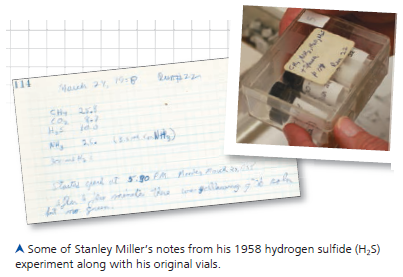
Could the First Biological Molecules Have Formed Near Volcanoes on Early Earth In 2007, Jeffrey Bada, a former graduate student of Stanley Miller, discovered some vials of samples that had never been analyzed from an experiment performed by Miller in 1958. In that experiment, Miller used hydrogen sulfide gas (H₂ S) as one of the gases in the reactant mixture. Since H₂ S is released by volcanoes, the H₂ S experiment was designed to mimic conditions near volcanoes on early Earth. In 2011, Bada and colleagues published the results of their analysis of these "lost" samples. In this exercise, you will make calculations using the molar ratios of reactants and products from the H₂ S experiment.
How the Experiment Was Done According to his laboratory notebook, Miller used the same apparatus as in his original experiment (see Figure 4.2), but the mixture of gaseous reactants included methane (CH₄), carbon dioxide (CO₂ ), hydrogen sulfide (H₂ S), and ammonia (NH 3 ). After three days of simulated volcanic activity, he collected samples of the liquid, partially purified the chemicals, and sealed the samples in sterile vials. In 2011, Bada's research team used modern analytical methods to analyze the products in the vials for the presence of amino acids, the building blocks of proteins.
Data from the Experiment The table below shows 4 of the 23 amino acids detected in the 2011 analysis of the samples from Miller's 1958 H₂ S experiment.
The earlier published experiment carried out by Miller did not include H₂ S in the reactants (see Figure 4.2). Which of the compounds shown in the data table can be made in the H₂ S experiment but could not be made in the earlier experiment
Could the First Biological Molecules Have Formed Near Volcanoes on Early Earth In 2007, Jeffrey Bada, a former graduate student of Stanley Miller, discovered some vials of samples that had never been analyzed from an experiment performed by Miller in 1958. In that experiment, Miller used hydrogen sulfide gas (H₂ S) as one of the gases in the reactant mixture. Since H₂ S is released by volcanoes, the H₂ S experiment was designed to mimic conditions near volcanoes on early Earth. In 2011, Bada and colleagues published the results of their analysis of these "lost" samples. In this exercise, you will make calculations using the molar ratios of reactants and products from the H₂ S experiment.
How the Experiment Was Done According to his laboratory notebook, Miller used the same apparatus as in his original experiment (see Figure 4.2), but the mixture of gaseous reactants included methane (CH₄), carbon dioxide (CO₂ ), hydrogen sulfide (H₂ S), and ammonia (NH 3 ). After three days of simulated volcanic activity, he collected samples of the liquid, partially purified the chemicals, and sealed the samples in sterile vials. In 2011, Bada's research team used modern analytical methods to analyze the products in the vials for the presence of amino acids, the building blocks of proteins.
Data from the Experiment The table below shows 4 of the 23 amino acids detected in the 2011 analysis of the samples from Miller's 1958 H₂ S experiment.
The earlier published experiment carried out by Miller did not include H₂ S in the reactants (see Figure 4.2). Which of the compounds shown in the data table can be made in the H₂ S experiment but could not be made in the earlier experiment
التوضيح


هذا السؤال ليس له إجابة موثقة من أحد الخبراء بعد، دع الذكاء الاصطناعي Copilot في كويز بلس يساعدك في إيجاد الحل.

Campbell Biology 11th Edition by Lisa Urry,Michael Cain,Steven Wasserman,Peter Minorsky,Jane Reece

لماذا لم يعجبك هذا التمرين؟
أخرى 8 أحرف كحد أدنى و 255 حرفاً كحد أقصى
حرف 255






