







 تكلم مع الذكاء الاصطناعي


Campbell Biology 11th Edition by Lisa Urry,Michael Cain,Steven Wasserman,Peter Minorsky,Jane Reece
النسخة 11الرقم المعياري الدولي: 978-0134093413Campbell Biology 11th Edition by Lisa Urry,Michael Cain,Steven Wasserman,Peter Minorsky,Jane Reece
النسخة 11الرقم المعياري الدولي: 978-0134093413 تمرين 3
Estimating Quantitative Data from a Graph and Developing Hypotheses
Do Ecological Factors Affect Evolutionary Rates Researchers studied the fossil record to investigate whether differing modes of larval dispersal might explain species longevity within one taxon of marine snails, the family Volutidae. Some of the snail species had nonplanktonic larvae: They developed directly into adults without a swimming stage. Other species had planktonic larvae: They had a swimming stage and could disperse very long distances. The adults of these planktonic species tended to have broad geographic distributions, whereas nonplanktonic species tended to be more isolated.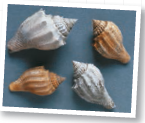
How the Research Was Done The researchers studied the stratigraphic distribution of volutes in outcrops of sedimentary rocks located along North America's Gulf coast. These rocks, which formed from 66 to 37 million years ago, early in the Paleogene period, are an excellent source of well-preserved snail fossils. The researchers were able to classify each fossil species of volute snail as having planktonic or nonplanktonic larvae based on features of the earliest formed whorls of the snail's shell. Each bar in the graph shows how long one species of snail persisted in the fossil record.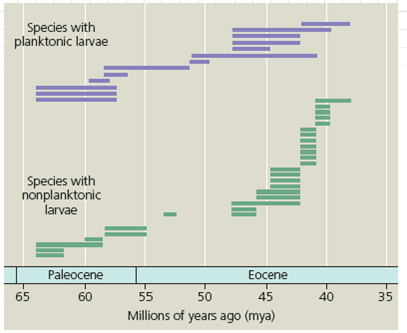
Propose a hypothesis to explain the differences in longevity of snail species with planktonic and nonplanktonic larvae.
Do Ecological Factors Affect Evolutionary Rates Researchers studied the fossil record to investigate whether differing modes of larval dispersal might explain species longevity within one taxon of marine snails, the family Volutidae. Some of the snail species had nonplanktonic larvae: They developed directly into adults without a swimming stage. Other species had planktonic larvae: They had a swimming stage and could disperse very long distances. The adults of these planktonic species tended to have broad geographic distributions, whereas nonplanktonic species tended to be more isolated.
How the Research Was Done The researchers studied the stratigraphic distribution of volutes in outcrops of sedimentary rocks located along North America's Gulf coast. These rocks, which formed from 66 to 37 million years ago, early in the Paleogene period, are an excellent source of well-preserved snail fossils. The researchers were able to classify each fossil species of volute snail as having planktonic or nonplanktonic larvae based on features of the earliest formed whorls of the snail's shell. Each bar in the graph shows how long one species of snail persisted in the fossil record.
Propose a hypothesis to explain the differences in longevity of snail species with planktonic and nonplanktonic larvae.
التوضيح


هذا السؤال ليس له إجابة موثقة من أحد الخبراء بعد، دع الذكاء الاصطناعي Copilot في كويز بلس يساعدك في إيجاد الحل.

Campbell Biology 11th Edition by Lisa Urry,Michael Cain,Steven Wasserman,Peter Minorsky,Jane Reece

لماذا لم يعجبك هذا التمرين؟
أخرى 8 أحرف كحد أدنى و 255 حرفاً كحد أقصى
حرف 255






