







 تكلم مع الذكاء الاصطناعي


Living in the Environment 18th Edition by Tyler Miller,Scott Spoolman
النسخة 18الرقم المعياري الدولي: 9781285969725Living in the Environment 18th Edition by Tyler Miller,Scott Spoolman
النسخة 18الرقم المعياري الدولي: 9781285969725 تمرين 5
According to the International Energy Agency, the average American adds 19.6 metric tons (21.6 tons) of CO 2 per year to the atmosphere, compared with a world average of 4.23 metric tons (4.65 tons). The table on the next page is designed to help you understand the sources of your personal inputs of CO 2 into the atmosphere. You will be making calculations to fill in the blanks in this table.
Some typical numbers are provided in the "Typical Quantity per Year" column of the table. However, your calculations will be more accurate if you can use information based on your own personal lifestyle, which you can enter in the blank "Personal Quantity per Year" column. For example, you could add up your monthly utility bills for a year and divide the total by the number of persons in your household to get a rough estimate of your own utility use.
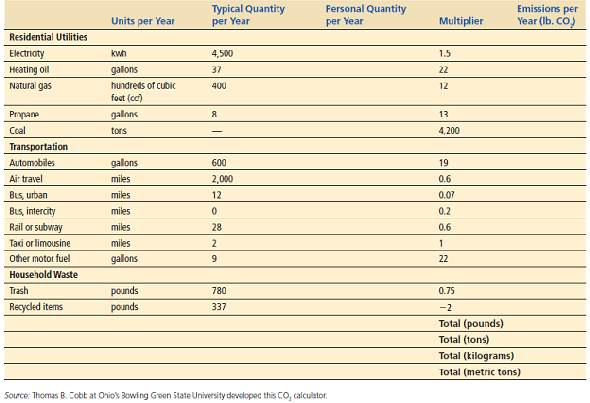
Calculate your carbon footprint. To calculate your emissions, first complete the blank "Personal Quantity per Year" column as described above. Wherever you cannot provide personal data, use that listed in the "Typical Quantity per Year" column. Enter each number in the "Personal Quantity per Year" column to represent your annual consumption (using the units specified in the "Units per Year" column). Now multiply your annual consumption for each activity by the associated number in the "Multiplier" column to obtain an estimate of the pounds of CO 2 resulting from that activity, which you will enter in the "Emissions per Year" column. Finally, add the numbers in that column to find your carbon footprint, and express the final CO 2 result in both pounds and tons (1 ton 5 2,000 pounds) and in kilograms and metric tons (1 kilogram 5 2.2 pounds; 1 metric ton 5 1.1 tons).
Some typical numbers are provided in the "Typical Quantity per Year" column of the table. However, your calculations will be more accurate if you can use information based on your own personal lifestyle, which you can enter in the blank "Personal Quantity per Year" column. For example, you could add up your monthly utility bills for a year and divide the total by the number of persons in your household to get a rough estimate of your own utility use.
Calculate your carbon footprint. To calculate your emissions, first complete the blank "Personal Quantity per Year" column as described above. Wherever you cannot provide personal data, use that listed in the "Typical Quantity per Year" column. Enter each number in the "Personal Quantity per Year" column to represent your annual consumption (using the units specified in the "Units per Year" column). Now multiply your annual consumption for each activity by the associated number in the "Multiplier" column to obtain an estimate of the pounds of CO 2 resulting from that activity, which you will enter in the "Emissions per Year" column. Finally, add the numbers in that column to find your carbon footprint, and express the final CO 2 result in both pounds and tons (1 ton 5 2,000 pounds) and in kilograms and metric tons (1 kilogram 5 2.2 pounds; 1 metric ton 5 1.1 tons).
التوضيح موثّق
موثّق
موثّق
Each person's carbon footprint...

Living in the Environment 18th Edition by Tyler Miller,Scott Spoolman

لماذا لم يعجبك هذا التمرين؟
أخرى 8 أحرف كحد أدنى و 255 حرفاً كحد أقصى
حرف 255






