expand icon
book Molecular Biology Of The Cell 6th Edition by Bruce Alberts, Alexander Johnson, Julian Lewis, David Morgan, Martin Raff, Keith Roberts, Peter Walter cover

Molecular Biology Of The Cell 6th Edition by Bruce Alberts, Alexander Johnson, Julian Lewis, David Morgan, Martin Raff, Keith Roberts, Peter Walter

النسخة 6الرقم المعياري الدولي: 978-0815345244
book Molecular Biology Of The Cell 6th Edition by Bruce Alberts, Alexander Johnson, Julian Lewis, David Morgan, Martin Raff, Keith Roberts, Peter Walter cover

Molecular Biology Of The Cell 6th Edition by Bruce Alberts, Alexander Johnson, Julian Lewis, David Morgan, Martin Raff, Keith Roberts, Peter Walter

النسخة 6الرقم المعياري الدولي: 978-0815345244
تمرين 11
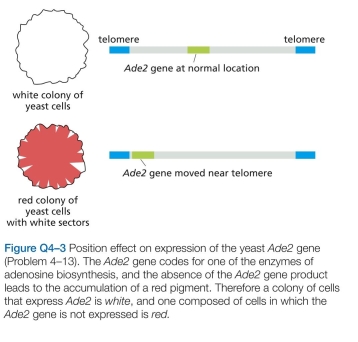
Look at the two yeast colonies in Figure Q4-3. Each of these colonies contains about 100,000 cells descended from a single yeast cell, originally somewhere in the mid- dle of the clump. A white colony arises when the Look at the two yeast colonies in Figure Q4-3. Each of these colonies contains about 100,000 cells descended from a single yeast cell, originally somewhere in the mid- dle of the clump. A white colony arises when the   gene is expressed from its normal chromosomal location. When the   gene is moved to a location near a telomere, it is packed into heterochromatin and inactivated in most cells, giving rise to colonies that are mostly red. In these largely red colonies, white sectors fan out from the middle of the colony. In both the red and white sectors, the     gene is still located near telomeres. Explain why white sec- tors have formed near the rim of the red colony. Based on the patterns observed, what can you conclude about the propagation of the transcriptional state of the   gene from mother to daughter cells in this experiment? gene is expressed from its normal chromosomal location. When the Look at the two yeast colonies in Figure Q4-3. Each of these colonies contains about 100,000 cells descended from a single yeast cell, originally somewhere in the mid- dle of the clump. A white colony arises when the   gene is expressed from its normal chromosomal location. When the   gene is moved to a location near a telomere, it is packed into heterochromatin and inactivated in most cells, giving rise to colonies that are mostly red. In these largely red colonies, white sectors fan out from the middle of the colony. In both the red and white sectors, the     gene is still located near telomeres. Explain why white sec- tors have formed near the rim of the red colony. Based on the patterns observed, what can you conclude about the propagation of the transcriptional state of the   gene from mother to daughter cells in this experiment? gene is moved to a location near a telomere, it is packed into heterochromatin and inactivated in most cells, giving rise to colonies that are mostly red. In these largely red colonies, white sectors fan out from the middle of the colony. In both the red and white sectors, the Look at the two yeast colonies in Figure Q4-3. Each of these colonies contains about 100,000 cells descended from a single yeast cell, originally somewhere in the mid- dle of the clump. A white colony arises when the   gene is expressed from its normal chromosomal location. When the   gene is moved to a location near a telomere, it is packed into heterochromatin and inactivated in most cells, giving rise to colonies that are mostly red. In these largely red colonies, white sectors fan out from the middle of the colony. In both the red and white sectors, the     gene is still located near telomeres. Explain why white sec- tors have formed near the rim of the red colony. Based on the patterns observed, what can you conclude about the propagation of the transcriptional state of the   gene from mother to daughter cells in this experiment? Look at the two yeast colonies in Figure Q4-3. Each of these colonies contains about 100,000 cells descended from a single yeast cell, originally somewhere in the mid- dle of the clump. A white colony arises when the   gene is expressed from its normal chromosomal location. When the   gene is moved to a location near a telomere, it is packed into heterochromatin and inactivated in most cells, giving rise to colonies that are mostly red. In these largely red colonies, white sectors fan out from the middle of the colony. In both the red and white sectors, the     gene is still located near telomeres. Explain why white sec- tors have formed near the rim of the red colony. Based on the patterns observed, what can you conclude about the propagation of the transcriptional state of the   gene from mother to daughter cells in this experiment? gene is still located near telomeres. Explain why white sec- tors have formed near the rim of the red colony. Based on the patterns observed, what can you conclude about the propagation of the transcriptional state of the Look at the two yeast colonies in Figure Q4-3. Each of these colonies contains about 100,000 cells descended from a single yeast cell, originally somewhere in the mid- dle of the clump. A white colony arises when the   gene is expressed from its normal chromosomal location. When the   gene is moved to a location near a telomere, it is packed into heterochromatin and inactivated in most cells, giving rise to colonies that are mostly red. In these largely red colonies, white sectors fan out from the middle of the colony. In both the red and white sectors, the     gene is still located near telomeres. Explain why white sec- tors have formed near the rim of the red colony. Based on the patterns observed, what can you conclude about the propagation of the transcriptional state of the   gene from mother to daughter cells in this experiment? gene from mother to daughter cells in this experiment?
التوضيح
موثّق
like image
like image

Transposable elements are mobile pieces ...

close menu
Molecular Biology Of The Cell 6th Edition by Bruce Alberts, Alexander Johnson, Julian Lewis, David Morgan, Martin Raff, Keith Roberts, Peter Walter
cross icon