expand icon
book Molecular Biology Of The Cell 6th Edition by Bruce Alberts, Alexander Johnson, Julian Lewis, David Morgan, Martin Raff, Keith Roberts, Peter Walter cover

Molecular Biology Of The Cell 6th Edition by Bruce Alberts, Alexander Johnson, Julian Lewis, David Morgan, Martin Raff, Keith Roberts, Peter Walter

النسخة 6الرقم المعياري الدولي: 978-0815345244
book Molecular Biology Of The Cell 6th Edition by Bruce Alberts, Alexander Johnson, Julian Lewis, David Morgan, Martin Raff, Keith Roberts, Peter Walter cover

Molecular Biology Of The Cell 6th Edition by Bruce Alberts, Alexander Johnson, Julian Lewis, David Morgan, Martin Raff, Keith Roberts, Peter Walter

النسخة 6الرقم المعياري الدولي: 978-0815345244
تمرين 9
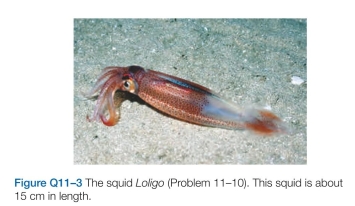
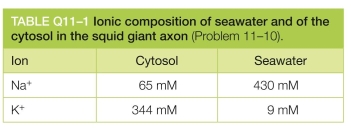
0 The giant axon of the squid (Figure Q11-3) occu- pies a unique position in the history of our understanding of cell membrane potentials and nerve action. When an electrode is stuck into an intact giant axon, the membrane potential registers -70 mV. When the axon, suspended in a bath of seawater, is stimulated to conduct a nerve impulse, the membrane potential changes transiently from -70 mV to +40 mV. 0 The giant axon of the squid (Figure Q11-3) occu- pies a unique position in the history of our understanding of cell membrane potentials and nerve action. When an electrode is stuck into an intact giant axon, the membrane potential registers -70 mV. When the axon, suspended in a bath of seawater, is stimulated to conduct a nerve impulse, the membrane potential changes transiently from -70 mV to +40 mV.     For univalent ions and at   (293 K), the Nernst equation reduces to   where     are the concentrations outside and inside, respectively. Using this equation, calculate the potential across the resting membrane (1) assuming that it is due solely to   and (2) assuming that it is due solely to     and   concentrations in the axon cytosol and in seawa- ter are given in Table Q11-1.) Which calculation is closer to the measured resting potential? Which calculation is closer to the measured action potential? Explain why these assumptions approximate the measured resting and action potentials. 0 The giant axon of the squid (Figure Q11-3) occu- pies a unique position in the history of our understanding of cell membrane potentials and nerve action. When an electrode is stuck into an intact giant axon, the membrane potential registers -70 mV. When the axon, suspended in a bath of seawater, is stimulated to conduct a nerve impulse, the membrane potential changes transiently from -70 mV to +40 mV.     For univalent ions and at   (293 K), the Nernst equation reduces to   where     are the concentrations outside and inside, respectively. Using this equation, calculate the potential across the resting membrane (1) assuming that it is due solely to   and (2) assuming that it is due solely to     and   concentrations in the axon cytosol and in seawa- ter are given in Table Q11-1.) Which calculation is closer to the measured resting potential? Which calculation is closer to the measured action potential? Explain why these assumptions approximate the measured resting and action potentials. For univalent ions and at 0 The giant axon of the squid (Figure Q11-3) occu- pies a unique position in the history of our understanding of cell membrane potentials and nerve action. When an electrode is stuck into an intact giant axon, the membrane potential registers -70 mV. When the axon, suspended in a bath of seawater, is stimulated to conduct a nerve impulse, the membrane potential changes transiently from -70 mV to +40 mV.     For univalent ions and at   (293 K), the Nernst equation reduces to   where     are the concentrations outside and inside, respectively. Using this equation, calculate the potential across the resting membrane (1) assuming that it is due solely to   and (2) assuming that it is due solely to     and   concentrations in the axon cytosol and in seawa- ter are given in Table Q11-1.) Which calculation is closer to the measured resting potential? Which calculation is closer to the measured action potential? Explain why these assumptions approximate the measured resting and action potentials. (293 K), the Nernst equation reduces to 0 The giant axon of the squid (Figure Q11-3) occu- pies a unique position in the history of our understanding of cell membrane potentials and nerve action. When an electrode is stuck into an intact giant axon, the membrane potential registers -70 mV. When the axon, suspended in a bath of seawater, is stimulated to conduct a nerve impulse, the membrane potential changes transiently from -70 mV to +40 mV.     For univalent ions and at   (293 K), the Nernst equation reduces to   where     are the concentrations outside and inside, respectively. Using this equation, calculate the potential across the resting membrane (1) assuming that it is due solely to   and (2) assuming that it is due solely to     and   concentrations in the axon cytosol and in seawa- ter are given in Table Q11-1.) Which calculation is closer to the measured resting potential? Which calculation is closer to the measured action potential? Explain why these assumptions approximate the measured resting and action potentials. where 0 The giant axon of the squid (Figure Q11-3) occu- pies a unique position in the history of our understanding of cell membrane potentials and nerve action. When an electrode is stuck into an intact giant axon, the membrane potential registers -70 mV. When the axon, suspended in a bath of seawater, is stimulated to conduct a nerve impulse, the membrane potential changes transiently from -70 mV to +40 mV.     For univalent ions and at   (293 K), the Nernst equation reduces to   where     are the concentrations outside and inside, respectively. Using this equation, calculate the potential across the resting membrane (1) assuming that it is due solely to   and (2) assuming that it is due solely to     and   concentrations in the axon cytosol and in seawa- ter are given in Table Q11-1.) Which calculation is closer to the measured resting potential? Which calculation is closer to the measured action potential? Explain why these assumptions approximate the measured resting and action potentials. 0 The giant axon of the squid (Figure Q11-3) occu- pies a unique position in the history of our understanding of cell membrane potentials and nerve action. When an electrode is stuck into an intact giant axon, the membrane potential registers -70 mV. When the axon, suspended in a bath of seawater, is stimulated to conduct a nerve impulse, the membrane potential changes transiently from -70 mV to +40 mV.     For univalent ions and at   (293 K), the Nernst equation reduces to   where     are the concentrations outside and inside, respectively. Using this equation, calculate the potential across the resting membrane (1) assuming that it is due solely to   and (2) assuming that it is due solely to     and   concentrations in the axon cytosol and in seawa- ter are given in Table Q11-1.) Which calculation is closer to the measured resting potential? Which calculation is closer to the measured action potential? Explain why these assumptions approximate the measured resting and action potentials. are the concentrations outside and inside, respectively. Using this equation, calculate the potential across the resting membrane (1) assuming that it is due solely to 0 The giant axon of the squid (Figure Q11-3) occu- pies a unique position in the history of our understanding of cell membrane potentials and nerve action. When an electrode is stuck into an intact giant axon, the membrane potential registers -70 mV. When the axon, suspended in a bath of seawater, is stimulated to conduct a nerve impulse, the membrane potential changes transiently from -70 mV to +40 mV.     For univalent ions and at   (293 K), the Nernst equation reduces to   where     are the concentrations outside and inside, respectively. Using this equation, calculate the potential across the resting membrane (1) assuming that it is due solely to   and (2) assuming that it is due solely to     and   concentrations in the axon cytosol and in seawa- ter are given in Table Q11-1.) Which calculation is closer to the measured resting potential? Which calculation is closer to the measured action potential? Explain why these assumptions approximate the measured resting and action potentials. and (2) assuming that it is due solely to 0 The giant axon of the squid (Figure Q11-3) occu- pies a unique position in the history of our understanding of cell membrane potentials and nerve action. When an electrode is stuck into an intact giant axon, the membrane potential registers -70 mV. When the axon, suspended in a bath of seawater, is stimulated to conduct a nerve impulse, the membrane potential changes transiently from -70 mV to +40 mV.     For univalent ions and at   (293 K), the Nernst equation reduces to   where     are the concentrations outside and inside, respectively. Using this equation, calculate the potential across the resting membrane (1) assuming that it is due solely to   and (2) assuming that it is due solely to     and   concentrations in the axon cytosol and in seawa- ter are given in Table Q11-1.) Which calculation is closer to the measured resting potential? Which calculation is closer to the measured action potential? Explain why these assumptions approximate the measured resting and action potentials. 0 The giant axon of the squid (Figure Q11-3) occu- pies a unique position in the history of our understanding of cell membrane potentials and nerve action. When an electrode is stuck into an intact giant axon, the membrane potential registers -70 mV. When the axon, suspended in a bath of seawater, is stimulated to conduct a nerve impulse, the membrane potential changes transiently from -70 mV to +40 mV.     For univalent ions and at   (293 K), the Nernst equation reduces to   where     are the concentrations outside and inside, respectively. Using this equation, calculate the potential across the resting membrane (1) assuming that it is due solely to   and (2) assuming that it is due solely to     and   concentrations in the axon cytosol and in seawa- ter are given in Table Q11-1.) Which calculation is closer to the measured resting potential? Which calculation is closer to the measured action potential? Explain why these assumptions approximate the measured resting and action potentials. and 0 The giant axon of the squid (Figure Q11-3) occu- pies a unique position in the history of our understanding of cell membrane potentials and nerve action. When an electrode is stuck into an intact giant axon, the membrane potential registers -70 mV. When the axon, suspended in a bath of seawater, is stimulated to conduct a nerve impulse, the membrane potential changes transiently from -70 mV to +40 mV.     For univalent ions and at   (293 K), the Nernst equation reduces to   where     are the concentrations outside and inside, respectively. Using this equation, calculate the potential across the resting membrane (1) assuming that it is due solely to   and (2) assuming that it is due solely to     and   concentrations in the axon cytosol and in seawa- ter are given in Table Q11-1.) Which calculation is closer to the measured resting potential? Which calculation is closer to the measured action potential? Explain why these assumptions approximate the measured resting and action potentials. concentrations in the axon cytosol and in seawa- ter are given in Table Q11-1.) Which calculation is closer to the measured resting potential? Which calculation is closer to the measured action potential? Explain why these assumptions approximate the measured resting and action potentials.

التوضيح
موثّق
like image
like image

(A) The number of peaks denotes the numb...

close menu
Molecular Biology Of The Cell 6th Edition by Bruce Alberts, Alexander Johnson, Julian Lewis, David Morgan, Martin Raff, Keith Roberts, Peter Walter
cross icon