







 تكلم مع الذكاء الاصطناعي


Molecular Biology Of The Cell 6th Edition by Bruce Alberts, Alexander Johnson, Julian Lewis, David Morgan, Martin Raff, Keith Roberts, Peter Walter
النسخة 6الرقم المعياري الدولي: 978-0815345244Molecular Biology Of The Cell 6th Edition by Bruce Alberts, Alexander Johnson, Julian Lewis, David Morgan, Martin Raff, Keith Roberts, Peter Walter
النسخة 6الرقم المعياري الدولي: 978-0815345244 تمرين 3
When human cancer cells are exposed to ultra- violet (UV) light at 90 mJ/  most of the cells undergo apoptosis within 24 hours. Release of cytochrome
  from mitochondria can be detected as early as 6 hours after exposure of a population of cells to UV light, and it contin- ues to increase for more than 10 hours thereafter. Does this mean that individual cells slowly release their cytochrome
  over this time period? Or, alternatively, do individual cells release their cytochrome c rapidly but with different cells being triggered over the longer time period? To answer this fundamental question, you have fused the gene for green fluorescent protein (GFP) to the gene for cytochrome
  so that you can observe the behav- ior of individual cells by confocal fluorescence microscopy. In cells that are expressing the cytochrome
  GFP fusion, fluorescence shows the punctate pattern typical of mito- chondrial proteins. You then irradiate these cells with UV light and observe individual cells for changes in the punc- tate pattern. Two such cells (outlined in white) are shown in Figure Q18-2A and
A. Assuming that the normal and dominant forms of Fas are expressed to the same level and bind Fas ligand equally, what fraction of Fas-Fas ligand complexes on a lymphocyte from a heterozygous ALPS patient would be expected to be composed entirely of normal Fas subunits?
B. In an individual heterozygous for a mutation that eliminates Fas expression, what fraction of Fas-Fas ligand complexes would be expected to be composed entirely of normal Fas subunits?
C. Why are the Fas mutations that are associated with ALPS dominant, while those that eliminate expression of Fas are recessive?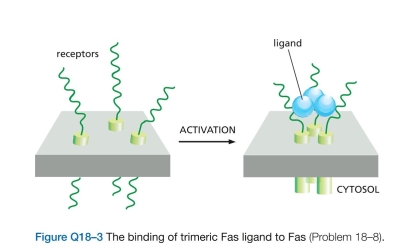
most of the cells undergo apoptosis within 24 hours. Release of cytochrome from mitochondria can be detected as early as 6 hours after exposure of a population of cells to UV light, and it contin- ues to increase for more than 10 hours thereafter. Does this mean that individual cells slowly release their cytochrome over this time period? Or, alternatively, do individual cells release their cytochrome c rapidly but with different cells being triggered over the longer time period? To answer this fundamental question, you have fused the gene for green fluorescent protein (GFP) to the gene for cytochrome so that you can observe the behav- ior of individual cells by confocal fluorescence microscopy. In cells that are expressing the cytochrome GFP fusion, fluorescence shows the punctate pattern typical of mito- chondrial proteins. You then irradiate these cells with UV light and observe individual cells for changes in the punc- tate pattern. Two such cells (outlined in white) are shown in Figure Q18-2A and A. Assuming that the normal and dominant forms of Fas are expressed to the same level and bind Fas ligand equally, what fraction of Fas-Fas ligand complexes on a lymphocyte from a heterozygous ALPS patient would be expected to be composed entirely of normal Fas subunits?
B. In an individual heterozygous for a mutation that eliminates Fas expression, what fraction of Fas-Fas ligand complexes would be expected to be composed entirely of normal Fas subunits?
C. Why are the Fas mutations that are associated with ALPS dominant, while those that eliminate expression of Fas are recessive?
التوضيح موثّق
موثّق
موثّق
Apoptosis is an important process in the...

Molecular Biology Of The Cell 6th Edition by Bruce Alberts, Alexander Johnson, Julian Lewis, David Morgan, Martin Raff, Keith Roberts, Peter Walter

لماذا لم يعجبك هذا التمرين؟
أخرى 8 أحرف كحد أدنى و 255 حرفاً كحد أقصى
حرف 255






