expand icon
book Molecular Biology Of The Cell 6th Edition by Bruce Alberts, Alexander Johnson, Julian Lewis, David Morgan, Martin Raff, Keith Roberts, Peter Walter cover

Molecular Biology Of The Cell 6th Edition by Bruce Alberts, Alexander Johnson, Julian Lewis, David Morgan, Martin Raff, Keith Roberts, Peter Walter

النسخة 6الرقم المعياري الدولي: 978-0815345244
book Molecular Biology Of The Cell 6th Edition by Bruce Alberts, Alexander Johnson, Julian Lewis, David Morgan, Martin Raff, Keith Roberts, Peter Walter cover

Molecular Biology Of The Cell 6th Edition by Bruce Alberts, Alexander Johnson, Julian Lewis, David Morgan, Martin Raff, Keith Roberts, Peter Walter

النسخة 6الرقم المعياري الدولي: 978-0815345244
تمرين 12
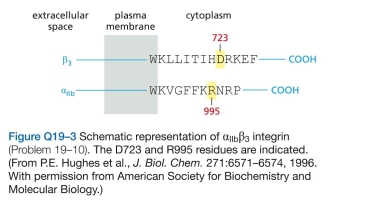
0 The affinity of integrins for matrix components can be modulated by changes to their cytoplasmic domains: a process known as inside-out signaling. You have iden- tified a key region in the cytoplasmic domains of 0 The affinity of integrins for matrix components can be modulated by changes to their cytoplasmic domains: a process known as inside-out signaling. You have iden- tified a key region in the cytoplasmic domains of   integrin that seems to be required for inside-out signaling (Figure Q19-3). Substitution of alanine for either D723 in the   chain or R995 in the   chain leads to a high level of spontaneous activation, under conditions where the wild-type chains are inactive. Your advisor suggests that you convert the aspartate in the   chain to an arginine (D723R) and the arginine in the   chain to an aspartate (R995D). You compare all three   chains (R995, R995A, and R995D) against all three   chains (D723, D723A, and D723R). You find that all pairs have a high level of sponta- neous activation, except D723 vs R995 (the wild type) and D723R vs R995D, which have low levels. Based on these results, how do you think the   integrin is held in its inactive state?  integrin that seems to be required for inside-out signaling (Figure Q19-3). Substitution of alanine for either D723 in the 0 The affinity of integrins for matrix components can be modulated by changes to their cytoplasmic domains: a process known as inside-out signaling. You have iden- tified a key region in the cytoplasmic domains of   integrin that seems to be required for inside-out signaling (Figure Q19-3). Substitution of alanine for either D723 in the   chain or R995 in the   chain leads to a high level of spontaneous activation, under conditions where the wild-type chains are inactive. Your advisor suggests that you convert the aspartate in the   chain to an arginine (D723R) and the arginine in the   chain to an aspartate (R995D). You compare all three   chains (R995, R995A, and R995D) against all three   chains (D723, D723A, and D723R). You find that all pairs have a high level of sponta- neous activation, except D723 vs R995 (the wild type) and D723R vs R995D, which have low levels. Based on these results, how do you think the   integrin is held in its inactive state?  chain or R995 in the 0 The affinity of integrins for matrix components can be modulated by changes to their cytoplasmic domains: a process known as inside-out signaling. You have iden- tified a key region in the cytoplasmic domains of   integrin that seems to be required for inside-out signaling (Figure Q19-3). Substitution of alanine for either D723 in the   chain or R995 in the   chain leads to a high level of spontaneous activation, under conditions where the wild-type chains are inactive. Your advisor suggests that you convert the aspartate in the   chain to an arginine (D723R) and the arginine in the   chain to an aspartate (R995D). You compare all three   chains (R995, R995A, and R995D) against all three   chains (D723, D723A, and D723R). You find that all pairs have a high level of sponta- neous activation, except D723 vs R995 (the wild type) and D723R vs R995D, which have low levels. Based on these results, how do you think the   integrin is held in its inactive state?  chain leads to a high level of spontaneous activation, under conditions where the wild-type chains are inactive. Your advisor suggests that you convert the aspartate in the 0 The affinity of integrins for matrix components can be modulated by changes to their cytoplasmic domains: a process known as inside-out signaling. You have iden- tified a key region in the cytoplasmic domains of   integrin that seems to be required for inside-out signaling (Figure Q19-3). Substitution of alanine for either D723 in the   chain or R995 in the   chain leads to a high level of spontaneous activation, under conditions where the wild-type chains are inactive. Your advisor suggests that you convert the aspartate in the   chain to an arginine (D723R) and the arginine in the   chain to an aspartate (R995D). You compare all three   chains (R995, R995A, and R995D) against all three   chains (D723, D723A, and D723R). You find that all pairs have a high level of sponta- neous activation, except D723 vs R995 (the wild type) and D723R vs R995D, which have low levels. Based on these results, how do you think the   integrin is held in its inactive state?  chain to an arginine (D723R) and the arginine in the 0 The affinity of integrins for matrix components can be modulated by changes to their cytoplasmic domains: a process known as inside-out signaling. You have iden- tified a key region in the cytoplasmic domains of   integrin that seems to be required for inside-out signaling (Figure Q19-3). Substitution of alanine for either D723 in the   chain or R995 in the   chain leads to a high level of spontaneous activation, under conditions where the wild-type chains are inactive. Your advisor suggests that you convert the aspartate in the   chain to an arginine (D723R) and the arginine in the   chain to an aspartate (R995D). You compare all three   chains (R995, R995A, and R995D) against all three   chains (D723, D723A, and D723R). You find that all pairs have a high level of sponta- neous activation, except D723 vs R995 (the wild type) and D723R vs R995D, which have low levels. Based on these results, how do you think the   integrin is held in its inactive state?  chain to an aspartate (R995D). You compare all three 0 The affinity of integrins for matrix components can be modulated by changes to their cytoplasmic domains: a process known as inside-out signaling. You have iden- tified a key region in the cytoplasmic domains of   integrin that seems to be required for inside-out signaling (Figure Q19-3). Substitution of alanine for either D723 in the   chain or R995 in the   chain leads to a high level of spontaneous activation, under conditions where the wild-type chains are inactive. Your advisor suggests that you convert the aspartate in the   chain to an arginine (D723R) and the arginine in the   chain to an aspartate (R995D). You compare all three   chains (R995, R995A, and R995D) against all three   chains (D723, D723A, and D723R). You find that all pairs have a high level of sponta- neous activation, except D723 vs R995 (the wild type) and D723R vs R995D, which have low levels. Based on these results, how do you think the   integrin is held in its inactive state?  chains (R995, R995A, and R995D) against all three 0 The affinity of integrins for matrix components can be modulated by changes to their cytoplasmic domains: a process known as inside-out signaling. You have iden- tified a key region in the cytoplasmic domains of   integrin that seems to be required for inside-out signaling (Figure Q19-3). Substitution of alanine for either D723 in the   chain or R995 in the   chain leads to a high level of spontaneous activation, under conditions where the wild-type chains are inactive. Your advisor suggests that you convert the aspartate in the   chain to an arginine (D723R) and the arginine in the   chain to an aspartate (R995D). You compare all three   chains (R995, R995A, and R995D) against all three   chains (D723, D723A, and D723R). You find that all pairs have a high level of sponta- neous activation, except D723 vs R995 (the wild type) and D723R vs R995D, which have low levels. Based on these results, how do you think the   integrin is held in its inactive state?  chains (D723, D723A, and D723R). You find that all pairs have a high level of sponta- neous activation, except D723 vs R995 (the wild type) and D723R vs R995D, which have low levels. Based on these results, how do you think the 0 The affinity of integrins for matrix components can be modulated by changes to their cytoplasmic domains: a process known as inside-out signaling. You have iden- tified a key region in the cytoplasmic domains of   integrin that seems to be required for inside-out signaling (Figure Q19-3). Substitution of alanine for either D723 in the   chain or R995 in the   chain leads to a high level of spontaneous activation, under conditions where the wild-type chains are inactive. Your advisor suggests that you convert the aspartate in the   chain to an arginine (D723R) and the arginine in the   chain to an aspartate (R995D). You compare all three   chains (R995, R995A, and R995D) against all three   chains (D723, D723A, and D723R). You find that all pairs have a high level of sponta- neous activation, except D723 vs R995 (the wild type) and D723R vs R995D, which have low levels. Based on these results, how do you think the   integrin is held in its inactive state?  integrin is held in its inactive state? 0 The affinity of integrins for matrix components can be modulated by changes to their cytoplasmic domains: a process known as inside-out signaling. You have iden- tified a key region in the cytoplasmic domains of   integrin that seems to be required for inside-out signaling (Figure Q19-3). Substitution of alanine for either D723 in the   chain or R995 in the   chain leads to a high level of spontaneous activation, under conditions where the wild-type chains are inactive. Your advisor suggests that you convert the aspartate in the   chain to an arginine (D723R) and the arginine in the   chain to an aspartate (R995D). You compare all three   chains (R995, R995A, and R995D) against all three   chains (D723, D723A, and D723R). You find that all pairs have a high level of sponta- neous activation, except D723 vs R995 (the wild type) and D723R vs R995D, which have low levels. Based on these results, how do you think the   integrin is held in its inactive state?
التوضيح
موثّق
like image
like image

The extracellular matrix is an important...

close menu
Molecular Biology Of The Cell 6th Edition by Bruce Alberts, Alexander Johnson, Julian Lewis, David Morgan, Martin Raff, Keith Roberts, Peter Walter
cross icon