







 Chat with AI

Deck 3: The Human Body: a Nutrition Perspective
Full screen (f)

Question

Question
Question
Question
Question
Question
Question
Question
Question
Question
Question
Question
Question
Question
Question
Question
Question
Question
Question
Question
Question
Question
Question
Question
Question
Question
Question
Question
Question
Question
Question
Question
Question
Question
Question
Question
Question
Question
Question
Question
Question
Question
Question
Question
Question
Question
Question
Question
Question
Question
Question
Question
Question
Question
Question
Question
Question
Question
Question
Question
Question
Question
Match the following with the descriptions below
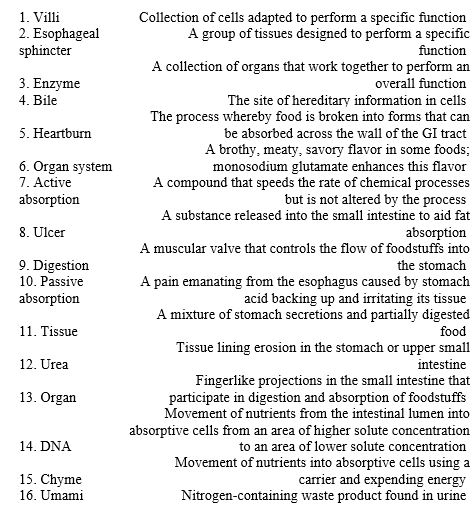
Question
Question
Question
Question
Question

Unlock Deck
Sign up to unlock the cards in this deck!
Unlock Deck
Unlock Deck
1/67

Play

Full screen (f)
Deck 3: The Human Body: a Nutrition Perspective
1
Which hormone functions in the regulation of the body's metabolic rate?
A) vitamin D
B) thyroid hormone
C) glucagon
D) insulin
A) vitamin D
B) thyroid hormone
C) glucagon
D) insulin
B
2
The ______ system is assisted by the lymphatic system and the physical barriers of the skin and gastrointestinal tract.
A) respiratory
B) skeletal
C) immune
D) nervous
A) respiratory
B) skeletal
C) immune
D) nervous
C
3
Which large blood vessel is the first to receive most recently eaten nutrients, transporting them to the liver?
A) Hepatic portal vein
B) Mesenteric vein
C) Subclavian vein
D) Hepatic vein
A) Hepatic portal vein
B) Mesenteric vein
C) Subclavian vein
D) Hepatic vein
A
4
To which body part does blood travel to pick up oxygen and release carbon dioxide?
A) Heart
B) Lungs
C) Liver
D) Kidneys
A) Heart
B) Lungs
C) Liver
D) Kidneys
Unlock Deck
Unlock for access to all 67 flashcards in this deck.
Unlock Deck
k this deck
5
After digestion and absorption, which circulatory system carries fat and fat-soluble vitamins?
A) Portal
B) Enterohepatic
C) Lymphatic
D) Mesentery
A) Portal
B) Enterohepatic
C) Lymphatic
D) Mesentery
Unlock Deck
Unlock for access to all 67 flashcards in this deck.
Unlock Deck
k this deck
6
All of the following are features of the epiglottis EXCEPT which one?
A) It covers the opening of the trachea.
B) It prevents food from entering the windpipe during swallowing.
C) It guides food down the esophagus.
D) It is the first GI tract sphincter.
A) It covers the opening of the trachea.
B) It prevents food from entering the windpipe during swallowing.
C) It guides food down the esophagus.
D) It is the first GI tract sphincter.
Unlock Deck
Unlock for access to all 67 flashcards in this deck.
Unlock Deck
k this deck
7
Which of the following is true about the lymphatic system?
A) The specialized fluid carried by this system is blood.
B) This system never intersects with the bloodstream.
C) It is not involved in the transport of nutrients.
D) It is important for transporting fat-soluble nutrients.
A) The specialized fluid carried by this system is blood.
B) This system never intersects with the bloodstream.
C) It is not involved in the transport of nutrients.
D) It is important for transporting fat-soluble nutrients.
Unlock Deck
Unlock for access to all 67 flashcards in this deck.
Unlock Deck
k this deck
8
The stomach empties into the small intestine through the
A) pyloric sphincter.
B) esophageal sphincter.
C) sphincter of Oddi.
D) ileocecal sphincter.
A) pyloric sphincter.
B) esophageal sphincter.
C) sphincter of Oddi.
D) ileocecal sphincter.
Unlock Deck
Unlock for access to all 67 flashcards in this deck.
Unlock Deck
k this deck
9
The constant turnover of body tissues requires the ______ supplied by carbohydrates, proteins, and lipids.
A) hormones
B) vitamins
C) chemical energy
D) structural components
A) hormones
B) vitamins
C) chemical energy
D) structural components
Unlock Deck
Unlock for access to all 67 flashcards in this deck.
Unlock Deck
k this deck
10
All of the following must be supplied by the diet to support the chemical processes of human physiology EXCEPT
A) vitamins and minerals.
B) carbohydrates.
C) lipids.
D) phytochemicals.
A) vitamins and minerals.
B) carbohydrates.
C) lipids.
D) phytochemicals.
Unlock Deck
Unlock for access to all 67 flashcards in this deck.
Unlock Deck
k this deck
11
Which of the following is stored within the nucleus of the cell and acts as a code book for synthesizing specific proteins?
A) RNA
B) Cells
C) Organs
D) DNA
A) RNA
B) Cells
C) Organs
D) DNA
Unlock Deck
Unlock for access to all 67 flashcards in this deck.
Unlock Deck
k this deck
12
Which of the following is a feature of the lymphatic system?
A) It is composed of a mucus-like substance.
B) It picks up and transports dietary lipids.
C) It serves to transport fat- and water-soluble vitamins to the heart.
D) It funnels nutrients to the liver via a one-way pump.
A) It is composed of a mucus-like substance.
B) It picks up and transports dietary lipids.
C) It serves to transport fat- and water-soluble vitamins to the heart.
D) It funnels nutrients to the liver via a one-way pump.
Unlock Deck
Unlock for access to all 67 flashcards in this deck.
Unlock Deck
k this deck
13
Which of the following is NOT a function of the urinary system?
A) Helps to regulate water content of the body
B) Contributes to acid-base balance of the blood
C) Excretion of water-soluble vitamins
D) Excretion of fat-soluble vitamins
A) Helps to regulate water content of the body
B) Contributes to acid-base balance of the blood
C) Excretion of water-soluble vitamins
D) Excretion of fat-soluble vitamins
Unlock Deck
Unlock for access to all 67 flashcards in this deck.
Unlock Deck
k this deck
14
Most chemical digestion takes place in the
A) stomach.
B) small intestine.
C) pancreas.
D) large intestine.
A) stomach.
B) small intestine.
C) pancreas.
D) large intestine.
Unlock Deck
Unlock for access to all 67 flashcards in this deck.
Unlock Deck
k this deck
15
Transmission of nerve impulses relies on the concentrations of ______ in the neuron.
A) sodium and potassium
B) cholesterol
C) calcium and magnesium
D) B vitamins
A) sodium and potassium
B) cholesterol
C) calcium and magnesium
D) B vitamins
Unlock Deck
Unlock for access to all 67 flashcards in this deck.
Unlock Deck
k this deck
16
The ___________________________ system is made up of several glands that act in the regulation of metabolism, reproduction, water balance, and many other functions.
A) cardiovascular
B) urinary
C) lymphatic
D) endocrine
A) cardiovascular
B) urinary
C) lymphatic
D) endocrine
Unlock Deck
Unlock for access to all 67 flashcards in this deck.
Unlock Deck
k this deck
17
What structure prevents food from entering the trachea when you swallow?
A) Epiglottis
B) Tongue
C) Tonsils
D) Esophagus
A) Epiglottis
B) Tongue
C) Tonsils
D) Esophagus
Unlock Deck
Unlock for access to all 67 flashcards in this deck.
Unlock Deck
k this deck
18
Nutrient-rich blood leaving the intestine goes by way of a vein to the
A) kidneys.
B) heart.
C) liver.
D) pancreas.
A) kidneys.
B) heart.
C) liver.
D) pancreas.
Unlock Deck
Unlock for access to all 67 flashcards in this deck.
Unlock Deck
k this deck
19
______ tissue is part of rigid body structures, such as bone and cartilage.
A) Nervous
B) Connective
C) Muscle
D) Epithelial
A) Nervous
B) Connective
C) Muscle
D) Epithelial
Unlock Deck
Unlock for access to all 67 flashcards in this deck.
Unlock Deck
k this deck
20
Where does digestion begin?
A) Mouth
B) Stomach
C) Esophagus
D) Small intestine
A) Mouth
B) Stomach
C) Esophagus
D) Small intestine
Unlock Deck
Unlock for access to all 67 flashcards in this deck.
Unlock Deck
k this deck
21
Peristalsis refers to
A) chewing and swallowing.
B) the opening and closing of sphincters.
C) the action of bile on dietary fat.
D) muscular movement of materials through the GI tract.
A) chewing and swallowing.
B) the opening and closing of sphincters.
C) the action of bile on dietary fat.
D) muscular movement of materials through the GI tract.
Unlock Deck
Unlock for access to all 67 flashcards in this deck.
Unlock Deck
k this deck
22
What is one function of the pyloric sphincter?
A) Prevents esophageal contents from emptying too quickly into the stomach
B) Prevents stomach contents from backing up into the esophagus
C) Prevents intestinal contents from backing up into the stomach
D) Prevents intestinal contents from emptying too quickly into the colon
A) Prevents esophageal contents from emptying too quickly into the stomach
B) Prevents stomach contents from backing up into the esophagus
C) Prevents intestinal contents from backing up into the stomach
D) Prevents intestinal contents from emptying too quickly into the colon
Unlock Deck
Unlock for access to all 67 flashcards in this deck.
Unlock Deck
k this deck
23
Where are most digestive enzymes produced?
A) Pancreas and small intestine
B) Liver and large intestine
C) Pancreas and large intestine
D) Liver and pancreas
A) Pancreas and small intestine
B) Liver and large intestine
C) Pancreas and large intestine
D) Liver and pancreas
Unlock Deck
Unlock for access to all 67 flashcards in this deck.
Unlock Deck
k this deck
24
Which of the following is NOT a short-term storage site for carbohydrates in the body?
A) brain
B) liver
C) muscle
D) blood
A) brain
B) liver
C) muscle
D) blood
Unlock Deck
Unlock for access to all 67 flashcards in this deck.
Unlock Deck
k this deck
25
The study of how genes determine our nutritional requirements is called
A) nutrigenomics.
B) nutrigenetics.
C) nutritional biochemistry.
D) genetic engineering.
A) nutrigenomics.
B) nutrigenetics.
C) nutritional biochemistry.
D) genetic engineering.
Unlock Deck
Unlock for access to all 67 flashcards in this deck.
Unlock Deck
k this deck
26
Which of the following is a description of chyme?
A) A watery mixture of partially digested food released by the stomach into the intestines
B) The semisolid mass of undigested food that is swallowed
C) The mixture of pancreatic juices containing enzymes for digestion
D) A thick, viscous material synthesized by mucosal cells for protection against digestive juices
A) A watery mixture of partially digested food released by the stomach into the intestines
B) The semisolid mass of undigested food that is swallowed
C) The mixture of pancreatic juices containing enzymes for digestion
D) A thick, viscous material synthesized by mucosal cells for protection against digestive juices
Unlock Deck
Unlock for access to all 67 flashcards in this deck.
Unlock Deck
k this deck
27
The muscular contractions that move food through the digestive tract are called
A) regurgitation.
B) peristalsis.
C) propulsion.
D) compression.
A) regurgitation.
B) peristalsis.
C) propulsion.
D) compression.
Unlock Deck
Unlock for access to all 67 flashcards in this deck.
Unlock Deck
k this deck
28
Which of the following is a function of sphincter muscles?
A) Breaks apart food particles
B) Controls passage of food through the GI tract
C) Controls peristalsis
D) Releases enzymes and hormones into the GI tract
A) Breaks apart food particles
B) Controls passage of food through the GI tract
C) Controls peristalsis
D) Releases enzymes and hormones into the GI tract
Unlock Deck
Unlock for access to all 67 flashcards in this deck.
Unlock Deck
k this deck
29
Which of the following is NOT a sphincter?
A) Diverticular
B) Esophageal
C) Pyloric
D) Ileocecal
A) Diverticular
B) Esophageal
C) Pyloric
D) Ileocecal
Unlock Deck
Unlock for access to all 67 flashcards in this deck.
Unlock Deck
k this deck
30
The study of the ways nutrients and food influence gene expression is called
A) epidemiology.
B) molecular biology.
C) nutrigenomics.
D) nutrigenetics.
A) epidemiology.
B) molecular biology.
C) nutrigenomics.
D) nutrigenetics.
Unlock Deck
Unlock for access to all 67 flashcards in this deck.
Unlock Deck
k this deck
31
What sphincter separates the small intestine from the large intestine?
A) Pyloric
B) Esophageal
C) Anal
D) Ileocecal
A) Pyloric
B) Esophageal
C) Anal
D) Ileocecal
Unlock Deck
Unlock for access to all 67 flashcards in this deck.
Unlock Deck
k this deck
32
What percentage of a meal has been absorbed by the time it leaves the small intestine?
A) 25%
B) 55%
C) 80%
D) 95%
A) 25%
B) 55%
C) 80%
D) 95%
Unlock Deck
Unlock for access to all 67 flashcards in this deck.
Unlock Deck
k this deck
33
What substance helps suspend fat in a watery digestive mixture, making fat more available to digestive enzymes?
A) Bicarbonate
B) Mucus
C) Bile
D) Pancreatic juices
A) Bicarbonate
B) Mucus
C) Bile
D) Pancreatic juices
Unlock Deck
Unlock for access to all 67 flashcards in this deck.
Unlock Deck
k this deck
34
Which of the following body organs produces bile?
A) Stomach
B) Salivary glands
C) Pancreas
D) Liver
A) Stomach
B) Salivary glands
C) Pancreas
D) Liver
Unlock Deck
Unlock for access to all 67 flashcards in this deck.
Unlock Deck
k this deck
35
Which of the following, upon digestion, is NOT normally absorbed directly into the bloodstream?
A) Minerals
B) Fats
C) Carbohydrates
D) Proteins
A) Minerals
B) Fats
C) Carbohydrates
D) Proteins
Unlock Deck
Unlock for access to all 67 flashcards in this deck.
Unlock Deck
k this deck
36
The ring-like muscles that retard or prevent backflow of partially digested food in the gastrointestinal tract are called
A) sphincters.
B) passages.
C) openings.
D) gates.
A) sphincters.
B) passages.
C) openings.
D) gates.
Unlock Deck
Unlock for access to all 67 flashcards in this deck.
Unlock Deck
k this deck
37
Which of the following organs serves as a storage depot for many vitamins and minerals?
A) stomach
B) kidney
C) brain
D) liver
A) stomach
B) kidney
C) brain
D) liver
Unlock Deck
Unlock for access to all 67 flashcards in this deck.
Unlock Deck
k this deck
38
Which of the following is true about digestive enzymes?
A) One enzyme can speed many types of chemical processes.
B) Enzymes are not sensitive to temperature.
C) Enzymes that work in the acidic environment of the stomach cannot work in the basic or alkaline environment of the small intestine and vice versa.
D) Enzymes typically work independently of vitamins or minerals.
A) One enzyme can speed many types of chemical processes.
B) Enzymes are not sensitive to temperature.
C) Enzymes that work in the acidic environment of the stomach cannot work in the basic or alkaline environment of the small intestine and vice versa.
D) Enzymes typically work independently of vitamins or minerals.
Unlock Deck
Unlock for access to all 67 flashcards in this deck.
Unlock Deck
k this deck
39
Which of the following is NOT considered part of the GI tract?
A) Anus
B) Kidneys
C) Colon
D) Esophagus
A) Anus
B) Kidneys
C) Colon
D) Esophagus
Unlock Deck
Unlock for access to all 67 flashcards in this deck.
Unlock Deck
k this deck
40
These protein-based substances enhance digestion by making chemical reactions more likely to happen.
A) Bile
B) Emulsifiers
C) Enzymes
D) Hormones
A) Bile
B) Emulsifiers
C) Enzymes
D) Hormones
Unlock Deck
Unlock for access to all 67 flashcards in this deck.
Unlock Deck
k this deck
41
The walls of the small intestine are folded, and within the folds are fingerlike projections called
A) nephrons.
B) cilia.
C) villi.
D) rugae.
A) nephrons.
B) cilia.
C) villi.
D) rugae.
Unlock Deck
Unlock for access to all 67 flashcards in this deck.
Unlock Deck
k this deck
42
In passive absorption, nutrients enter the cell
A) with a carrier.
B) with the expenditure of energy.
C) from an area of higher solute concentration to one of lower concentration.
D) from an area of lower solute concentration to one of higher concentration.
A) with a carrier.
B) with the expenditure of energy.
C) from an area of higher solute concentration to one of lower concentration.
D) from an area of lower solute concentration to one of higher concentration.
Unlock Deck
Unlock for access to all 67 flashcards in this deck.
Unlock Deck
k this deck
43
Which of the following substances is primarily involved in the emulsification of fat to facilitate its digestion?
A) Bicarbonate
B) Pancreatic juices
C) Hydrochloric acid
D) Bile
A) Bicarbonate
B) Pancreatic juices
C) Hydrochloric acid
D) Bile
Unlock Deck
Unlock for access to all 67 flashcards in this deck.
Unlock Deck
k this deck
44
Most stomach ulcers are cause by ______ infection.
A) Clostridium botulinum
B) Salmonella
C)
D) Helicobacter pylori
E) coli
A) Clostridium botulinum
B) Salmonella
C)
D) Helicobacter pylori
E) coli
Unlock Deck
Unlock for access to all 67 flashcards in this deck.
Unlock Deck
k this deck
45
Which of the following therapies is appropriate for treatment of occasional heartburn?
A) Aspirin
B) Antacids
C) Orange juice
D) Milk and cream
A) Aspirin
B) Antacids
C) Orange juice
D) Milk and cream
Unlock Deck
Unlock for access to all 67 flashcards in this deck.
Unlock Deck
k this deck
46
Partially digested food that enters the small intestine from the stomach is called
A) bolus.
B) mass.
C) chyme.
D) bile.
A) bolus.
B) mass.
C) chyme.
D) bile.
Unlock Deck
Unlock for access to all 67 flashcards in this deck.
Unlock Deck
k this deck
47
The most active area for the absorption of nutrients into the body is the
A) stomach.
B) small intestine.
C) large intestine.
D) liver.
A) stomach.
B) small intestine.
C) large intestine.
D) liver.
Unlock Deck
Unlock for access to all 67 flashcards in this deck.
Unlock Deck
k this deck
48
Which pH best describes the environment of the stomach when stimulated?
A) Neutral
B) Both acidic and basic
C) Acidic
D) Basic
A) Neutral
B) Both acidic and basic
C) Acidic
D) Basic
Unlock Deck
Unlock for access to all 67 flashcards in this deck.
Unlock Deck
k this deck
49
Which of the following is an important dietary recommendation for avoiding heartburn?
A) Eat smaller meals that are lower in fat.
B) Eat large meals.
C) Eat meals low in carbohydrate.
D) Avoid fluids.
A) Eat smaller meals that are lower in fat.
B) Eat large meals.
C) Eat meals low in carbohydrate.
D) Avoid fluids.
Unlock Deck
Unlock for access to all 67 flashcards in this deck.
Unlock Deck
k this deck
50
Excessive acid production in the stomach or upper small intestine could result in
A) poor iron, calcium, and folate absorption.
B) excessive intestinal bacterial growth.
C) an ulcer.
D) decreased fiber digestion and absorption.
A) poor iron, calcium, and folate absorption.
B) excessive intestinal bacterial growth.
C) an ulcer.
D) decreased fiber digestion and absorption.
Unlock Deck
Unlock for access to all 67 flashcards in this deck.
Unlock Deck
k this deck
51
Constipation can best be prevented by
A) eating dietary fiber.
B) restricting fluids.
C) restricting physical exercise.
D) using laxatives.
A) eating dietary fiber.
B) restricting fluids.
C) restricting physical exercise.
D) using laxatives.
Unlock Deck
Unlock for access to all 67 flashcards in this deck.
Unlock Deck
k this deck
52
Which of the following is true regarding bile?
A) It is an enzyme.
B) It stimulates the release of pancreatic juices.
C) It is produced by the liver.
D) It is a hormone.
A) It is an enzyme.
B) It stimulates the release of pancreatic juices.
C) It is produced by the liver.
D) It is a hormone.
Unlock Deck
Unlock for access to all 67 flashcards in this deck.
Unlock Deck
k this deck
53
A function of the large intestine is to absorb
A) fats and proteins.
B) vitamins and minerals.
C) water and minerals.
D) proteins and carbohydrates.
A) fats and proteins.
B) vitamins and minerals.
C) water and minerals.
D) proteins and carbohydrates.
Unlock Deck
Unlock for access to all 67 flashcards in this deck.
Unlock Deck
k this deck
54
A recurrent and serious form of heartburn is called
A) esophageal ulceritis.
B) gastric distress.
C) cardiovascular reflux disease.
D) gastroesophageal reflux disease.
A) esophageal ulceritis.
B) gastric distress.
C) cardiovascular reflux disease.
D) gastroesophageal reflux disease.
Unlock Deck
Unlock for access to all 67 flashcards in this deck.
Unlock Deck
k this deck
55
Absorption of nutrients by intestinal cells occurs by all of the following mechanisms EXCEPT
A) sustained absorption.
B) passive absorption.
C) active absorption.
D) facilitated absorption.
A) sustained absorption.
B) passive absorption.
C) active absorption.
D) facilitated absorption.
Unlock Deck
Unlock for access to all 67 flashcards in this deck.
Unlock Deck
k this deck
56
A(n) _______________ is a medication that inhibits the ability of gastric cells to secrete hydrogen ions.
A) antacid
B) antibiotic
C) NSAID
D) proton pump inhibitor
A) antacid
B) antibiotic
C) NSAID
D) proton pump inhibitor
Unlock Deck
Unlock for access to all 67 flashcards in this deck.
Unlock Deck
k this deck
57
All of the following are characteristics of heartburn EXCEPT which one?
A) It is caused by a backflow of acid from the stomach into the esophagus.
B) It can damage the esophagus permanently.
C) It subsides when a person relaxes and lies down after a meal.
D) It is a gnawing pain in the upper chest.
A) It is caused by a backflow of acid from the stomach into the esophagus.
B) It can damage the esophagus permanently.
C) It subsides when a person relaxes and lies down after a meal.
D) It is a gnawing pain in the upper chest.
Unlock Deck
Unlock for access to all 67 flashcards in this deck.
Unlock Deck
k this deck
58
The villi of the small intestine
A) provide an enormous surface area that facilitates absorption.
B) store fat-soluble vitamins.
C) continuously push food through the small intestine to the colon.
D) inactivate enzymes consumed with food.
A) provide an enormous surface area that facilitates absorption.
B) store fat-soluble vitamins.
C) continuously push food through the small intestine to the colon.
D) inactivate enzymes consumed with food.
Unlock Deck
Unlock for access to all 67 flashcards in this deck.
Unlock Deck
k this deck
59
When food enters the small intestine, a hormone stimulates the release of ______ from the pancreas.
A) bile
B) acid
C) bicarbonate
D) mucus
A) bile
B) acid
C) bicarbonate
D) mucus
Unlock Deck
Unlock for access to all 67 flashcards in this deck.
Unlock Deck
k this deck
60
The function of thick mucus in the stomach is to
A) promote fat digestion.
B) activate stomach enzymes.
C) protect stomach cells from acid and enzymes.
D) keep the stomach bacteria-free.
A) promote fat digestion.
B) activate stomach enzymes.
C) protect stomach cells from acid and enzymes.
D) keep the stomach bacteria-free.
Unlock Deck
Unlock for access to all 67 flashcards in this deck.
Unlock Deck
k this deck
61
When a nutrient moves, with the help of a carrier, from an area of higher solute concentration into an absorptive cell where the concentration is lower, this is called
A) passive diffusion.
B) facilitated diffusion.
C) active absorption.
D) phagocytosis.
A) passive diffusion.
B) facilitated diffusion.
C) active absorption.
D) phagocytosis.
Unlock Deck
Unlock for access to all 67 flashcards in this deck.
Unlock Deck
k this deck
62
Match the following with the descriptions below
Unlock Deck
Unlock for access to all 67 flashcards in this deck.
Unlock Deck
k this deck
63
When a nutrient moves freely from an area of higher solute concentration into an absorptive cell where the concentration is lower, this is called
A) Passive diffusion
B) Facilitated diffusion
C) Active absorption
D) Phagocytosis
A) Passive diffusion
B) Facilitated diffusion
C) Active absorption
D) Phagocytosis
Unlock Deck
Unlock for access to all 67 flashcards in this deck.
Unlock Deck
k this deck
64
A compound that allows for communication between one cell and the next is a
A) neuron.
B) neurotransmitter.
C) nephron.
D) synapse.
A) neuron.
B) neurotransmitter.
C) nephron.
D) synapse.
Unlock Deck
Unlock for access to all 67 flashcards in this deck.
Unlock Deck
k this deck
65
The organelles that are known as the "power plants" or the "powerhouses" of the cell are the
A) mitochondria.
B) nuclei.
C) ribosomes.
D) lysosomes.
A) mitochondria.
B) nuclei.
C) ribosomes.
D) lysosomes.
Unlock Deck
Unlock for access to all 67 flashcards in this deck.
Unlock Deck
k this deck
66
The components of feces include which of the following?
Unlock Deck
Unlock for access to all 67 flashcards in this deck.
Unlock Deck
k this deck
67
Which absorptive process in the small intestine requires a carrier and energy to transport nutrients into absorptive cells?
A) Phagocytosis
B) Facilitated diffusion
C) Passive diffusion
D) Active absorption
A) Phagocytosis
B) Facilitated diffusion
C) Passive diffusion
D) Active absorption
Unlock Deck
Unlock for access to all 67 flashcards in this deck.
Unlock Deck
k this deck
Unlock Deck
Unlock for access to all 67 flashcards in this deck.






