







 Chat with AI

Deck 35: International Trade
Full screen (f)

Question

Question
Question
Question
Question
Question
Question
Question
Question
Question
Question
Question
Question
Question
Question
Question
Question
Question
Question
Question
Question
Question
Question
Question
Question
Question
Question
Question
Question
Question
Question
Question
Question
Question
Question
Question
Question
Question
Question
Question
Question
Question
Question
Question
Question
Question
Question
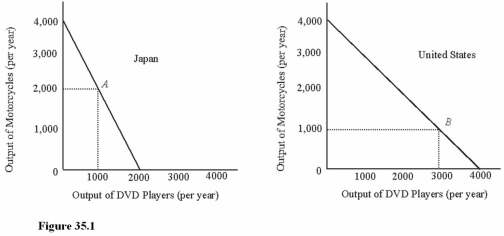
Which of the following statements is true for the two countries illustrated in Figure 35.1?
A)Japan has an absolute advantage in motorcycles.
B)The United States has a comparative advantage in DVD players.
C)Japan has an absolute advantage in motorcycles,the United States in DVD players.
Question
Question
Question
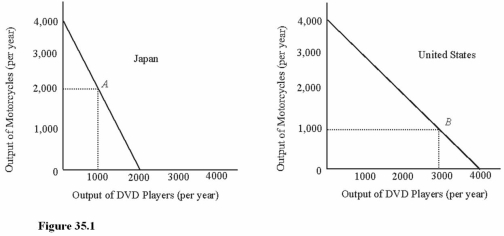
In Figure 35.1,what is the opportunity cost of motorcycles in Japan?
A)1/2 of a DVD player per motorcycle.
B)1 DVD player per motorcycle.
C)2 DVD players per motorcycle.
Question
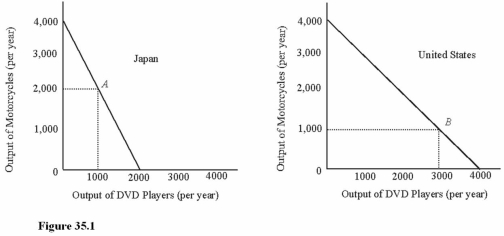
Suppose both countries illustrated in Figure 35.1 specialized completely in the good they could produce with the lowest opportunity cost.What would the total production of motorcycles be?
A)2,000.
B)3,000.
C)4,000.
Question
Question
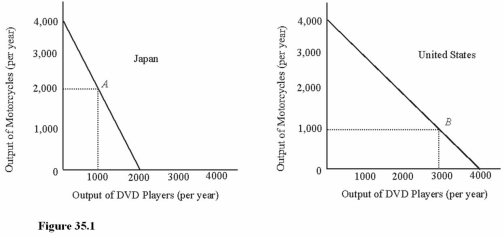
In Figure 35.1,what is the opportunity cost of motorcycles in the United States?
A)1/2 of a DVD player per motorcycle.
B)1/3 of a DVD player per motorcycle.
C)2 DVD players per motorcycle.
D)1 DVD player per motorcycle.
Question
Question
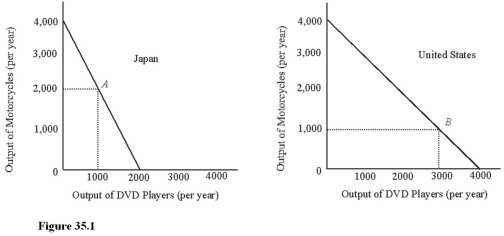
Which of the following terms of trade would enable the two countries illustrated in Figure 35.1 to trade with each other and increase consumption possibilities?
A)1/3 of a DVD player per motorcycle.
B)4 DVD players per motorcycle.
C)3 DVD players per motorcycle.
D)3/4 of a DVD player per motorcycle.
Question
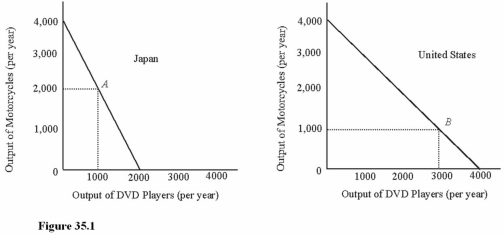
In Figure 35.1,what is the opportunity cost of DVD players in Japan?
A)1/2 of a motorcycle per DVD player.
B)1 motorcycle per DVD player.
C)2 motorcycles per DVD player.
Question
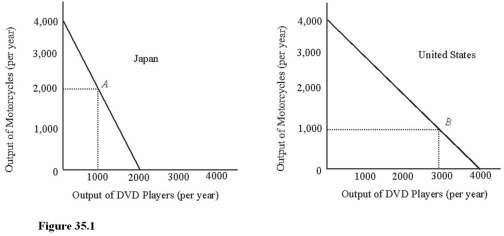
If the two countries are at points A and B in Figure 35.1 and do not trade,what is the total number of motorcycles produced per year?
A)1,000.
B)2,000.
C)3,000.
Question
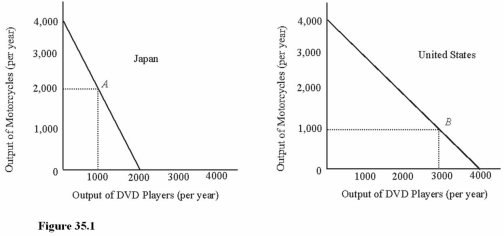
Which of the following best describes the comparative advantage of the two countries illustrated in Figure 35.1?
A)Japan has a comparative advantage in both goods.
B)Japan has a comparative advantage in DVD players,the United States in motorcycles.
C)Japan has a comparative advantage in motorcycles,the United States in DVD players.
Question
Question
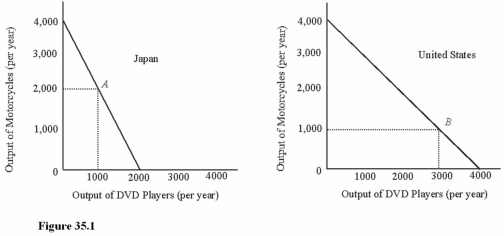
Compared to their initial positions at points A and B,as a result of complete specialization and trade,the output of the two countries added together in Figure 35.1 would result in an increase in
A)Both DVD players and motorcycles.
B)Motorcycles only.
C)DVD players only.
Question
Question
Question
Question
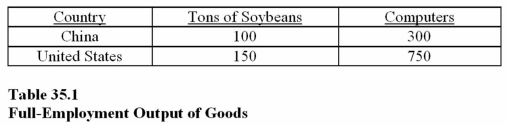
Based on the information in Table 35.1,assume China and the United States have the same amount of resources with which to produce soybeans and computers and they produce no other goods.For trade to be mutually beneficial for both countries,the terms of trade will be such that 1 ton of soybeans will exchange for
A)More than 3 computers but less than 5.
B)More than 1/5 of a computer but less than 1/3.
C)Less than 3 computers.
Question
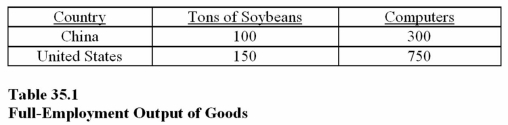
Based on the information in Table 35.1,assume China and the United States have the same amount of resources with which to produce soybeans and computers and they produce no other goods.The opportunity cost of producing 1 computer in China is
A)1/3 of a ton of soybeans.
B)1/4 of a ton of soybeans.
C)3 tons of soybeans.
Question
Question
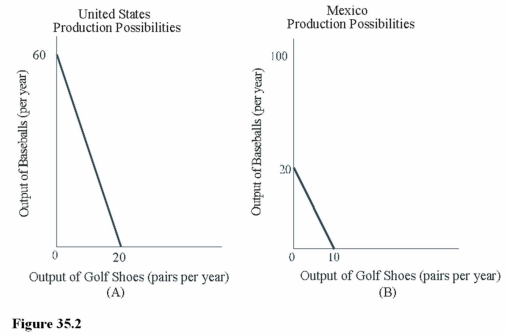
The production possibilities curves illustrated in Figure 35.2 reveal that
A)The United States has no comparative advantage.
B)The United States has an absolute advantage in both goods.
C)Mexico has no comparative advantage.
Question
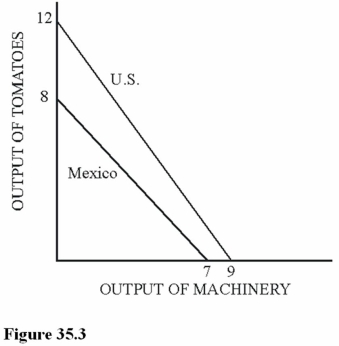
Refer to Figure 35.3 for the production possibilities curves for the United States and Mexico.These two curves indicate that
A)The United States should specialize in the production of both goods because it has an absolute advantage in the production of both.
B)The United States should specialize in the production of machinery.
C)Mexico should specialize in the production of tomatoes.
D)Mexico should specialize in the production of machinery.
Question
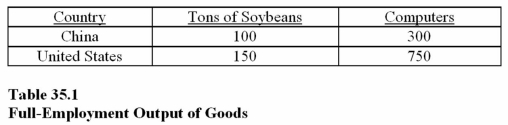
Based on the information in Table 35.1,assume China and the United States have the same amount of resources with which to produce soybeans and computers and they produce no other goods.From the information in Table 35.1,it is clear that
A)China has a comparative advantage in computers.
B)China has both an absolute and comparative advantage in soybeans.
C)The United States has a comparative advantage in both goods.
D)The United States has an absolute advantage in both goods.
Question
Question
Question
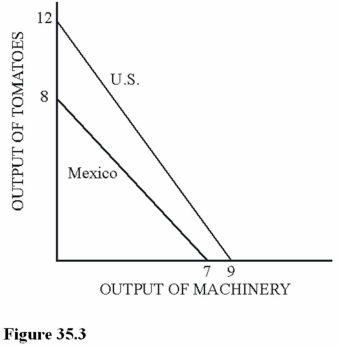
Refer to Figure 35.3 for the production possibilities curves for the United States and Mexico.These two curves indicate that
A)The United States has a comparative advantage in the production of machinery.
B)Mexico has an absolute advantage in the production of machinery.
C)The United States has an absolute advantage in the production of both goods.
Question
Question
Question
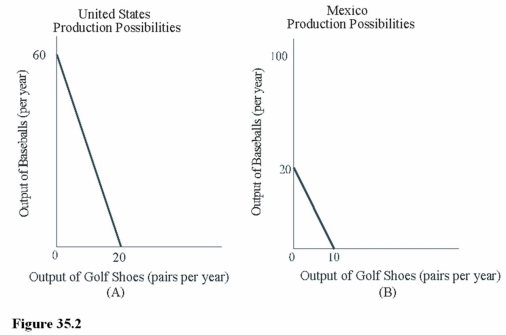 Based on the comparative cost ratios implied in Figure 35.2,it is clear that
A)The United States has a comparative advantage in baseballs and Mexico has a comparative advantage in golf shoes.
B)Mexico should import all of its golf shoes from the United States.
C)The United States should import all of its baseballs from Mexico.
Question

Based on the information in Table 35.1,assume China and the United States have the same amount of resources with which to produce soybeans and computers and they produce no other goods.The opportunity cost of producing 1 ton of soybeans in the United States is
A)1/5 of a computer.
B)1/3 of a computer.
C)3 computers.
D)5 computers.
Question
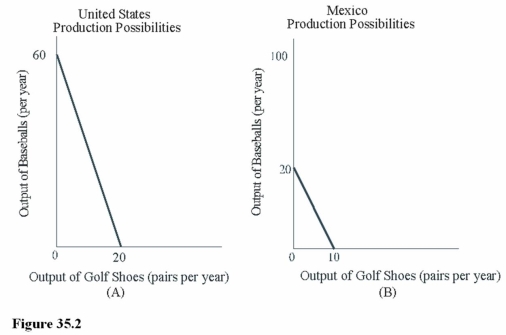
Using Figure 35.2,the opportunity cost of producing 1 pair of golf shoes in the United States is
A)Less than the opportunity cost in Mexico.
B)2 baseballs.
C)1/3 of a baseball.
D)3 baseballs.
Question
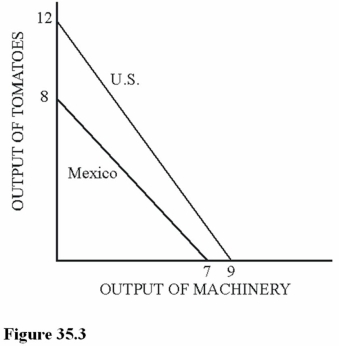
Refer to Figure 35.3 for the production possibilities curves for the United States and Mexico.These two curves indicate that
A)There is no benefit to the United States as a result of trading tomatoes or machinery with Mexico.
B)Mexico does not have an absolute advantage in the production of either good.
C)The United States has a comparative advantage in the production of machinery.
Question
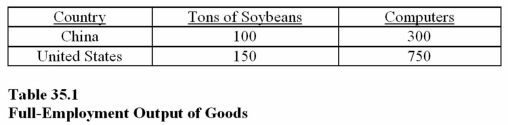
Based on the information in Table 35.1,assume China and the United States have the same amount of resources with which to produce soybeans and computers and they produce no other goods.The output of computers and soybeans would be greatest if
A)China specialized in producing soybeans,and the United States specialized in producing computers.
B)Both countries prohibited trade.
C)China specialized in producing computers,while the United States specialized in producing soybeans.
Question

Unlock Deck
Sign up to unlock the cards in this deck!
Unlock Deck
Unlock Deck
1/152

Play

Full screen (f)
Deck 35: International Trade
1
Which of the following statements about U.S.trade is true?
A)On average,other countries buy more U.S.goods and services than the United States buys from them.
B)The United States has a trade deficit with every country with which it trades.
C)The United States typically has a substantial trade surplus in services.
A)On average,other countries buy more U.S.goods and services than the United States buys from them.
B)The United States has a trade deficit with every country with which it trades.
C)The United States typically has a substantial trade surplus in services.
The United States typically has a substantial trade surplus in services.
2
According to the text,which of the following are both imports and exports for the United States?
A)Cars,computers,and auto parts.
B)Baseballs,computers,and cars.
C)Computers,oil,and auto parts.
A)Cars,computers,and auto parts.
B)Baseballs,computers,and cars.
C)Computers,oil,and auto parts.
Cars,computers,and auto parts.
3
Over a given period of time,if exports are greater than imports,the result is
A)A trade war.
B)A trade deficit.
C)An embargo.
D)A trade surplus.
A)A trade war.
B)A trade deficit.
C)An embargo.
D)A trade surplus.
A trade surplus.
4
In terms of the world as a whole,imports must equal exports because
A)The United Nations requires it.
B)It is part of international law.
C)Most countries,other than the United States,have a balanced trade situation.
D)Every good exported by one country becomes an import for another country.
A)The United Nations requires it.
B)It is part of international law.
C)Most countries,other than the United States,have a balanced trade situation.
D)Every good exported by one country becomes an import for another country.
Unlock Deck
Unlock for access to all 152 flashcards in this deck.
Unlock Deck
k this deck
5
All of the following companies export over 25 percent of their production except
A)Caterpillar Tractors.
B)Boeing.
C)Sun Microsystems.
D)McDonalds.
A)Caterpillar Tractors.
B)Boeing.
C)Sun Microsystems.
D)McDonalds.
Unlock Deck
Unlock for access to all 152 flashcards in this deck.
Unlock Deck
k this deck
6
The United States exports more than it imports
A)Only when the economy is booming.
B)Only in merchandise goods.
C)Only in services.
A)Only when the economy is booming.
B)Only in merchandise goods.
C)Only in services.
Unlock Deck
Unlock for access to all 152 flashcards in this deck.
Unlock Deck
k this deck
7
Increased opportunities for trade increase production by
A)Protecting countries from competition.
B)Improving efficiency through specialization.
C)Shifting the production possibilities curve outward.
A)Protecting countries from competition.
B)Improving efficiency through specialization.
C)Shifting the production possibilities curve outward.
Unlock Deck
Unlock for access to all 152 flashcards in this deck.
Unlock Deck
k this deck
8
According to the text,which of the following is true?
A)The United States imports paper,but not computers since it exports computers.
B)The United States imports paper and exports corn.
C)The United States imports auto parts and cars,but it doesn't export cars.
A)The United States imports paper,but not computers since it exports computers.
B)The United States imports paper and exports corn.
C)The United States imports auto parts and cars,but it doesn't export cars.
Unlock Deck
Unlock for access to all 152 flashcards in this deck.
Unlock Deck
k this deck
9
Which of the following countries has the highest export ratio?
A)The United States.
B)Belgium.
C)China.
A)The United States.
B)Belgium.
C)China.
Unlock Deck
Unlock for access to all 152 flashcards in this deck.
Unlock Deck
k this deck
10
Which of the following countries has the lowest export ratio?
A)The United States.
B)India.
C)Haiti.
D)Myanmar.
A)The United States.
B)India.
C)Haiti.
D)Myanmar.
Unlock Deck
Unlock for access to all 152 flashcards in this deck.
Unlock Deck
k this deck
11
If the United States has a trade deficit,this means that
A)Exports exceed imports.
B)The U.S.economy produces more than it consumes.
C)The trade balance is negative.
A)Exports exceed imports.
B)The U.S.economy produces more than it consumes.
C)The trade balance is negative.
Unlock Deck
Unlock for access to all 152 flashcards in this deck.
Unlock Deck
k this deck
12
When comparing the ratio of trade to GDP,relative to other countries,the United States typically has
A)Lower ratios for both imports and exports.
B)A higher ratio for imports but a lower ratio for exports.
C)A lower ratio for imports but a higher ratio for exports.
A)Lower ratios for both imports and exports.
B)A higher ratio for imports but a lower ratio for exports.
C)A lower ratio for imports but a higher ratio for exports.
Unlock Deck
Unlock for access to all 152 flashcards in this deck.
Unlock Deck
k this deck
13
Specialization in production
A)Decreases total world output.
B)Increases output.
C)Reduces the standard of living.
A)Decreases total world output.
B)Increases output.
C)Reduces the standard of living.
Unlock Deck
Unlock for access to all 152 flashcards in this deck.
Unlock Deck
k this deck
14
A country's export ratio is
A)The ratio of imports to exports.
B)The ratio of exports to GDP.
C)The ratio of trade to GDP.
A)The ratio of imports to exports.
B)The ratio of exports to GDP.
C)The ratio of trade to GDP.
Unlock Deck
Unlock for access to all 152 flashcards in this deck.
Unlock Deck
k this deck
15
The United States imports heavily in all of the following markets except
A)Aircraft.
B)Coffee.
C)Aluminum.
A)Aircraft.
B)Coffee.
C)Aluminum.
Unlock Deck
Unlock for access to all 152 flashcards in this deck.
Unlock Deck
k this deck
16
According to the text,which of the following does the United States export?
A)Cars and cigarettes but not corn.
B)Lumber but not farm equipment.
C)Cars,cigarettes,corn,farm equipment,and education.
A)Cars and cigarettes but not corn.
B)Lumber but not farm equipment.
C)Cars,cigarettes,corn,farm equipment,and education.
Unlock Deck
Unlock for access to all 152 flashcards in this deck.
Unlock Deck
k this deck
17
Over a given period of time,if imports are greater than exports,the result is
A)A trade war.
B)A trade deficit.
C)An embargo.
A)A trade war.
B)A trade deficit.
C)An embargo.
Unlock Deck
Unlock for access to all 152 flashcards in this deck.
Unlock Deck
k this deck
18
Goods and services purchased from international sources are
A)Exports.
B)Imports.
C)Net exports.
A)Exports.
B)Imports.
C)Net exports.
Unlock Deck
Unlock for access to all 152 flashcards in this deck.
Unlock Deck
k this deck
19
Goods and services sold to foreign buyers are
A)Exports.
B)Imports.
C)The terms of trade.
A)Exports.
B)Imports.
C)The terms of trade.
Unlock Deck
Unlock for access to all 152 flashcards in this deck.
Unlock Deck
k this deck
20
Based on export ratios,which of the following countries is closest to being a closed economy?
A)Belgium.
B)China.
C)Saudi Arabia.
D)Myanmar.
A)Belgium.
B)China.
C)Saudi Arabia.
D)Myanmar.
Unlock Deck
Unlock for access to all 152 flashcards in this deck.
Unlock Deck
k this deck
21
The expansion of world output as a result of trade is mainly due to the effects of
A)Higher trade barriers.
B)Improved terms of trade.
C)Specialization according to comparative advantage.
A)Higher trade barriers.
B)Improved terms of trade.
C)Specialization according to comparative advantage.
Unlock Deck
Unlock for access to all 152 flashcards in this deck.
Unlock Deck
k this deck
22
Consumption possibilities,during a given time period,refer to the
A)Maximum amount of imported goods and services that a country can consume.
B)Amount by which a country can expand its production possibilities by engaging in international trade.
C)Alternative combinations of goods and services that a country can consume.
A)Maximum amount of imported goods and services that a country can consume.
B)Amount by which a country can expand its production possibilities by engaging in international trade.
C)Alternative combinations of goods and services that a country can consume.
Unlock Deck
Unlock for access to all 152 flashcards in this deck.
Unlock Deck
k this deck
23
If a country does not engage in trade with other countries,it is known as
A)An open economy.
B)A trade deficit economy.
C)A closed economy.
A)An open economy.
B)A trade deficit economy.
C)A closed economy.
Unlock Deck
Unlock for access to all 152 flashcards in this deck.
Unlock Deck
k this deck
24
The United States is capable of producing many goods and services that it imports,but it does not because
A)We produce those goods more cheaply if we make them ourselves.
B)We can import those goods at a lower opportunity cost than if we make them ourselves.
C)We can export goods that we specialize in.
A)We produce those goods more cheaply if we make them ourselves.
B)We can import those goods at a lower opportunity cost than if we make them ourselves.
C)We can export goods that we specialize in.
Unlock Deck
Unlock for access to all 152 flashcards in this deck.
Unlock Deck
k this deck
25
When a country participates in international trade,its consumption possibilities
A)Must still equal its production possibilities.
B)May increase,but its trading partners consumption possibilities will decrease.
C)Will increase if it is a rich country and will decrease if it is a poor country.
D)Always exceed its production possibilities.
A)Must still equal its production possibilities.
B)May increase,but its trading partners consumption possibilities will decrease.
C)Will increase if it is a rich country and will decrease if it is a poor country.
D)Always exceed its production possibilities.
Unlock Deck
Unlock for access to all 152 flashcards in this deck.
Unlock Deck
k this deck
26
A country with a comparative advantage in producing computer chips
A)Has a lower opportunity cost of producing computer chips than its trading partners.
B)Can produce computer chips with fewer resources than its trading partners.
C)Can achieve better terms of trade in selling computer chips than its trading partners.
A)Has a lower opportunity cost of producing computer chips than its trading partners.
B)Can produce computer chips with fewer resources than its trading partners.
C)Can achieve better terms of trade in selling computer chips than its trading partners.
Unlock Deck
Unlock for access to all 152 flashcards in this deck.
Unlock Deck
k this deck
27
Two countries will have zero incentive to trade if their production possibilities curves are parallel straight lines because
A)The opportunity costs for both countries are the same.
B)One country has an absolute advantage in the production of both goods,thus providing that country with no incentive for trade.
C)One country has a comparative advantage in the production of both goods,thus providing that country with no incentive for trade.
A)The opportunity costs for both countries are the same.
B)One country has an absolute advantage in the production of both goods,thus providing that country with no incentive for trade.
C)One country has a comparative advantage in the production of both goods,thus providing that country with no incentive for trade.
Unlock Deck
Unlock for access to all 152 flashcards in this deck.
Unlock Deck
k this deck
28
The benefits from international trade include
A)A rightward shift of the production possibilities curve.
B)Greater efficiency in the use of the world's limited resources.
C)A higher standard of living for every person.
A)A rightward shift of the production possibilities curve.
B)Greater efficiency in the use of the world's limited resources.
C)A higher standard of living for every person.
Unlock Deck
Unlock for access to all 152 flashcards in this deck.
Unlock Deck
k this deck
29
If a country is completely self-reliant in producing goods for its own consumption needs,then
A)It consumes more than it can with trade.
B)Its consumption possibilities equal its production possibilities.
C)It promotes specialization.
A)It consumes more than it can with trade.
B)Its consumption possibilities equal its production possibilities.
C)It promotes specialization.
Unlock Deck
Unlock for access to all 152 flashcards in this deck.
Unlock Deck
k this deck
30
Suppose the country of Maverick has specialized in the production of a good but has not yet entered into trade.At this point in time,Maverick has
A)Moved to a level of production outside its production possibilities curve.
B)Shifted its production possibilities curve outward.
C)Moved along its existing production possibilities curve.
A)Moved to a level of production outside its production possibilities curve.
B)Shifted its production possibilities curve outward.
C)Moved along its existing production possibilities curve.
Unlock Deck
Unlock for access to all 152 flashcards in this deck.
Unlock Deck
k this deck
31
World output of goods and services increases with specialization because
A)The world's resources are being used more efficiently.
B)Each country's production possibilities curve shifts rightward.
C)Each country's workers are willing to work harder than they did before specialization.
A)The world's resources are being used more efficiently.
B)Each country's production possibilities curve shifts rightward.
C)Each country's workers are willing to work harder than they did before specialization.
Unlock Deck
Unlock for access to all 152 flashcards in this deck.
Unlock Deck
k this deck
32
When a country has a lower opportunity cost in producing a good than any other country,
A)It has an absolute advantage in producing the good.
B)It has favorable terms of trade in producing the good.
C)Consumption possibilities will increase with specialization and trade.
A)It has an absolute advantage in producing the good.
B)It has favorable terms of trade in producing the good.
C)Consumption possibilities will increase with specialization and trade.
Unlock Deck
Unlock for access to all 152 flashcards in this deck.
Unlock Deck
k this deck
33
Two countries with differing comparative advantages may engage in trade because
A)They will be able to consume more goods in total due to specialization and trade.
B)They will achieve an absolute advantage with one another.
C)They will be able to produce and consume goods on their production possibilities curves.
A)They will be able to consume more goods in total due to specialization and trade.
B)They will achieve an absolute advantage with one another.
C)They will be able to produce and consume goods on their production possibilities curves.
Unlock Deck
Unlock for access to all 152 flashcards in this deck.
Unlock Deck
k this deck
34
It's not likely that a country will specialize completely in one good even if it has a lower opportunity cost because
A)Comparative advantage is not a workable concept in the world economy.
B)Opportunity costs increase as more of a good is produced.
C)The country would want to save some of the good for its own citizens.
A)Comparative advantage is not a workable concept in the world economy.
B)Opportunity costs increase as more of a good is produced.
C)The country would want to save some of the good for its own citizens.
Unlock Deck
Unlock for access to all 152 flashcards in this deck.
Unlock Deck
k this deck
35
Without trade,a country's consumption possibilities are
A)Limited to its domestic production possibilities.
B)More than its terms of trade.
C)Less than its trade balance.
A)Limited to its domestic production possibilities.
B)More than its terms of trade.
C)Less than its trade balance.
Unlock Deck
Unlock for access to all 152 flashcards in this deck.
Unlock Deck
k this deck
36
Which of the following is a gain from trade?
A)A higher standard of living for all trading countries.
B)A shorter workweek for all trading countries.
C)A level of self-sufficiency for all trading countries.
A)A higher standard of living for all trading countries.
B)A shorter workweek for all trading countries.
C)A level of self-sufficiency for all trading countries.
Unlock Deck
Unlock for access to all 152 flashcards in this deck.
Unlock Deck
k this deck
37
If a country engages in trade with other countries,it is known as
A)An open economy.
B)A democracy.
C)A closed economy.
A)An open economy.
B)A democracy.
C)A closed economy.
Unlock Deck
Unlock for access to all 152 flashcards in this deck.
Unlock Deck
k this deck
38
Specialization in production and then trading with other countries
A)Change the mix of output for rich countries but not for poor countries.
B)Change the mix of output for each country and increase total world output.
C)Increase the standard of living for rich countries but not for poor countries.
A)Change the mix of output for rich countries but not for poor countries.
B)Change the mix of output for each country and increase total world output.
C)Increase the standard of living for rich countries but not for poor countries.
Unlock Deck
Unlock for access to all 152 flashcards in this deck.
Unlock Deck
k this deck
39
A country has a comparative advantage in a good if
A)It can produce more of the good than another country.
B)It can produce a good at a lower opportunity cost relative to another country.
C)It can specialize only in two goods.
A)It can produce more of the good than another country.
B)It can produce a good at a lower opportunity cost relative to another country.
C)It can specialize only in two goods.
Unlock Deck
Unlock for access to all 152 flashcards in this deck.
Unlock Deck
k this deck
40
Comparative advantage in production is achieved by
A)Subsidizing,specializing,and lowering the price of an exported good.
B)Being able to produce a good with fewer inputs than in other countries.
C)Having terms of trade that are better than the terms of trade faced in other countries.
D)Having a lower opportunity cost of producing a good relative to that of other countries.
A)Subsidizing,specializing,and lowering the price of an exported good.
B)Being able to produce a good with fewer inputs than in other countries.
C)Having terms of trade that are better than the terms of trade faced in other countries.
D)Having a lower opportunity cost of producing a good relative to that of other countries.
Unlock Deck
Unlock for access to all 152 flashcards in this deck.
Unlock Deck
k this deck
41
Suppose the production of 12 tons of copper in the United States requires the same amount of resources as the production of 3 tons of aluminum.In Mexico,12 tons of copper requires the same amount of resources as 2 tons of aluminum.Implicitly
A)Mexico has a comparative advantage in producing copper.
B)The United States has an absolute advantage in producing aluminum.
C)Mexico has an absolute advantage in producing copper.
A)Mexico has a comparative advantage in producing copper.
B)The United States has an absolute advantage in producing aluminum.
C)Mexico has an absolute advantage in producing copper.
Unlock Deck
Unlock for access to all 152 flashcards in this deck.
Unlock Deck
k this deck
42
Assume the United States and Australia have the same amount of resources.In a given time period,the United States can produce 2 tons of beef or 200,000 cars.Australia can produce 1 ton of beef or 100,000 cars.This means that
A)The United States has a comparative advantage in beef.
B)Australia has a comparative advantage in cars.
C)The United States has an absolute advantage in both beef and cars.
A)The United States has a comparative advantage in beef.
B)Australia has a comparative advantage in cars.
C)The United States has an absolute advantage in both beef and cars.
Unlock Deck
Unlock for access to all 152 flashcards in this deck.
Unlock Deck
k this deck
43
Assume South Korea and Vietnam have the same amount of resources.In a given time period,South Korea can produce 100,000 jackets or 1,000,000 shirts.Vietnam can produce 200,000 jackets or 2,000,000 shirts.This means that
A)Vietnam has an absolute advantage in both jackets and shirts.
B)Vietnam has a comparative advantage in shirts.
C)South Korea has an absolute advantage in jackets.
A)Vietnam has an absolute advantage in both jackets and shirts.
B)Vietnam has a comparative advantage in shirts.
C)South Korea has an absolute advantage in jackets.
Unlock Deck
Unlock for access to all 152 flashcards in this deck.
Unlock Deck
k this deck
44
When one country can produce a given amount of a good using fewer inputs than any other country,
A)It has an absolute advantage in producing the good.
B)It has a comparative advantage in producing the good.
C)Specialization will definitely increase worldwide consumption possibilities.
A)It has an absolute advantage in producing the good.
B)It has a comparative advantage in producing the good.
C)Specialization will definitely increase worldwide consumption possibilities.
Unlock Deck
Unlock for access to all 152 flashcards in this deck.
Unlock Deck
k this deck
45
Suppose China can produce either 300 telephones or 200 DVD players,and Japan can produce either 200 telephones or 100 DVD players.Implicitly,Japan has
A)Both an absolute and a comparative advantage in telephones.
B)An absolute but not necessarily a comparative advantage in telephones.
C)A comparative but not necessarily an absolute advantage in telephones.
A)Both an absolute and a comparative advantage in telephones.
B)An absolute but not necessarily a comparative advantage in telephones.
C)A comparative but not necessarily an absolute advantage in telephones.
Unlock Deck
Unlock for access to all 152 flashcards in this deck.
Unlock Deck
k this deck
46
Suppose China can produce either 600 telephones or 400 DVD players,and Japan can produce either 400 telephones or 200 DVD players.Implicitly,China has
A)A comparative but not necessarily an absolute advantage in DVD players.
B)An absolute but not necessarily a comparative advantage in DVD players.
C)Both an absolute and a comparative advantage in DVD players.
A)A comparative but not necessarily an absolute advantage in DVD players.
B)An absolute but not necessarily a comparative advantage in DVD players.
C)Both an absolute and a comparative advantage in DVD players.
Unlock Deck
Unlock for access to all 152 flashcards in this deck.
Unlock Deck
k this deck
47
Which of the following statements is true for the two countries illustrated in Figure 35.1?
A)Japan has an absolute advantage in motorcycles.
B)The United States has a comparative advantage in DVD players.
C)Japan has an absolute advantage in motorcycles,the United States in DVD players.
Unlock Deck
Unlock for access to all 152 flashcards in this deck.
Unlock Deck
k this deck
48
Suppose China can produce 200 TVs or 200 DVD players.South Korea can produce either 100 TVs or 200 DVD players.In terms of TV production we can conclude that
A)China has an absolute advantage.
B)South Korea has an absolute advantage.
C)China has a comparative advantage.
A)China has an absolute advantage.
B)South Korea has an absolute advantage.
C)China has a comparative advantage.
Unlock Deck
Unlock for access to all 152 flashcards in this deck.
Unlock Deck
k this deck
49
Suppose the United States can produce 2,000 cars or 2,000 trucks.Japan can produce either 2,000 cars or 1,000 trucks.In terms of car production we can conclude that
A)Japan has an absolute advantage.
B)The United States has an absolute advantage.
C)The United States has a comparative advantage.
D)Japan has a comparative advantage.
A)Japan has an absolute advantage.
B)The United States has an absolute advantage.
C)The United States has a comparative advantage.
D)Japan has a comparative advantage.
Unlock Deck
Unlock for access to all 152 flashcards in this deck.
Unlock Deck
k this deck
50
In Figure 35.1,what is the opportunity cost of motorcycles in Japan?
A)1/2 of a DVD player per motorcycle.
B)1 DVD player per motorcycle.
C)2 DVD players per motorcycle.
Unlock Deck
Unlock for access to all 152 flashcards in this deck.
Unlock Deck
k this deck
51
Suppose both countries illustrated in Figure 35.1 specialized completely in the good they could produce with the lowest opportunity cost.What would the total production of motorcycles be?
A)2,000.
B)3,000.
C)4,000.
Unlock Deck
Unlock for access to all 152 flashcards in this deck.
Unlock Deck
k this deck
52
Assume the United States and Canada have the same amount of resources.In a given time period,the United States can produce 3 tons of steel or 300 tons of wheat.Canada can produce 4 tons of steel or 400 tons of wheat.This means that
A)The United States has a comparative advantage in steel.
B)Canada has a comparative advantage in steel.
C)The United States has an absolute advantage in steel.
D)Canada has an absolute advantage in both steel and wheat.
A)The United States has a comparative advantage in steel.
B)Canada has a comparative advantage in steel.
C)The United States has an absolute advantage in steel.
D)Canada has an absolute advantage in both steel and wheat.
Unlock Deck
Unlock for access to all 152 flashcards in this deck.
Unlock Deck
k this deck
53
In Figure 35.1,what is the opportunity cost of motorcycles in the United States?
A)1/2 of a DVD player per motorcycle.
B)1/3 of a DVD player per motorcycle.
C)2 DVD players per motorcycle.
D)1 DVD player per motorcycle.
Unlock Deck
Unlock for access to all 152 flashcards in this deck.
Unlock Deck
k this deck
54
Suppose Russia can produce either 600 pianos or 400 HDTVs,and Italy can produce either 300 pianos or 150 HDTVs.Implicitly,Russia has
A)Both an absolute and a comparative advantage in HDTVs.
B)A comparative but not necessarily an absolute advantage in HDTVs.
C)An absolute but not necessarily a comparative advantage in HDTVs.
A)Both an absolute and a comparative advantage in HDTVs.
B)A comparative but not necessarily an absolute advantage in HDTVs.
C)An absolute but not necessarily a comparative advantage in HDTVs.
Unlock Deck
Unlock for access to all 152 flashcards in this deck.
Unlock Deck
k this deck
55
Which of the following terms of trade would enable the two countries illustrated in Figure 35.1 to trade with each other and increase consumption possibilities?
A)1/3 of a DVD player per motorcycle.
B)4 DVD players per motorcycle.
C)3 DVD players per motorcycle.
D)3/4 of a DVD player per motorcycle.
Unlock Deck
Unlock for access to all 152 flashcards in this deck.
Unlock Deck
k this deck
56
In Figure 35.1,what is the opportunity cost of DVD players in Japan?
A)1/2 of a motorcycle per DVD player.
B)1 motorcycle per DVD player.
C)2 motorcycles per DVD player.
Unlock Deck
Unlock for access to all 152 flashcards in this deck.
Unlock Deck
k this deck
57
If the two countries are at points A and B in Figure 35.1 and do not trade,what is the total number of motorcycles produced per year?
A)1,000.
B)2,000.
C)3,000.
Unlock Deck
Unlock for access to all 152 flashcards in this deck.
Unlock Deck
k this deck
58
Which of the following best describes the comparative advantage of the two countries illustrated in Figure 35.1?
A)Japan has a comparative advantage in both goods.
B)Japan has a comparative advantage in DVD players,the United States in motorcycles.
C)Japan has a comparative advantage in motorcycles,the United States in DVD players.
Unlock Deck
Unlock for access to all 152 flashcards in this deck.
Unlock Deck
k this deck
59
The United States has an absolute advantage in producing T-shirts,but not a comparative advantage,because
A)Another country may have an absolute advantage in producing T-shirts.
B)The United States uses fewer resources to produce T-shirts than another country can
C)Other countries,such as China,can produce T-shirts at a lower opportunity cost relative to the United States.
A)Another country may have an absolute advantage in producing T-shirts.
B)The United States uses fewer resources to produce T-shirts than another country can
C)Other countries,such as China,can produce T-shirts at a lower opportunity cost relative to the United States.
Unlock Deck
Unlock for access to all 152 flashcards in this deck.
Unlock Deck
k this deck
60
Compared to their initial positions at points A and B,as a result of complete specialization and trade,the output of the two countries added together in Figure 35.1 would result in an increase in
A)Both DVD players and motorcycles.
B)Motorcycles only.
C)DVD players only.
Unlock Deck
Unlock for access to all 152 flashcards in this deck.
Unlock Deck
k this deck
61
With regard to international trade,
A)The production possibilities exceed the consumption possibilities.
B)Rich countries benefit at the expense of poor countries.
C)The market mechanism determines the terms of trade.
A)The production possibilities exceed the consumption possibilities.
B)Rich countries benefit at the expense of poor countries.
C)The market mechanism determines the terms of trade.
Unlock Deck
Unlock for access to all 152 flashcards in this deck.
Unlock Deck
k this deck
62
Assume Saudi Arabia can produce 4 units of good X or 3 units of good Y.Tunisia can produce 5 units of good X or 8 units of good Y.What would be the terms of trade between Saudi Arabia and Tunisia for 1 unit of good Y?
A)Between 3/4 and 8/5 units of X.
B)Between 3 and 5 units of X.
C)Between 4 and 8 units of X.
D)Between 5/8 and 4/3 units of X.
A)Between 3/4 and 8/5 units of X.
B)Between 3 and 5 units of X.
C)Between 4 and 8 units of X.
D)Between 5/8 and 4/3 units of X.
Unlock Deck
Unlock for access to all 152 flashcards in this deck.
Unlock Deck
k this deck
63
Suppose Canada can produce either 300 tons of paper or 200 HDTVs,and India can produce either 200 tons of paper or 100 HDTVs.The terms of trade between the two countries will lie between
A)1/2 and 2/3 of an HDTV per ton of paper.
B)1/3 and 2/3 of an HDTV per ton of paper.
C)1/3 and 1/2 of an HDTV per ton of paper.
A)1/2 and 2/3 of an HDTV per ton of paper.
B)1/3 and 2/3 of an HDTV per ton of paper.
C)1/3 and 1/2 of an HDTV per ton of paper.
Unlock Deck
Unlock for access to all 152 flashcards in this deck.
Unlock Deck
k this deck
64
Based on the information in Table 35.1,assume China and the United States have the same amount of resources with which to produce soybeans and computers and they produce no other goods.For trade to be mutually beneficial for both countries,the terms of trade will be such that 1 ton of soybeans will exchange for
A)More than 3 computers but less than 5.
B)More than 1/5 of a computer but less than 1/3.
C)Less than 3 computers.
Unlock Deck
Unlock for access to all 152 flashcards in this deck.
Unlock Deck
k this deck
65
Based on the information in Table 35.1,assume China and the United States have the same amount of resources with which to produce soybeans and computers and they produce no other goods.The opportunity cost of producing 1 computer in China is
A)1/3 of a ton of soybeans.
B)1/4 of a ton of soybeans.
C)3 tons of soybeans.
Unlock Deck
Unlock for access to all 152 flashcards in this deck.
Unlock Deck
k this deck
66
Assume Belgium can produce 5 units of good X or 2 units of good Y.Germany can produce 4 units of good X or 3 units of good Y.What would be the terms of trade between Belgium and Germany for 1 unit of good Y?
A)Between 4 and 5 units of X.
B)Between 4/3 and 5/2 units of X.
C)Between 4/3 and 5 units of X.
A)Between 4 and 5 units of X.
B)Between 4/3 and 5/2 units of X.
C)Between 4/3 and 5 units of X.
Unlock Deck
Unlock for access to all 152 flashcards in this deck.
Unlock Deck
k this deck
67
The production possibilities curves illustrated in Figure 35.2 reveal that
A)The United States has no comparative advantage.
B)The United States has an absolute advantage in both goods.
C)Mexico has no comparative advantage.
Unlock Deck
Unlock for access to all 152 flashcards in this deck.
Unlock Deck
k this deck
68
Refer to Figure 35.3 for the production possibilities curves for the United States and Mexico.These two curves indicate that
A)The United States should specialize in the production of both goods because it has an absolute advantage in the production of both.
B)The United States should specialize in the production of machinery.
C)Mexico should specialize in the production of tomatoes.
D)Mexico should specialize in the production of machinery.
Unlock Deck
Unlock for access to all 152 flashcards in this deck.
Unlock Deck
k this deck
69
Based on the information in Table 35.1,assume China and the United States have the same amount of resources with which to produce soybeans and computers and they produce no other goods.From the information in Table 35.1,it is clear that
A)China has a comparative advantage in computers.
B)China has both an absolute and comparative advantage in soybeans.
C)The United States has a comparative advantage in both goods.
D)The United States has an absolute advantage in both goods.
Unlock Deck
Unlock for access to all 152 flashcards in this deck.
Unlock Deck
k this deck
70
If the terms of trade between any two countries lie somewhere between their respective opportunity costs,then the effects of trade will include
A)Consumption outside the production possibilities curve for both countries.
B)Less output for both countries.
C)Less interdependence between the economies of the two countries.
A)Consumption outside the production possibilities curve for both countries.
B)Less output for both countries.
C)Less interdependence between the economies of the two countries.
Unlock Deck
Unlock for access to all 152 flashcards in this deck.
Unlock Deck
k this deck
71
To ensure mutually beneficial trade,the terms of trade between two countries should always
A)Allow each country to develop its area of absolute advantage.
B)Be between their respective opportunity costs in production.
C)Be set to favor the larger country because its output will be greater.
A)Allow each country to develop its area of absolute advantage.
B)Be between their respective opportunity costs in production.
C)Be set to favor the larger country because its output will be greater.
Unlock Deck
Unlock for access to all 152 flashcards in this deck.
Unlock Deck
k this deck
72
Refer to Figure 35.3 for the production possibilities curves for the United States and Mexico.These two curves indicate that
A)The United States has a comparative advantage in the production of machinery.
B)Mexico has an absolute advantage in the production of machinery.
C)The United States has an absolute advantage in the production of both goods.
Unlock Deck
Unlock for access to all 152 flashcards in this deck.
Unlock Deck
k this deck
73
A country will not trade unless
A)It has an absolute advantage.
B)The terms of trade are superior to domestic opportunities.
C)Its balance of trade is in a surplus position.
A)It has an absolute advantage.
B)The terms of trade are superior to domestic opportunities.
C)Its balance of trade is in a surplus position.
Unlock Deck
Unlock for access to all 152 flashcards in this deck.
Unlock Deck
k this deck
74
The amount of good A given up for good B in trade is the
A)Comparative advantage.
B)Absolute advantage.
C)Terms of trade.
A)Comparative advantage.
B)Absolute advantage.
C)Terms of trade.
Unlock Deck
Unlock for access to all 152 flashcards in this deck.
Unlock Deck
k this deck
75
Based on the comparative cost ratios implied in Figure 35.2,it is clear thatA)The United States has a comparative advantage in baseballs and Mexico has a comparative advantage in golf shoes.
B)Mexico should import all of its golf shoes from the United States.
C)The United States should import all of its baseballs from Mexico.
Unlock Deck
Unlock for access to all 152 flashcards in this deck.
Unlock Deck
k this deck
76
Based on the information in Table 35.1,assume China and the United States have the same amount of resources with which to produce soybeans and computers and they produce no other goods.The opportunity cost of producing 1 ton of soybeans in the United States is
A)1/5 of a computer.
B)1/3 of a computer.
C)3 computers.
D)5 computers.
Unlock Deck
Unlock for access to all 152 flashcards in this deck.
Unlock Deck
k this deck
77
Using Figure 35.2,the opportunity cost of producing 1 pair of golf shoes in the United States is
A)Less than the opportunity cost in Mexico.
B)2 baseballs.
C)1/3 of a baseball.
D)3 baseballs.
Unlock Deck
Unlock for access to all 152 flashcards in this deck.
Unlock Deck
k this deck
78
Refer to Figure 35.3 for the production possibilities curves for the United States and Mexico.These two curves indicate that
A)There is no benefit to the United States as a result of trading tomatoes or machinery with Mexico.
B)Mexico does not have an absolute advantage in the production of either good.
C)The United States has a comparative advantage in the production of machinery.
Unlock Deck
Unlock for access to all 152 flashcards in this deck.
Unlock Deck
k this deck
79
Based on the information in Table 35.1,assume China and the United States have the same amount of resources with which to produce soybeans and computers and they produce no other goods.The output of computers and soybeans would be greatest if
A)China specialized in producing soybeans,and the United States specialized in producing computers.
B)Both countries prohibited trade.
C)China specialized in producing computers,while the United States specialized in producing soybeans.
Unlock Deck
Unlock for access to all 152 flashcards in this deck.
Unlock Deck
k this deck
80
Assume Ireland can produce 4 units of good X or 2 units of good Y.France can produce 3 units of good X or 9 units of good Y.What would be the terms of trade between Ireland and France for 1 unit of good X?
A)Between 1/2 and 3 units of Y.
B)Between 1/3 and 1/2 units of Y.
C)Between 4 and 9 units of Y.
A)Between 1/2 and 3 units of Y.
B)Between 1/3 and 1/2 units of Y.
C)Between 4 and 9 units of Y.
Unlock Deck
Unlock for access to all 152 flashcards in this deck.
Unlock Deck
k this deck
Unlock Deck
Unlock for access to all 152 flashcards in this deck.






